Financial Inclusion: Meaning, Importance, and Real-World Examples
Managing money to balance savings and expenses becomes easier with financial literacy. But financial literacy happens when people have access to financial services. Financial inclusion aims to ensure this to help individuals and businesses access affordable financial products and services.
Let’s find out what financial inclusion is, how it works, and why it is important.

What Is Financial Inclusion?
Financial inclusion refers to making financial services easy to access without any bias. These services include savings, banking, credit, insurance, and investment opportunities.
It aims to offer basic financial services to everyone regardless of their income level.
Bringing underprivileged and unbanked individuals into the formal financial system is another goal of financial inclusion. Daily wage workers, small business owners, rural households, and people with little credit history or paperwork fall under this category.
Financial inclusion helps consumers transition from cash-only transactions to safer, more dependable ways to borrow, save, and manage money over time by utilising digital technologies, streamlined KYC procedures, and inexpensive accounts.
How Financial Inclusion Works: The Modern Ecosystem
To guarantee that everyone has access to fundamental financial services, the government, legislators, and financial institutions collaborate.
Here’s how it works:
The Role of Fintech and Neobanks
Financial services through digital channels replace brick-and-mortar branches. This improves access to these services.
Microfinance and Small Finance Banks
Microfinance offers basic financial services to individuals and small businesses who lack access to formal banking and related services.
Government Policy and Regulatory Sandboxes
With regulatory sandboxes, the government lets financial institutions test new products and services to drive innovation.
The Power of AI in Credit Scoring
AI helps financial institutions analyse the risk profile of clients with no or limited credit history. This helps in fairer and faster loan decisions.
Read More: What is Financial Planning - Meaning, Types, and Purpose
Why Is Financial Inclusion Important?
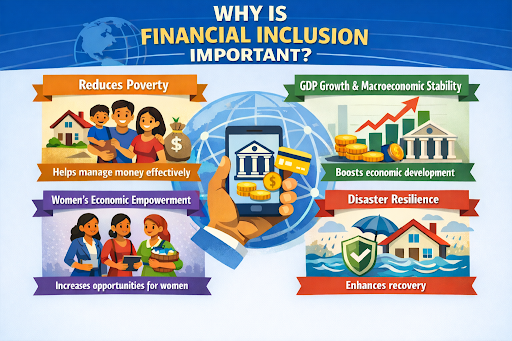
Financial inclusion helps in economic and social development.
Here’s why it is important:
Reduces Poverty
With easy access to financial services, financial inclusion helps individuals manage and grow their wealth. This helps break the debt trap by moneylenders.
GDP Growth and Macroeconomic Stability
Investments, savings, and entrepreneurship are all enhanced by financial inclusion. Economic growth is aided when people are financially literate.
Women’s Economic Empowerment
With financial services, women get control over their finances. This helps improve educational and health outcomes.
Disaster Resilience
With digital platforms, you can offer emergency relief funds during disasters. This helps reduce delays and improve support.
Read More: What Is Online Banking? Definition and How It Works
Principal Goals of Financial Inclusion Programs
Affordable financial services and financial literacy are provided by financial inclusion. The following are the main goals of the financial inclusion programmes:
All-Access
The goal of financial inclusion is to provide every household with easily accessible financial services. This covers low-income populations, small enterprises, rural regions, and unorganised labourers.
Affordable Services
With no-frills savings and low-cost transaction accounts, financial inclusion helps offer easy and affordable banking services at the grassroots level.
Consumer Protection
With regulations, financial inclusion helps protect the interests of the financially vulnerable section. It ensures transparent pricing and ethical conduct, so uneducated or uninformed individuals gain trust.
Knowledge of finance
Through a variety of initiatives, financial inclusion seeks to advance critical knowledge and abilities. This enables you to successfully manage your budget and make well-informed decisions.
Success Stories: Examples of Financial Inclusion
The government has created multiple schemes to ensure financial inclusion in India. Here’s a quick overview:
| Scheme | Initiative | Impact |
| Pradhan Mantri Jan Dhan Yojana (PMJDY) |
|
|
| Pradhan Mantri Suraksha Bima Yojana (PMSBY) | Coverage of death/disability due to accident for people with a bank account | 50.15 crore Cumulative enrolments |
| Pradhan Mantri MUDRA Yojana (PMMY) | Offers collateral-free credit to micro enterprises |
|
| Stand Up India Scheme (SUPI) |
|
|
| Pradhan Mantri Jeevan Jyoti Bima Yojana (PMJJBY) | Life insurance for people in the age group of 18 to 50 years | 23.12 crore Cumulative enrolments |
| Atal Pension Yojana (APY) | Offers a defined pension as per the contributions | 7.47 crore Total Subscribers |
Major Challenges to Overcome
There are many challenges that affect the progress of financial inclusion initiatives. Here are the major challenges to overcome:
- Lack of infrastructure in remote locations
- Lack of financial literacy among the underserved populations
- Digital divide for individuals who do not have access to smartphones
- Uneducated users may fall prey to financial fraud and cybersecurity risks
Read More: Overdraft Facility Meaning, Features, and How it Works
Building An Inclusive Financial Future
The goal of financial inclusion is to give everyone access to financial services so they can make wise financial decisions. Financial inclusion may boost economic growth and lessen poverty with the correct technology, education, and policy.
Hero Fincorp helps ensure financial inclusion by offering personal loans with a paperless process and quick approvals. This offers financial support, helping you manage emergencies.
So why wait? Take the next step toward a more secure financial future by choosing solutions that make access to credit simple, fast, and inclusive—download our app now!
Frequently Asked Questions
What is the difference between financial inclusion and digital inclusion?
Access to financial services is made possible by financial inclusion. Access to digital tools, skills, and the internet is provided by digital inclusion.
How can financial inclusion be quantified?
A number of metrics, including credit availability, the proportion of individuals with bank accounts, the use of digital financial services, and the presence of financial infrastructure in underserved areas, can be used to gauge financial inclusion.
The "underbanked" are who?
"Underbanked" describes those who have bank accounts but depend on other financial services like payday loans, money orders and cheque cashing services.
What are the five As in financial inclusion?
The five As include Availability, Awareness, Access, Affordability, and Appropriateness.
Disclaimer: The information provided in this blog post is intended for informational purposes only. The content is based on research and opinions available at the time of writing. While we strive to ensure accuracy, we do not claim to be exhaustive or definitive. Readers are advised to independently verify any details mentioned here, such as specifications, features, and availability, before making any decisions. Hero FinCorp does not take responsibility for any discrepancies, inaccuracies, or changes that may occur after the publication of this blog. The choice to rely on the information presented herein is at the reader's discretion, and we recommend consulting official sources and experts for the most up-to-date and accurate information about the featured products.
