What Is Marginal Standing Facility (MSF)?
Banks deal with liquidity pressures more often than we realise. A sudden surge in withdrawals.
An unexpected settlement obligation. A temporary freeze in interbank lending. When such situations arise, banks need immediate access to funds to keep operations running smoothly. This is where the Marginal Standing Facility becomes critical.
Often mentioned alongside repo rates and policy decisions, MSF plays a quiet but powerful role in India’s monetary framework. In this blog, we explain the role of the Marginal Standing Facility in India’s broader financial system.
Marginal Standing Facility (MSF): A Brief
For banks experiencing an unexpected cash constraint, the Marginal Standing Facility serves as a safety net. It intervenes to stop overnight borrowing from drying up or interbank markets from tightening.
Introduced by the Reserve Bank of India in 2011–12, the Marginal Standing Facility (MSF) allows scheduled commercial banks to borrow short-term funds from the RBI during emergencies. These loans are granted overnight against approved government securities, even if they dip into mandatory reserves.
In short, when traditional lending sources don't work, the Marginal Standing Facility gives banks last-resort liquidity. It increases confidence in the banking system and helps avoid sudden disruptions to the financial markets.
Key Terms Related to Marginal Standing Facility
Before getting into how the Marginal Standing Facility operates, let’s understand a few terminologies. Sharing some common MSF-related terms:
- SLR (Statutory Liquidity Ratio): The portion of deposits banks must hold in liquid assets. MSF allows limited borrowing by dipping into excess SLR securities.
- NDTL (Net Demand and Time Liabilities): The basis on which reserve requirements are calculated. MSF borrowing limits are linked to a percentage of NDTL.
- Repo Rate: The standard interest rate at which banks receive loans from the RBI. The repo rate is typically less than the MSF rate.
- Reverse Repo Rate: It refers to the rate at which banks park excess funds with the RBI. It forms the lower bound of the policy corridor.
- Bank Rate: The long-term lending rate of the RBI, often closely aligning with the MSF rate.
How Does the Marginal Standing Facility Work?
Instead of serving as a regular finance source, the Marginal Standing Facility functions as an emergency borrowing window. MSF is activated when banks face sudden, end-of-day liquidity shortages and other avenues are unavailable.
Here’s how it plays out:
- A scheduled commercial bank experiences an unexpected shortfall in funds.
- The bank approaches the Reserve Bank of India for overnight borrowing under MSF.
- It pledges eligible government securities as collateral, even if this means dipping into excess SLR holdings.
- The RBI lends funds at the MSF rate, which is higher than the repo rate to discourage regular use.
- The borrowing is strictly overnight.
- The bank repays the amount on the next working day along with applicable interest.
This Marginal Standing Facility process ensures liquidity support without disrupting financial stability.
Impact of Marginal Standing Facility Rate on Banks and Borrowers
The effect of the MSF rate is felt across the financial ecosystem.
For banks, a higher MSF rate raises the cost of emergency borrowing. This promotes careful handling of liquidity. When the RBI raises rates, it also denotes tighter monetary conditions.
Changes in the Marginal Standing Facility may indirectly affect lending rates for borrowers. Interest rates on consumer and business loans increase due to rising bank funding costs.
During periods of stress, MSF helps banks continue lending rather than freezing credit.
Also Read: Top Factors that Impact Personal Loan Interest Rate
Benefits and Limitations of the Marginal Standing Facility
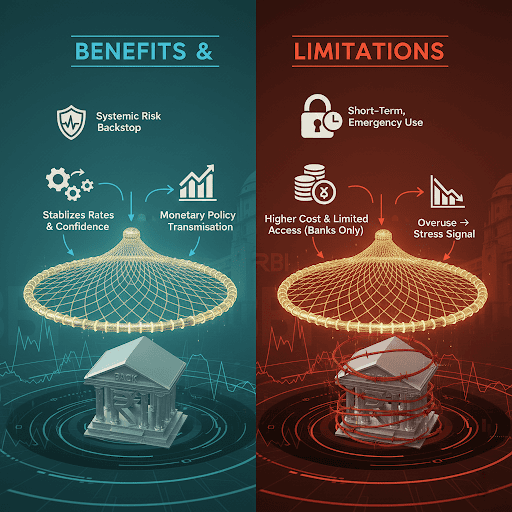
The Marginal Standing Facility plays a stabilising role, but it is not without constraints. Understanding the Marginal Standing Facility benefits and limitations helps interpret RBI policy signals.
Benefits
- Emergency liquidity support during market stress
- Acts as a backstop to prevent systemic risk
- Strengthens monetary policy transmission
- Stabilises overnight interest rates
- Enhances confidence in the banking system
Limitations
- Higher borrowing cost compared to repo operations
- Intended only for short-term and emergency use
- Accessible only to scheduled commercial banks
- Overuse may signal financial stress
Why MSF Matters in India’s Financial System
One trustworthy safety measure is the Marginal Standing Facility. MSF safeguards financial stability and avoids interruptions caused by panic by guaranteeing banks always have access to last-resort funding.
At Hero FinCorp, we closely track policy instruments like MSF because they influence funding costs, interest rates, and overall credit availability. Staying informed about such mechanisms helps borrowers and businesses make smarter financial decisions.
Explore our blogs and financial guides at Hero FinCorp to stay updated on key RBI policies, interest rate movements, and practical insights that help you plan loans, manage costs, and make confident financial choices!
Frequently Asked Questions
What’s the difference between the Marginal Standing Facility and the Liquidity Adjustment Facility (LAF)?
LAF is used for routine liquidity management, while MSF is meant for emergency borrowing at a higher rate.
How much can banks borrow under the MSF?
Banks can borrow up to a fixed percentage of their NDTL, as specified by the RBI from time to time.
Can NBFCs avail loans under MSF?
No. MSF is available only to scheduled commercial banks.
How often does RBI revise the MSF rate?
The MSF rate usually moves in line with changes in the policy repo rate.
Why is MSF considered a penal rate?
Because it is higher than the repo rate, it discourages regular use and limits it to emergencies.
Disclaimer: The information provided in this blog post is intended for informational purposes only. The content is based on research and opinions available at the time of writing. While we strive to ensure accuracy, we do not claim to be exhaustive or definitive. Readers are advised to independently verify any details mentioned here, such as specifications, features, and availability, before making any decisions. Hero FinCorp does not take responsibility for any discrepancies, inaccuracies, or changes that may occur after the publication of this blog. The choice to rely on the information presented herein is at the reader's discretion, and we recommend consulting official sources and experts for the most up-to-date and accurate information about the featured products.
