What is Repo Rate? Meaning, Current Repo Rate, How It Works & Its Impact on Loans

- What is Repo Rate?
- How Does the Repo Rate Work?
- Current Repo Rate in India
- Why Does the RBI Change the Repo Rate?
- How Repo Rate Affects Personal Loans
- Repo Rate vs Reverse Repo Rate
- Repo Rate vs Bank Rate
- Advantages and Limitations of Repo Rate
- How Borrowers Can Manage Loans During Repo Rate Changes
- Personal Loans from Hero FinCorp
- Final Thoughts
- Frequently Asked Questions
You might have seen article headlines about the RBI "cutting" or "keeping" the repo rate, with such articles often describing loans becoming cheaper or more expensive. What does this mean in terms of your finances?
The repo rate is the interest rate at which the Reserve Bank of India (RBI) lends funds to commercial banks, and whatever happens to the repo rate will make its way into borrowing costs, loan interest rates, EMIs, savings returns, inflation level, and overall economic activity.
If you have an idea of what is repo rate is and how changes to the repo rate in India affect you, this manual explains what the repo rate means.
What is Repo Rate?
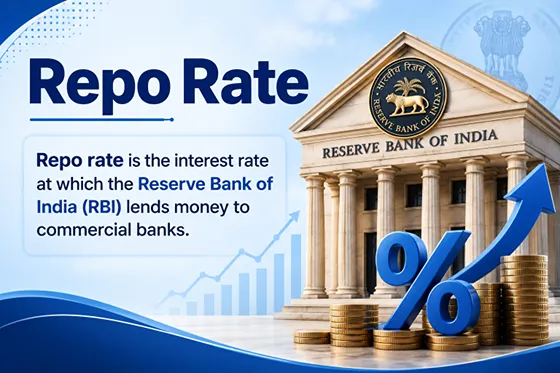
The repo rate definition refers to the interest rate at which the RBI provides short-term funds to commercial banks against government securities. In simple terms, it's the rate at which the RBI lends short-term funds to commercial banks against government securities. By raising or lowering this rate, the RBI can influence how much it costs banks to borrow, which in turn affects how much they charge their own customers.
How Does the Repo Rate Work?
The repo rate works through a structured borrowing process between commercial banks and the RBI. Here's how the process typically plays out:
- Banks need short-term funds to manage day-to-day liquidity requirements
- They pledge government securities to the RBI as collateral
- The RBI lends money to the bank at the prevailing repo rate
- Banks repurchase the securities once they repay the borrowed amount, along with interest
- Changes in the repo rate ripple outward, affecting how much banks charge on loans to businesses and individuals
For example, Aabha plans to apply for a personal loan to renovate her home. If the RBI reduces the repo rate and her lender passes on the benefit, she may receive a loan at a lower interest rate. However, the actual impact depends on the lender's policy and the type of loan.
Current Repo Rate in India
The RBI reviews the repo rate India periodically through its Monetary Policy Committee (MPC). As of the latest available RBI policy update, the policy repo rate is 5.25%. Borrowers and investors should regularly check RBI announcements because the rate may change during future MPC meetings.
Why Does the RBI Change the Repo Rate?
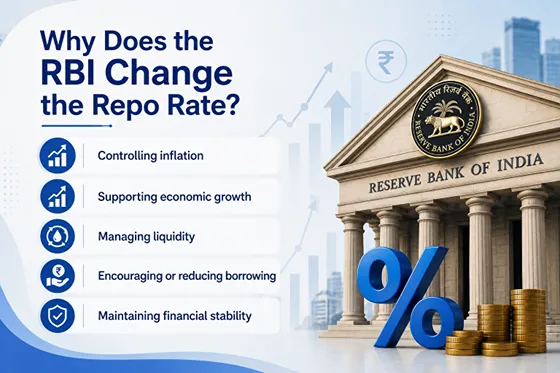
The RBI revises the repo rate to support its monetary policy objectives and maintain economic stability. Key reasons include:
- Controlling inflation - raising rates typically cools down excess spending and price pressure
- Supporting economic growth - lowering rates can encourage borrowing and investment
- Managing liquidity - adjusting the flow of money circulating in the economy
- Encouraging or reducing borrowing - influencing how attractive loans are for businesses and individuals
- Maintaining financial stability – balancing growth and inflation objectives over time
How Repo Rate Affects Personal Loans
Repo rate movements can influence your personal loan in a few ways:
- Interest rates on new loans may move up or down depending on the lender's response to RBI policy changes
- Loan affordability can shift, since even small rate changes affect the total interest you pay over the loan tenure
- EMI amounts may be impacted, particularly for loans linked to floating interest rates
- Floating vs fixed rates respond differently; floating rates adjust with policy changes, while fixed rates stay constant through the tenure
- Borrowing decisions are often timed around expected rate movements, though this depends on individual financial planning
Keep in mind that the actual impact on your loan depends entirely on your lender's policies and the specific loan type you hold.
Repo Rate vs Reverse Repo Rate
These two terms are often confused, so here's a quick comparison:
| Basis | Repo Rate | Reverse Repo Rate |
|---|---|---|
| Meaning | RBI lends money to banks | Banks deposit money with the RBI |
| Purpose | Increase liquidity | Reduce liquidity |
| Borrower | Commercial banks | RBI |
| Impact | Encourages lending | Encourages deposits |
| Economic Objective | Stimulate borrowing | Control excess liquidity |
Repo Rate vs Bank Rate
The repo rate applies when the RBI lends short-term funds to commercial banks against government securities as collateral. In contrast, the bank rate is the rate at which the RBI lends money to banks without a repurchase agreement and is generally associated with longer-term borrowing.
Other key differences include:
- Collateral: Repo rate requires government securities as collateral, whereas the bank rate does not involve a repurchase agreement.
- Tenure: Repo transactions are generally short-term, while the bank rate is associated with longer-term lending.
- Purpose: The repo rate is primarily used to manage liquidity in the banking system, whereas the bank rate serves as a broader monetary policy tool.
- Policy usage: Changes in the repo rate are used more frequently by the RBI to influence liquidity and market interest rates.
Advantages and Limitations of Repo Rate
The repo rate plays an important role in maintaining economic stability, but like any monetary policy tool, it has both advantages and limitations.
Advantages:
- Helps control inflation by influencing borrowing costs
- Supports economic growth when lowered strategically
- Regulates liquidity across the banking system
- Influences market interest rates on loans and deposits
Limitations:
- The impact on borrowers may not be immediate
- Banks may not always fully pass on rate changes to customers
- External economic conditions, like global markets, can affect how effective a rate change actually is
How Borrowers Can Manage Loans During Repo Rate Changes
Changes in the repo rate can influence borrowing costs over time. Borrowers can take a few practical steps to manage their loans effectively during periods of changing interest rates. If you're managing an existing loan or planning a new one, a few practical habits can help:
- Compare loan offers across lenders rather than settling for the first one
- Understand fixed vs floating rates before choosing your loan structure
- Review EMI affordability regularly, especially if you're on a floating rate
- Maintain a healthy credit score to access better interest rates
- Consider refinancing if a significantly better rate becomes available and it makes financial sense
- Avoid over-borrowing, regardless of how favourable current rates may seem
Also Read: What is Reverse Repo Rate?
Personal Loans from Hero FinCorp
If you're planning for a major expense or need funds during an emergency, eligible borrowers can explore a personal loan from Hero FinCorp. Hero FinCorp's personal loan offering includes:
- Competitive interest rates based on your profile
- A fully digital application process
- Minimal documentation requirements
- Flexible repayment tenure
- Transparent charges throughout
- Quick processing, subject to eligibility
Do keep in mind that your actual loan pricing will depend on your individual profile and the lender's policies at the time of application. You can explore your options through the instant Personal Loan App or check your eligibility online with Hero FinCorp.
Final Thoughts
The repo rate is a key tool of monetary policy used by the RBI that has, in one way or the other, an influence on everything from inflation to the loan EMIs paid each month. Thus, knowing what is repo rate and remaining updated on announcements made by the RBI can assist both individuals and companies in reducing their risks when taking financial and borrowing decisions. The current policy decisions and rates are reviewed from time to time by the RBI's Monetary Policy Committee.
Frequently Asked Questions
What is the repo rate?
The repo rate is the rate of interest at which the RBI provides short-term money to commercial banks against government securities, which is widely used to regulate liquidity and control inflation.
What is the current repo rate in India?
The current repo rate in India is said to be 5.25% as of June 2026, as decided by the Monetary Policy Committee after holding the rates unchanged.
Who decides the repo rate in India?
The Monetary Policy Committee (MPC), chaired by the RBI Governor, decides the repo rate during its bimonthly meetings, based on inflation, growth, and liquidity conditions in the economy.
Disclaimer: The information provided in this blog post is intended for informational purposes only. The content is based on research and opinions available at the time of writing. While we strive to ensure accuracy, we do not claim to be exhaustive or definitive. Readers are advised to independently verify any details mentioned here, such as specifications, features, and availability, before making any decisions. Hero FinCorp does not take responsibility for any discrepancies, inaccuracies, or changes that may occur after the publication of this blog. The choice to rely on the information presented herein is at the reader's discretion, and we recommend consulting official sources and experts for the most up-to-date and accurate information about the featured products.