What is the Liquidity Adjustment Facility (LAF)?
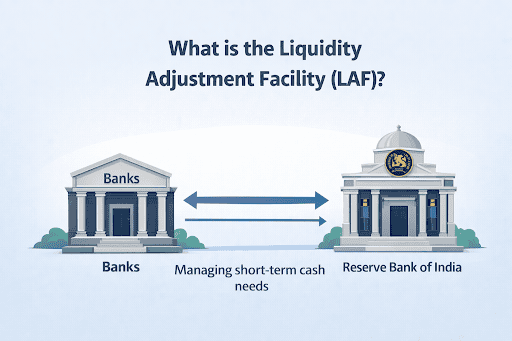
Banks handle money movement every day. Deposits come in, withdrawals go out, and loans are disbursed as planned. By the end of the day, each bank must ensure it has enough funds to settle all transactions without delay.
To manage short-term cash shortages or excess funds, the central bank provides a structured daily mechanism. This system helps banks balance liquidity in a controlled manner and keeps overnight interest rates stable across the banking system.
Liquidity Adjustment Facility Definition and Meaning
The liquidity adjustment facility is a daily arrangement between banks and the central bank to manage short-term liquidity. Banks either borrow money when funds fall short or deposit excess money when they have more than required.
Instead of allowing shortages or excess cash to disrupt the market, this system maintains balance through clearly defined operations. It helps ensure that overnight interest rates remain stable and banks continue operating smoothly.
The Reserve Bank of India uses this facility as one of its main tools to control liquidity without affecting long-term growth or customer confidence.
Components of Liquidity Adjustment Facility
The liquidity adjustment facility works through two daily operations. Each operation serves a different purpose, depending on whether banks need funds or hold surplus cash. Understanding both makes the system easier to follow.
Repo (Repurchase Agreement) Explained
Under repo operations, banks borrow money from the central bank for a very short period, usually overnight. In return, they provide approved government securities as collateral.
For example, if a bank faces a temporary shortage of ₹80 crore, it can borrow this amount by pledging securities. The bank agrees to buy them back the next day at a pre-decided price. The difference between the two prices reflects the interest the bank pays.
This method helps banks meet obligations without selling assets or interrupting customer services.
The current repo rate in India is 5.25%.
Also Read: What is Repo Rate? Meaning & How it Works
Reverse Repo Explained
Reverse repo works when banks have excess funds. Instead of leaving money idle, banks deposit surplus cash with the central bank for a short period and earn interest.
Suppose a bank has ₹120 crore that it does not need immediately. By placing it under a reverse repo, the bank earns interest for that day while helping reduce excess liquidity in the system. This prevents too much money from pushing interest rates down sharply.
The current reverse repo rate in India is 3.35%.
Liquidity Adjustment Facility Rate and Its Impact
The liquidity adjustment facility rate operates through two key rates. One applies when banks borrow funds, and the other applies when banks deposit surplus money. Together, these rates guide how short-term interest rates move in the market.
When borrowing becomes costlier, banks slow down lending. When rates ease, credit flows improve. These shifts affect inflation, consumer spending, and business activity.
Let's observe the recent changes in India’s repo rate and reverse repo rate, and their impact, updated with RBI policy decisions from 2025.
| Situation & Date | Repo Rate | Reverse Repo Rate | Market and Credit Impact |
| June 6, 2025 MPC Cut | 6.00% → 5.50% (50 bps cut) | 3.35% (unchanged) | Lower cost of borrowing supports credit flow and can reduce EMIs for borrowers |
| Dec 5, 2025 MPC Cut | 5.50% → 5.25% (25 bps cut) | 3.35% (unchanged) | Encourages lending and liquidity; neutral stance suggests stability with room for further easing |
| Current (Dec 2025) | 5.25% | 3.35% (steady) | Banks borrow more cheaply, and the reverse repo continues to absorb excess funds |
Key Takeaway - Recent RBI actions have eased the repo rate to boost credit and economic growth, while the reverse repo rate has stayed steady to manage liquidity. Lower policy rates often translate into more affordable loans and better borrowing conditions for individuals and businesses.
How Does the Liquidity Adjustment Facility Work?
The central bank follows a structured and predictable process. Banks review their cash position at the end of each working day. If funds fall short, they borrow. If excess remains, they deposit it.
The usual flow looks like this:
- Banks estimate daily cash requirements
- Banks place requests through scheduled central bank operations
- Funds move on an overnight basis
- Securities provide safety where required
- Transactions settle the next working day
The LAF plays a critical role in day-to-day liquidity management. It ensures banks remain liquid without holding excessive idle cash. At the same time, it allows the RBI to absorb or inject funds as needed, keeping inflation, credit flow, and financial stability in balance.
In effect, LAF acts as a fine-tuning mechanism, helping the RBI respond quickly to changing market conditions while supporting the smooth functioning of the money market and lending system
Role of Liquidity Adjustment Facility in the Indian Economy
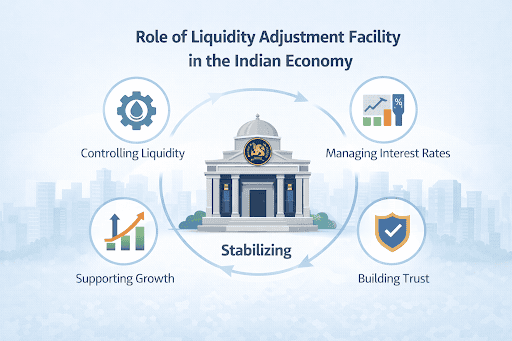
This mechanism plays a stabilising role in the financial system. It smoothens daily liquidity fluctuations and prevents sudden spikes or crashes in interest rates.
By controlling short-term money supply, the central bank ensures that lending and deposit rates reflect policy decisions quickly. Over time, the system controls inflation, supports economic growth, and builds trust in the banking system.
Differences Between Liquidity Adjustment Facility and Other RBI Tools
The central bank uses multiple tools to manage liquidity, each designed for a specific purpose. While this facility handles daily balance, others address emergency or long-term needs.
| Tool | Primary Use | Nature |
| LAF | Daily liquidity control | Overnight |
| MSF | Emergency funding | Last resort |
| SDF | Absorbing surplus | No collateral |
| OMO | Long-term adjustment | Structural |
Each tool supports stability, but their timing and objectives differ.
Benefits and Limitations of Liquidity Adjustment Facility
This system gives banks the flexibility to manage daily cash needs without stress. It helps keep interest rates stable and allows smooth transmission of monetary policy.
At the same time, overuse may reduce interbank lending activity. Sudden rate changes can also affect short-term planning. The central bank controls these risks through careful policy communication and gradual adjustments.
When banks and regulators use it responsibly, the system supports balance without distorting market behaviour.
Recent Trends and Updates on Liquidity Adjustment Facility in India
Recent policy actions show a cautious approach to liquidity management. The focus remains on inflation control while ensuring adequate credit availability.
Key observations include:
- Active absorption during surplus phases
- Narrow control of overnight rates
- Stable money market conditions
These steps help maintain order in the money market without restricting growth.
Bringing It All Together
Liquidity tools like this quietly influence interest rates and lending conditions across the banking system. Understanding how they work helps you read rate changes with more clarity and confidence.
When borrowing decisions depend on shifting financial conditions, having the right information matters. Explore Hero FinCorp’s resources to understand loan options better and take informed financial steps when the time feels right.
You can also directly apply here for a personal loan with us.
Frequently Asked Questions
What is the difference between repo and reverse repo operations?
Repo involves banks borrowing funds, while reverse repo involves banks depositing surplus funds.
How does LAF impact inflation and economic growth in India?
Controlling short-term liquidity influences borrowing costs, spending, and price stability.
Can banks use any security for repo operations under LAF?
Only RBI-approved government securities qualify for repo transactions under this facility.
How often does the RBI conduct LAF operations?
LAF operations are conducted daily to manage overnight liquidity conditions.
What happens if a bank fails to meet its obligation?
Failure triggers penalties and regulatory action, as repo agreements are binding obligations.
Is LAF only applicable to commercial banks or also to other financial institutions?
Primarily, commercial banks participate, though select financial institutions approved by the RBI may also access the facility.
Disclaimer: The information provided in this blog post is intended for informational purposes only. The content is based on research and opinions available at the time of writing. While we strive to ensure accuracy, we do not claim to be exhaustive or definitive. Readers are advised to independently verify any details mentioned here, such as specifications, features, and availability, before making any decisions. Hero FinCorp does not take responsibility for any discrepancies, inaccuracies, or changes that may occur after the publication of this blog. The choice to rely on the information presented herein is at the reader's discretion, and we recommend consulting official sources and experts for the most up-to-date and accurate information about the featured products.
