Buy Now Pay Later vs EMI: What You Need to Know
Today, the question of whether or not someone can afford something is no longer relevant. Why? Cause every checkout page gives you numerous options to split one major purchase into smaller, manageable chunks.
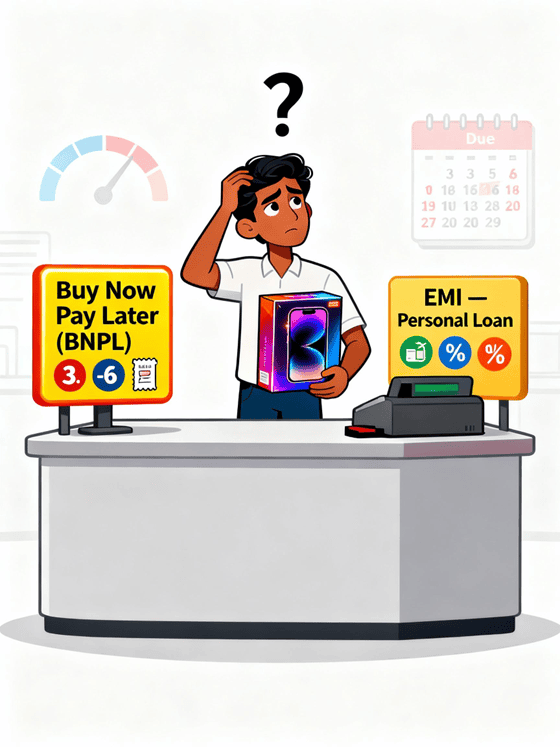
Of these two options, Buy Now Pay Later (BNPL) has become popular, as has opting for quick loans and paying them back as EMIs. The former offers you a 3 or 6-month interest-free option, and the latter offers longer tenures but with added interest.
Today, the question of whether or not someone can afford something is no longer relevant. Why? Cause every checkout page gives you numerous options to split one major purchase into smaller, manageable chunks.
Of these two options, Buy Now Pay Later (BNPL) has become popular, as has opting for quick loans and paying them back as EMIs. The former offers you a 3 or 6-month interest-free option, and the latter offers longer tenures but with added interest.
Most people choose based on gut feeling. "Zero interest sounds better, right?" But that's not always true. Sometimes EMI makes more financial sense despite interest charges. This post will tell you how to determine which one would be the best option for you, depending on the circumstances.
Buy Now Pay Later vs EMI – Head-to-Head Comparison
Before we get into when to choose between Buy Now Pay Later and EMIs, let us see how these two options stack up side-by-side.
Aspects | Buy Now Pay Later (BNPL) | Personal Loan split into EMIs |
Process involved | You choose the tenure, enter your PAN details, verify your number via AADHAAR OTP, and check out. | A formal background verification of income sources, credit score, and bank statements. |
Tenure and Interest Rates | Zero interest rates for tenures between 3 and 12 months. | An industry-wide average rate of 18% (varies from lender to lender), but tenures available up to 60 months |
Repercussion of delayed payments. | Very high interests (between 24 to 36%) and impact on credit score. | Significantly lower penalties in comparison, but here again, it impacts the credit score. |
Repayment Flexibility | None | A loan can be preclosed or restructured. |
Purchase value | Usually limited to ₹500 to ₹2,00,000 | ₹10,000 to ₹25,000 and above |
In short, BNPL offers an instant, short-term, zero-interest payment option (if paid on time) while EMIs offer longer tenures with structured repayment for higher purchase values.
When to Choose Buy Now Pay Later?
The answer to the question "When to choose the Buy Now Pay Later option?" is simple. You choose this when you need to make a small ticket purchase, like a fancy watch or a smartphone.
The biggest advantage BNPL offers is near instant approvals once you enter the required details. Most e-commerce platforms also offer several discounts on this option.
That said, you need to be disciplined with finances if you are to pursue this option. Miss a payment, and the penalties skyrocket.
Also Read: What Is No-Cost EMI and Does It Actually Work in Your Favour?
When to Take the Personal Loan Split Into EMIs Route?
A personal loan split into EMIs works best for high-ticket purchases. Say you want a gaming laptop or a DSLR with a prime lens that retails at about ₹2,50,000. Splitting this into a 6-month EMI will work out to just over ₹40,000 per month – not a practical amount for most.
But split this into a 36-month loan at even 18% interest, and this amount falls to just over ₹9,000 per month, an amount that is much more manageable for the average salaried buyer.
Cost Factors and Hidden Charges You Should Know
Now, both options do have some hidden charges that aren't always mentioned in the headlines designed to attract you to pick them. Let's look at these for each option.
BNPL's hidden charges often look like this:
- Processing fees: Some platforms charge 2-3% upfront, negating the "zero interest" factor.
- Late payment penalties: Some platforms charge a flat fee of ₹200-₹500 daily, while others charge hefty interest penalties.
- Convenience fees: 1-2% of the transaction charges are buried somewhere in the checkout breakdown.
- Auto-debit failures: If an auto-debit fails, some banks charge an additional ₹300-500 over the late fee.
The EMI's route often harbours the following hidden charges:
- Processing fees: 2-3% on the loan amount sanctioned. Some lenders like Hero Fincorp tell you these charges upfront.
- Prepayment penalties: You need to pay an additional 2-5% of the outstanding principal if you wish to preclose your loan.
- GST on interest: There is always an additional 18% GST added to your EMI amount.
How Hero FinCorp Supports Your BNPL and EMI Needs
There is no one-size-fits-all decision when it comes to picking between BNPL and EMIs. BNPL works best for smaller purchases, as you only have a limited tenure to choose from, and EMIs for the larger ones.
However, you need to be on top of your payments to truly take advantage of BNPL. That said, one thing is common between the two: if you miss a payment, it affects your credit score. So, buy using these options only if you can afford to do so.
Now, if you need a loan for a large purchase or an emergency, look to HeroFincorp You apply via a fully digital process, all the charges are listed upfront, and approvals happen in a matter of minutes. Apply today.
Frequently Asked Questions
What is the maximum purchase value eligible for BNPL in India?
At the moment, the largest purchase you can make via BNPL in India is between ₹1,00,000 and ₹2,00,000. This varies based on the platform, but do not, but you don't get access to such high options if you are using this option for the first time.
Does missing a BNPL payment impact my credit score?
Yes, it does, as it is essentially an interest-free loan given to you on the premise that you will repay it as per the agreement.
Can I convert a BNPL purchase into an EMI later?
Retail platforms in India generally do not offer the ability to convert a purchase made using the BNPL option into EMIs.
Are there processing fees associated with EMI loans?
Yes, all lenders charge you a processing fee any time you take up an EMI loan. Usually, this fee is in the 2-5% range of the principal amount.
What happens if I miss a BNPL payment due date?
When you miss a BNPL payment, depending on the terms of the contract, you are either charged a flat fee for every day over the due date or slapped with high-interest penalties. In addition to this, the missed payment is also reported to the credit bureaus.
Is EMI better for financing home appliances or vehicles?
For vehicles, the answer is a definite yes. This also applies if the appliance in question is an expensive one, like a top-of-the-line fridge or built-in microwave and oven.
