What is Discounted Cash Flow (DCF)?

If you follow the news, you will come across similar headlines quite often: Company A (a small and upcoming business) has been acquired for a huge sum of money, or Person X has invested a huge sum into it.
Have you ever wondered how large organisations or investors commit millions to buying such companies without knowing whether they will succeed? Gut instinct? Fortunately, no.
These organisations rely on several tried and trusted valuation methods, like Comparable Company Analysis, Precedent Transactions, and Discounted Cash Flow (DCF), to name a few. This post will focus on the latter and will tell you what it is, how it's calculated, and the pros and cons of this valuation method.
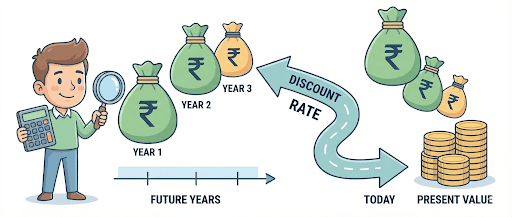
What Is DCF, And What Does It Mean?
Discounted Cash Flow (DCF) is a valuation method that calculates what a business is worth today based on the cash it is expected to generate tomorrow. Unlike the other valuation methods, it relies solely on internal cash flow projections rather than external factors like competition or the company's assets.
In short, it helps investors answer a simple question - “If this business earns ₹X in the future, how much is that income worth today?”
Why Is The DCF Model Crucial For Business Valuation?
The DCF model is widely used because it focuses on the core strength of any business, i.e., its ability to generate cash. The importance of this valuation method lies in its unique ability to:
- Estimate a business's intrinsic value regardless of stock market swings.
- Determine if the investment is worth the return.
- Compare businesses side by side
- Help lenders decide if the company will have the ability to repay a business loan.
- Help the entrepreneur understand their own repayment capacity.
Also Read: Understanding Loan Repayment in Herofincorp
The Discounted Cash Flow (DCF) Formula: Simplified
The DCF of any organisation can be calculated using this formula:
DCF = FCF1 / (1+R)¹ + FCF1 / (1+R)² + FCF1 / (1+R)³
or for short
DCF = Σ FCF / (1+R)t
Where:
- FCF = Free cash flow
- R = Discount rate
- t = Time period
- Σ = Sum of all the projected periods
How To Calculate DCF?
Calculating DCF is much simpler than the formula suggests when you break it down into simple steps.
Step 1: Calculate the Projected Free Cash Flow (FCF)
First, estimate how much Free Cash Flow your business will generate in the next 3–5 years. It's calculated using the formula:
Free Cash Flow = Operating Cash Flow - Capital Expenditures
Note: Free Cash flow projections should also be realistic. Overestimating it can distort the business's valuation significantly.
Step 2: Determine the Discount Rate
The discount rate, R, in the DCF formula represents the risk factor. The higher the potential risk, the higher the discount rate. It's often based on the Weighted Average Cost of Capital (WACC), which is calculated using the formula:
WACC = (Cost of Equity × Weight) + (Cost of Debt × Weight)
Step 3: Calculate The Terminal Value And Its Present Value
Businesses don't just function till the the estimated forecast period. Neither can you assume that it will continue to run forever. This is why you have to set a terminal value and calculate the DCF based on it.
Step 3: Calculate the Terminal Value and Its Present Value
Businesses usually continue beyond the projection period. So, you estimate a Terminal Value.
Terminal Value (TV): FCFn × (1+g)/r-g
Where:
- g = growth rate
- r = discount rate
Then, discount this terminal value back to present value.
Step 4: Arrive at DCF Valuation
Finally, add the present value of projected cash flows and the terminal value, and you get the DCF valuation or enterprise value of the business.
Discounted Cash Flow Example
Let's assume the following projection figures for a small tea stall operating in India with a discount rate of 10%.
| Year | Free Cash Flow (₹) | Discount Factor | Present Value (₹) |
| 1 | 1,00,000 | ÷ 1.10 | 90,909 |
| 2 | 1,20,000 | ÷ 1.21 | 99,174 |
| 3 | 1,50,000 | ÷ 1.33 | 1,12,781 |
Assume the Terminal Value of the business i.e year 3, as ₹20,00,000. When discounted back to today's value, the TV becomes:
₹20,00,000 ÷ 1.33 - ₹15,02,629.
Now that we have our Present value and Terminal Value, the DCF of this tea stall is:
₹90,909 + ₹99,174 + ₹1,12,781 + ₹15,02,629 = ₹18,05,493.
This amount represents the estimated present value of the business.
The Pros and Cons Of Using DCF As An Evaluation Method
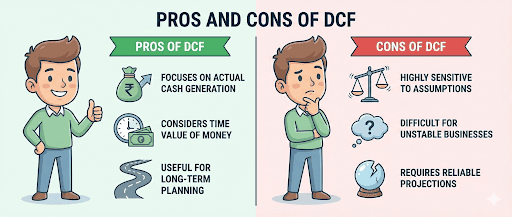
Valuing a company using the DCF model has its pros and cons.
Its advantages are as follows:
- It focuses on actual cash generation.
- It considers the time value of money.
- It's useful for long-term planning.
- It encourages realistic financial forecasting.
- It's widely accepted by investors.
However, it also has its fair share of downsides, such as:
- It's highly sensitive to assumptions.
- Small changes in the discount rate can alter a valuation considerably.
- It's difficult to use for unstable businesses.
- It requires reliable financial projections.
Summing It Up
DCF is one among several models available to determine the value of a business. Its core ideal is simple: determine what a company's future value is in today's money. It's a figure that proves useful to investors and business owners alike, and more importantly it's a core figure lenders look at when you approach them for loans.
If you have calculated your DCF and require funds for your business, turn to HeroFincorp. You can have the funds disbursed in 48 hours, and the entire application process is digital and transparent. Apply using the business loan web app now.
Disclaimer: The information provided in this blog post is intended for informational purposes only. The content is based on research and opinions available at the time of writing. While we strive to ensure accuracy, we do not claim to be exhaustive or definitive. Readers are advised to independently verify any details mentioned here, such as specifications, features, and availability, before making any decisions. Hero FinCorp does not take responsibility for any discrepancies, inaccuracies, or changes that may occur after the publication of this blog. The choice to rely on the information presented herein is at the reader's discretion, and we recommend consulting official sources and experts for the most up-to-date and accurate information about the featured products.
