What Is UPI Intent Flow? Significance & Benefits in Digital Payments
- The Evolution of UPI and Its Impact on Indian Financial Transactions
- Deconstructing the UPI Intent Flow: A Step-by-Step Guide
- Key Features and Benefits of UPI Intent Flow
- Seamless User Experience and Instant Transfers
- Enhanced Security and Fraud Prevention
- Improved Efficiency and Customer Satisfaction
- Technical Aspects: UPI Intent URI and Deep Linking
- Embracing Digital for Seamless Financial Transactions
- Frequently Asked Questions
In December 2025, India saw the volume of UPI transactions exceeding 21.6 billion, a clear indication of the increasing dependence on digital payments. The digital payment market in India witnessed a very rapid growth, and UPI turned out to be the most convenient and fastest mode of money transfer.
One feature that makes payments smoother is the UPI intent flow. If you’ve ever tapped “Pay via UPI” in an app and were automatically redirected to your UPI app to finish the payment, that’s the UPI transaction flow in action.
So, what is UPI intent flow? Simply put, it’s a process where the merchant app communicates directly with your UPI app. No need to type UPI IDs or bank details. It’s faster and reduces errors.
The Evolution of UPI and Its Impact on Indian Financial Transactions
UPI started as a simple peer-to-peer system. Now it manages all kinds of things like subscriptions, bill payments, merchant transactions, and loan repayments. More than 70% of Indian merchants prefer UPI-based payments, as they consider it fast, reliable, and easy to use.
The UPI intent flow makes this even simpler, removing extra steps and cutting down errors. This improves the UPI transaction flow for millions of users every day.
Also Read: Advantages of Using UPI for Everyday Transactions
Deconstructing the UPI Intent Flow: A Step-by-Step Guide
The UPI intent flow is designed to make payments fast and simple. Basically, the merchant app sends a payment request that opens directly in your UPI app. This leads to a seamless UPI payment process with hardly any effort required, but transactions remain secure. Understanding the UPI intent mechanism is beneficial for individuals as well as businesses in managing their payments effectively.
Initiating the Payment: From Merchant App to UPI App
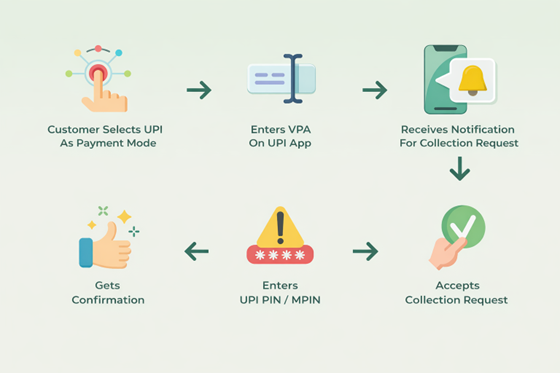
- Select UPI as your payment method on the merchant app.
- The merchant app sets up a UPI payment through an intent URI.
- On your device, you can see the list of UPI apps that are installed, such as Google Pay, PhonePe, or Paytm.
- Once redirected to your UPI app, you can then carry out the transaction.
User Authentication and Transaction Confirmation
The UPI app shows the amount and merchant details.
You verify everything is correct and enter your MPIN to approve the payment.
The payment completes instantly, and confirmation appears.
The Role of NPCI and Banks in UPI Transaction Flow
NPCI acts as the central hub linking your bank with the merchant’s bank. In the whole UPI transaction flow, NPCI plays the role of request validator, mediator between banks, and keeper of safe settlement. Banks debit and credit accounts in real time, keeping everything fast and reliable.
Also Read: What is a UPI Merchant? Understanding UPI Merchant Accounts
Key Features and Benefits of UPI Intent Flow
UPI intent flow is popular because it’s simple, fast, and secure. It reduces errors and ensures higher success rates.
Key benefits of UPI intent include:
- Manual entry of UPI IDs
- Faster checkout
- Fewer failed payments
- Secure MPIN authentication
- Wide acceptance across the country
This method also creates a seamless UPI experience, reducing extra steps and waiting time. Transactions complete in seconds, making instant money transfer perfect for bills, purchases, and EMIs.
Seamless User Experience and Instant Transfers
The flow ensures speed and convenience. Payments are completed in seconds and create a smooth, consistent user experience across apps.
Enhanced Security and Fraud Prevention
Data encryption and MPIN authentication protect each transaction. Users approve payments themselves through their own UPI apps, which minimises the chance of mistakes or fraud. UPI security features guarantee safe transfers, and fraud prevention measures protect your account.
Also Read: Common UPI Frauds and How to Avoid Them
Improved Efficiency and Customer Satisfaction
Merchant apps generate UPI intent URLs that redirect users to UPI apps. The result? Lesser abandoned carts, faster checkouts, and seamless cash flow.
Technical Aspects: UPI Intent URI and Deep Linking
UPI intent flow relies on the UPI intent URI and deep linking. The URI carries transaction details like payee VPA, amount, and reference ID. When you click on the link, you will be redirected to your UPI app directly, making the handoff seamless.
Deep linking enables merchant apps to communicate securely without disclosing sensitive data. The result? Faster, more reliable transactions and compatibility across devices.
Components of a UPI Intent URL
- Payee Virtual Payment Address (VPA)
- Payee name
- Transaction amount
- Transaction reference ID
- Currency code
- Optional notes
Also Read: Payee Meaning in Banking and Finance Explained
Embracing Digital for Seamless Financial Transactions
India’s digital payments ecosystem is growing fast, and Hero FinCorp digital payments are leading the way. Using UPI intent flow ensures speed, reliability, and security.
Just like UPI intent flow removes friction from payments, Hero FinCorp focuses on removing friction from borrowing. From quick approvals to easy digital repayment, the process is built around convenience.
Explore personal loan options and apply for one when the time feels right!
Frequently Asked Questions
What is the difference between UPI Intent Flow and Collect Flow?
UPI intent flow is initiated by the payer via a merchant app, while collect flow sends a request for payer approval.
Is the UPI Intent Flow secure for all types of transactions?
Yes, it uses encryption, MPIN authentication, and bank-level security.
What is the maximum transaction limit for a UPI Intent Flow payment?
The standard limit is ₹1 lakh, depending on your bank.
How do I troubleshoot if a UPI Intent Flow payment fails?
Check your internet connection, update your app, and verify bank status before retrying.
Does Hero FinCorp accept loan EMI payments via UPI Intent Flow?
Yes, Hero FinCorp supports UPI payments for EMI collections.
H3: Can I use UPI Intent Flow for international transactions?
Currently, it is primarily for domestic transactions in India.