UPI Fraud: Types of Scams, Prevention Tips, & How to Report Fraudulent Transactions
- What is UPI Fraud?
- Common Types of UPI Frauds
- 1. Fake UPI ID Fraud
- 2. QR Code Scam
- 3. Payment Request Scam
- 4. Fake Customer Care Scam
- 5. Phishing SMS and Email Scams
- 6. APK and App Installation Fraud
- 7. Screen Sharing App Fraud
- 8. Remote Access Fraud
- 9. Investment Scams
- 10. Lottery and Reward Scams
- 11. Job Offer Scams
- 12. Social Media Impersonation Scams
- 13. KYC Update Scams
- 14. Refund Scams
- 15. Merchant Fraud
- How Do UPI Payment Scams Work?
- Warning Signs of a UPI Scam
- How to Protect Yourself from UPI Fraud
- 1. Never share your UPI PIN or OTP
- 2. Verify recipient details before paying
- 3. Avoid unknown QR codes
- 4. Use only official banking and UPI apps
- 5. Secure your device
- 6. Check transaction notifications
- 7. Avoid clicking suspicious links
- 8. Never install apps on someone else's instruction
- 9. Keep your UPI details tidy
- What Should You Do Immediately After a UPI Fraud?
- How to Report a Fraudulent UPI Transaction
- BHIM UPI Fraud: What You Should Know
- UPI Fraud vs UPI Transaction Failure
- Safe UPI Practices for Everyday Payments
- Conclusion
- Frequently Asked Questions
A payment request pops up while you are busy. It looks routine, so you approve it. Moments later, the money is gone, and the sender has vanished.
That is UPI fraud in a nutshell, and it is growing. Government data placed in Parliament shows UPI-related frauds worth ₹981 crore across 12.64 lakh cases in FY 2024-25, following ₹1,087 crore the year before.
Here is the reassuring part. Fraudsters are not breaking into UPI. They are persuading people to hand money over. Once you learn how the tricks work, most of them stop working on you.
This guide covers what UPI fraud is, the common types, the warning signs, how to protect yourself, and exactly how to report a fraudulent transaction.
What is UPI Fraud?
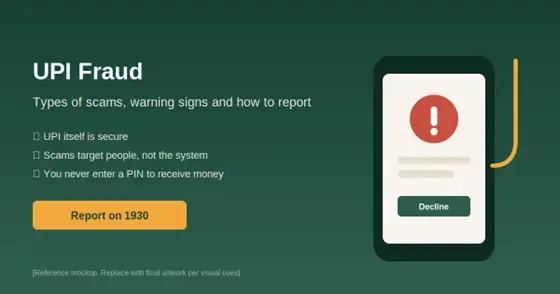
UPI fraud is any scam where a criminal uses the Unified Payments Interface to trick you into sending money or revealing your banking credentials. If you are new to the system itself, this explainer on what UPI is is a useful starting point.
The important thing to understand is that the platform is not the weak link. UPI is built by the National Payments Corporation of India and regulated by the Reserve Bank of India, with device binding, two-factor authentication and a PIN on every debit. Criminals rarely attempt to break that.
Instead, they target the person holding the phone. Almost every UPI scam is social engineering, which simply means manipulating you into acting against your own interest. The fraudster creates urgency, fear, or excitement, then guides you towards approving a payment or sharing a code.
This is why the fraud often looks like your own transaction in the bank records. You authorised it, even though you were deceived into doing so. Recognising that pattern is the single most useful defence you have, because it shifts your attention from the technology to the conversation.
Common Types of UPI Frauds
Most UPI transaction frauds fall into a handful of recognisable patterns. Knowing the types of UPI frauds in circulation makes them far easier to spot, so these are the ones reported most often.
1. Fake UPI ID Fraud
A scammer shares a UPI ID that closely resembles a genuine business or government handle, hoping you pay the wrong person. UPI ID fraud thrives on lookalike spellings, so read the verified name that appears before you confirm.
2. QR Code Scam
Someone sends a QR code and claims scanning it will credit money to you. Scanning a QR code only ever sends money. It never receives it.
3. Payment Request Scam
You get a collect request framed as a refund, a prize, or a returned payment. Approving it debits your account, because a request always pulls money from you.
4. Fake Customer Care Scam
You search online for a helpline and reach a number planted by fraudsters. They pose as support staff and walk you through steps that drain the account.
5. Phishing SMS and Email Scams
A message carries a link to a page that mimics your bank or UPI app. Anything you type there, including credentials, goes straight to the criminal.
6. APK and App Installation Fraud
You are sent an APK file over WhatsApp or SMS and told to install it for a reward or an update. The file is malware that reads your messages and OTPs.
7. Screen Sharing App Fraud
The caller asks you to install a screen sharing tool so they can help. They then watch you enter your PIN, or guide you into approving a transfer.
8. Remote Access Fraud
A variation where the app gives the fraudster control of your device rather than just a view of it, letting them operate your payment apps directly.
9. Investment Scams
Groups promising guaranteed daily returns collect UPI payments, show fake profits on a dashboard, then disappear once deposits grow large enough.
10. Lottery and Reward Scams
You have won something you never entered, and a small processing fee is due first. The fee is the scam, and no prize follows.
11. Job Offer Scams
A recruiter offers well paid work from home, then asks for a registration or training fee by UPI. Genuine employers do not charge you to be hired.
12. Social Media Impersonation Scams
A cloned profile of a friend or relative messages you about an emergency and asks for money urgently. Call the person on their usual number before sending anything.
13. KYC Update Scams
A message warns that your account will be blocked today unless KYC is updated through the attached link. Banks do not collect KYC through random links.
14. Refund Scams
A caller claims a failed order needs refunding and sends a request you must approve to receive it. Refunds arrive automatically and never need your PIN.
15. Merchant Fraud
A seller takes payment for goods that never arrive, often through a personal UPI handle on a social media shopfront rather than a verified business account.
How Do UPI Payment Scams Work?
Most UPI payment scams follow a familiar sequence, whatever story sits on top of it. UPI payment frauds vary enormously in the tale they tell, and barely at all in their structure.
It begins with contact. A call, an SMS, a WhatsApp message, a marketplace reply or a comment on social media. The fraudster has no idea who you are, and is simply working through a list.
Next comes the hook, and it is always emotional. Your account will be blocked. Your refund is waiting. You have been shortlisted. The aim is to get you reacting rather than thinking.
Then the pressure arrives. Everything must happen now, on this call, or the opportunity disappears. Urgency is deliberate, because it stops you pausing to verify anything.
Finally comes the ask, and this is the part worth memorising. The fraudster needs you to authorise the payment, because they cannot move money out of your account themselves. So they send a collect request, share a QR code, or talk you through entering your UPI PIN while insisting it is needed to receive funds.
In most cases, money leaves your account only when you approve it. That fact is your strongest protection, which is why avoiding unknown apps and remote-access tools is just as important as guarding your PIN.
Warning Signs of a UPI Scam
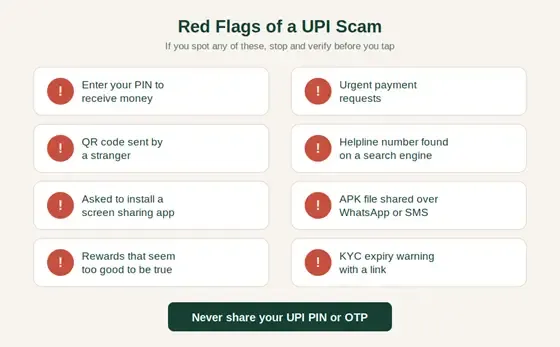
Certain signals should stop you mid-transaction. Treat any of these as a reason to pause and verify.
- You are asked to enter your PIN to receive money. This is the clearest red flag of all, because receiving never requires a PIN.
- The request is urgent. Genuine institutions give you time. Fraudsters never do.
- A stranger sends you a QR code and promises it will credit your account.
- You found the helpline number through a search engine or a social media comment rather than the official app.
- Someone asks for your OTP, UPI PIN or card details. No bank employee will ever need these.
- A link arrives by SMS or email asking you to log in, update KYC or claim a refund.
- The reward is unrealistic, whether that is a lottery you never entered or returns no regulated investment could offer.
- You are pressed to install an app from a link, an APK file, or a screen sharing tool.
How to Protect Yourself from UPI Fraud
Prevention costs nothing and takes very little effort. These habits stop the overwhelming majority of UPI-related frauds.
1. Never share your UPI PIN or OTP
Your UPI PIN authorises money leaving your account, so it belongs to you alone. No bank, no payment app, and no genuine support agent will ever ask for it, and neither will the police.
2. Verify recipient details before paying
Check the verified name that appears after you enter a UPI ID, and confirm it matches the person or business you intend to pay. For anything large, send one rupee first and confirm it arrived.
3. Avoid unknown QR codes
Scan only codes displayed at a shop counter or shared by someone you trust. Remember that scanning authorises a payment out, so nobody needs your scan to pay you.
4. Use only official banking and UPI apps
Download from the Google Play Store or Apple App Store, never from a link in a message. Choosing a trusted UPI Payment App and sticking to it makes anything unusual easier to notice.
5. Secure your device
Set a screen lock, add an app lock on payment apps, and keep your phone updated. If your handset is lost, that lock is what stands between a stranger and your accounts.
6. Check transaction notifications
Keep SMS and app alerts switched on and actually read them. Spotting a debit within minutes gives you the best possible chance of stopping further damage.
7. Avoid clicking suspicious links
Open your bank or UPI app directly instead of following a link. If a message claims something is wrong with your account, verify it inside the app.
8. Never install apps on someone else's instruction
Screen sharing and remote access tools are legitimate software used illegitimately. If a caller asks you to install one, end the call.
9. Keep your UPI details tidy
Review the accounts linked to your apps periodically, and understand how to Create UPI Number or remove one you no longer use. Fewer live handles means fewer ways to be targeted.
What Should You Do Immediately After a UPI Fraud?
If money has already left your account, speed matters more than anything else. Work through these steps in order.
- Contact your bank straight away. Use the number printed on your card or inside the official app. Ask them to block further transactions and flag the disputed debit.
- Report it inside your UPI app. Most apps have a raise dispute or report option against each transaction, which starts the payment system's own process.
- Secure the account. Change your UPI PIN and app passwords, and if you installed anything on the fraudster's instruction, uninstall it and restart the phone.
- Report to the cybercrime authorities. Call 1930 or file on the National Cyber Crime Reporting Portal. The sooner the beneficiary account is flagged, the better the chance of freezing the money before it moves on.
- Preserve the evidence. Save screenshots, transaction IDs, UTR numbers, the caller's number and every message. You will need these for the complaint.
- Watch the account for a few weeks. Check for further unauthorised debits, and tell the bank immediately if any appear.
Under the RBI framework on customer protection, reporting an unauthorised electronic transaction to your bank within three working days can limit your liability, so do not delay while you decide what happened.
How to Report a Fraudulent UPI Transaction
You have several channels, and using more than one is sensible. Here is where to report fraudulent UPI transaction cases, and what each route actually does.
1. Through your bank
Call the official helpline, then follow up in writing so there is a record. Ask for a complaint reference number and keep it safe.
2. Through the UPI app
Open the transaction in your payment app and use the dispute or report option where available. This routes the complaint through the payment system alongside your bank.
3. On the National Cyber Crime Reporting Portal
File a complaint at cybercrime.gov.in, which covers financial cyber fraud across the country and lets you track the status of your case.
4. On the cybercrime helpline 1930
This national helpline runs around the clock for financial cyber fraud. Operators record your details and push the case towards the beneficiary bank quickly, which is why calling early matters so much.
5. Escalating an unresolved complaint
If your bank has not resolved the matter within 30 days, or the response is unsatisfactory, you can escalate free of charge to the RBI Integrated Ombudsman. Prompt, documented reporting strengthens your case at every stage.
BHIM UPI Fraud: What You Should Know
BHIM is the NPCI's own UPI app, and BHIM UPI fraud follows exactly the same pattern as fraud on any other app. The platform is not being broken into. Users are being deceived.
The scams reported around BHIM mirror the wider list. Fake collect requests dressed up as refunds, phishing links that imitate the app's login page, QR codes shared with a promise of credit, and fake customer care numbers that appear high in search results.
Protection is identical too. Never approve a request from someone you cannot identify, never enter your PIN unless you are deliberately paying, and reach support only through the app itself or the official NPCI website.
If a fraudulent transaction does occur on BHIM, report it to your bank, raise it in the app, and file with 1930 or the cybercrime portal. The reporting route does not change with the app you use.
UPI Fraud vs UPI Transaction Failure
Not every payment problem is a scam, and confusing the two wastes time you may not have.
A failed or pending transaction is a technical issue. The money leaves your account but does not reach the recipient, usually because of a bank server delay or a network drop. These reverse automatically, generally within a few working days, and your bank statement will show the credit coming back.
A fraudulent transaction is different. The money reached someone, and that someone deceived you. Nothing reverses on its own, which is why reporting speed decides how much can be recovered.
The simple test is whether a person was involved. If a payment simply failed, wait for the auto reversal and raise a complaint if it does not arrive. If someone contacted you, pressured you, or received the money, treat it as fraud and report it immediately.
Safe UPI Practices for Everyday Payments
Good habits make security automatic rather than something you think about. A few worth building, whatever you are paying for.
- Shopping online: pay verified merchant accounts rather than a personal UPI handle, and be wary of sellers who insist on advance payment through social media.
- At the counter: scan the code fixed at the till, check the merchant name on screen, and confirm the amount before entering your PIN.
- Paying bills: use the biller listed inside your app rather than a link from a reminder message, since fake bill alerts are common.
- Sending money to people: confirm the verified name, and for a first transfer send a small test amount before the full sum.
- Receiving money: share your UPI ID or number and nothing else, because a genuine incoming payment needs no action from you at all.
It also helps to understand the wider landscape of digital payments, since each method carries its own risks. This guide to online payment methods is a good place to compare them.
One more habit worth keeping. Borrow only from lenders you can verify, because fake loan offers arriving by SMS are a fraud category of their own. If you need funds, check your personal loan eligibility with Hero FinCorp, an RBI-registered NBFC, or use the Hero Digital Lending App rather than any link a stranger sends you.
Conclusion
UPI fraud succeeds through persuasion, not hacking. Every scam ends with the same request, which is that you approve the payment yourself.
So slow down when a message feels urgent, verify before you tap, and keep your PIN entirely to yourself. If something does go wrong, contact your bank and call 1930 immediately, because the first hour matters more than the next week.
Frequently Asked Questions
What is UPI fraud?
UPI fraud is any scam where a criminal uses the Unified Payments Interface to trick you into transferring money or sharing banking credentials. The platform itself remains secure, so these frauds rely on deceiving the user rather than breaking the technology.
What are the most common types of UPI frauds?
The most common are fake UPI ID fraud, QR code scams, collect request scams, fake customer care numbers, phishing links, APK malware, screen sharing fraud, investment and lottery scams, job offer fraud, KYC update scams, and refund scams.
How do UPI payment scams work?
A fraudster contacts you, creates urgency with a story about a refund, prize or blocked account, then persuades you to approve a payment or share a code. The money moves only because you authorise it, which is what makes the deception effective.
What is a UPI ID fraud?
UPI ID fraud is when a scammer uses a handle that closely imitates a genuine business or official account, hoping you transfer money to them by mistake. Always check the verified name shown on screen before confirming any payment.
What is a UPI ID scam?
A UPI ID scam covers any misuse of virtual payment addresses to deceive you, including lookalike handles, IDs shared by fake customer care agents, and requests sent from unfamiliar addresses claiming to be refunds owed to you.
How can I identify a fake UPI payment request?
Look at what the request actually does. A collect request always debits your account, so any message describing it as a refund, prize or incoming payment is false. If you are not deliberately paying someone, decline it.
What should I do if I become a victim of UPI fraud?
Contact your bank immediately to block further transactions, report the transaction in your UPI app, call 1930 or file on cybercrime.gov.in, change your PIN and passwords, and save all screenshots, transaction IDs and messages as evidence.
How do I report a fraudulent UPI transaction?
Report it to your bank through the official helpline, raise a dispute inside your UPI app, and file a complaint on the National Cyber Crime Reporting Portal or by calling 1930. Using all three channels together is the safest approach.
How can I report a UPI payment scam?
Call the cybercrime helpline on 1930 or file at cybercrime.gov.in, and inform your bank in parallel. Keep the complaint reference number, and escalate to the RBI Integrated Ombudsman if the bank does not resolve matters within 30 days.
Where can I report BHIM UPI fraud?
The route is the same as any other app. Report inside BHIM, inform your bank immediately, and file with the cybercrime helpline 1930 or the national portal. Contact BHIM support only through the app or the official NPCI website.
Can I recover money lost in a UPI fraud?
Recovery is possible but never guaranteed, and it depends heavily on how quickly you report. Fast reporting lets banks attempt to freeze the beneficiary account before funds move on. Payments you were tricked into approving are assessed case by case.
What is the Cyber Crime Helpline for reporting UPI fraud?
The national cybercrime helpline number is 1930. It operates around the clock for financial cyber fraud, and the operator records your details and pushes the case towards the relevant bank so action can begin quickly.
Is it safe to scan unknown QR codes?
No. Scanning a QR code initiates a payment from your account and can never credit money to you. Anyone claiming you must scan a code to receive funds is attempting a scam, so decline and verify independently.
Can someone steal money if they know my UPI ID?
Not by itself. A UPI ID works like an address for receiving money, and no debit happens without your PIN. Sharing it is reasonably safe, though it may invite collect requests you should always decline.
Is sharing a UPI PIN ever safe?
Never, under any circumstances. Your UPI PIN authorises money leaving your account. No bank official, payment app, employer, delivery agent or police officer has any legitimate reason to ask for it at any time.
What is the difference between a UPI transaction failure and UPI fraud?
A failure is technical, where money is debited but not delivered, and it usually reverses automatically within a few working days. Fraud involves deception by another person, reverses nothing on its own, and needs reporting immediately.
How can I protect myself from UPI payment fraud?
Never share your PIN or OTP, verify recipient names before paying, avoid unknown QR codes and links, download apps only from official stores, keep a screen lock and app lock active, and read every transaction alert.
What documents or information should I keep while reporting UPI fraud?
Keep transaction IDs and UTR numbers, screenshots of the payment and any chat, the caller's phone number, bank SMS alerts, the recipient's UPI ID, and your bank complaint reference number. Detailed records speed up investigation considerably.
How long should I wait before reporting a suspicious UPI transaction?
Do not wait at all. Report the moment you notice it, because the chance of freezing funds falls sharply with time. Reporting an unauthorised transaction to your bank within three working days also helps limit your liability.
What are the safest practices for using UPI securely?
Pay verified merchants, confirm the recipient name every time, use billers listed inside your app, send a small test amount before large transfers, keep apps updated, and never install software on a caller's instruction.
Disclaimer: The information provided in this blog post is intended for informational purposes only. The content is based on research and opinions available at the time of writing. While we strive to ensure accuracy, we do not claim to be exhaustive or definitive. Readers are advised to independently verify any details mentioned here, such as specifications, features, and availability, before making any decisions. Hero FinCorp does not take responsibility for any discrepancies, inaccuracies, or changes that may occur after the publication of this blog. The choice to rely on the information presented herein is at the reader's discretion, and we recommend consulting official sources and experts for the most up-to-date and accurate information about the featured products.