Online Payment Methods: A Complete Guide for Secure Transactions
- What Are Online Payment Methods?
- Types of Payment Methods Used in India
- How Do Online Payment Methods Work?
- What Are the Benefits of Using Online Payment Methods?
- Pros and Cons of Payment Methods
- Choosing the Right Payment Method for Your Needs in India
- Make Payments with Confidence and Control
- Conclusions
- Frequently Asked Questions
For daily necessities like shopping, bill payments, subscriptions, and EMI repayments, people in India rely on a variety of payment methods. With the widespread acceptance of cards, wallets, and UPI apps, digital payments have become commonplace.
Even though making payments online seems simple, RBI-regulated mechanisms are involved in every transaction. Money travels through secure networks that are meant to keep users safe at every stage. A bank account, a reliable internet connection, and a smartphone are all you need.
This post explains how online payment methods operate, why they are important, and how to select the safest choice for your purchase.
What Are Online Payment Methods?
A payment method refers to the way money is transferred from your account to a seller or service provider.
Online payment methods use internet-based platforms to transfer funds. They include UPI apps, wallets, and card-based services. India built strong digital systems through NPCI and RBI-regulated networks.
Offline payments include cash, cheques, and swiping cards without an internet connection. They work for local stores but lack real-time transaction alerts.
Types of Payment Methods Used in India
India offers a wide range of payment options, and consumers often combine multiple methods based on convenience, habit, and trust.
Here are the major types of payment methods worth exploring today:
- Credit and Debit Cards: Cards help you shop online or pay utility bills. Tokenisation protects card details during payments.
- Net Banking: You approve payments from your bank portal. This suits high-value or business-based transfers.
- Mobile Wallets: Wallets store limited value for quick spends. They also unlock offers and cashback programmes.
- UPI-Based Payments: UPI links your bank account to apps like BHIM UPI. Each payment uses a secure UPI PIN.
- Cash on Delivery: COD suits customers who avoid sharing financial details online. It remains common in Tier 2 and Tier 3 regions.
- Buy Now Pay Later: BNPL splits purchases into smaller repayments. Track dues carefully to avoid extra fees.
- Bank Transfers: IMPS, RTGS, and NEFT support personal and business transfers. Each option has unique settlement timings.
- QR Code Payments: You scan merchant codes to pay instantly. QR adoption is strong across kirana stores and service locations.
- Cryptocurrency: Crypto payments are restricted in India and remain under evolving regulations.
Here’s a breakdown of the different payment methods commonly used across India today:
| Method | Fees | Speed | Security level | Best use case |
|---|---|---|---|---|
| UPI | Usually none | Instant | High | Everyday spending |
| Cards | Varies | Fast | High | Shopping, subscriptions |
| Net banking | Low | Fast | High | Larger transfers |
| Wallets | Low | Instant | High | Small ticket spends |
| Bank transfers | Low | Scheduled | High | Business payments |
| COD | None | At delivery | Medium | Cautious shoppers |
How Do Online Payment Methods Work?
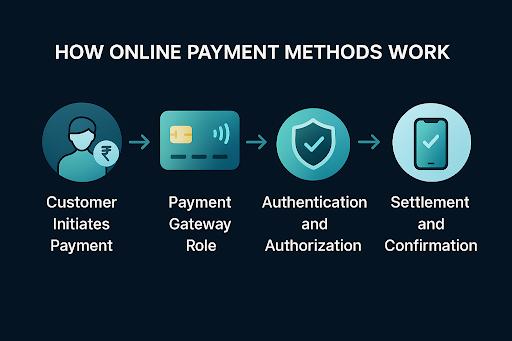
Most online payment methods follow a simple journey, although the backend is highly secure. Here is a clear, user-focused flow for this mode of payment.
Here is a clear step-by-step view:
- Step 1: Customer initiates Payment: You select the amount and choose your preferred payment option on the checkout page.
- Step 2: Payment Gateway Function: After encrypting your information, the payment gateway sends the request to your bank or UPI provider.
- Step 3: Techniques for Authorisation and Authentication: Your bank uses a secure UPI PIN, two-factor authentication, or OTP to verify your identity. This stops unauthorised payments and misuse.
- Step 4: Settlement and Confirmation: Once approved, money moves across NPCI or banking rails. You instantly see a confirmation on the app, SMS, email, or merchant screen.
You can imagine this journey as a straight line that starts at your device and ends with secure settlement in the merchant account.
What Are the Benefits of Using Online Payment Methods?
Users often ask if online payments are safe. Indian platforms follow strong protocols, including encryption, tokenisation, and bank-controlled authentication.
Key advantages of online payment methods include:
- Fast checkout and instant confirmations.
- Encrypted transfers through RBI-regulated systems.
- Digital receipts and easy transaction history.
- Better experience for merchants and customers.
- Reduced cash handling risks for everyone.
Pros and Cons of Payment Methods
Today, people use different payment methods for shopping, bill payments, subscriptions, and money transfers. Each option offers its own benefits and limitations depending on convenience, security, speed, and acceptance.
Cash
Pros: Widely accepted, simple to use, no internet required.
Cons: Risk of theft, difficult to track expenses, unsuitable for large payments.
Credit and Debit Cards
Pros: Convenient, secure, accepted online and offline, useful for rewards and cashback.
Cons: Risk of overspending, card fraud, and possible transaction charges.
UPI Payments
Pros: Instant transfers, available 24x7, easy QR-based payments, no extra charges for users.
Cons: Requires internet access and smartphone connectivity.
Net Banking
Pros: Suitable for large transactions, secure authentication, direct bank transfers.
Cons: May feel complicated for some users and depends on banking server availability.
Choosing the right payment method depends on individual needs, spending habits, and transaction requirements.
Choosing the Right Payment Method for Your Needs in India
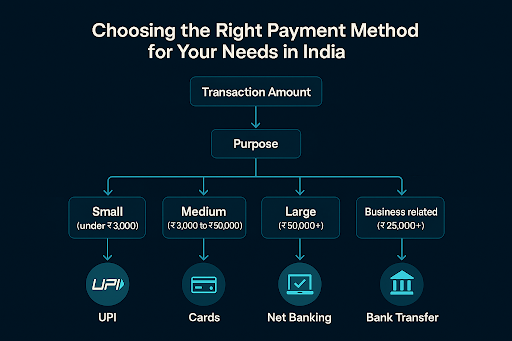
Different payment methods suit different situations based on your transaction amount, how often you pay, and where you are paying.
- For small spends under ₹300, UPI is usually the best option because it is fast and widely accepted.
- For spending between ₹10,000 and ₹15,000, cards are better since they offer secure OTP verification and clear payment tracking.
- Larger purchases like a ₹70,000 gadget are usually safer through net banking, where authentication is stronger. COD remains common in smaller towns for mid-ticket online orders.
Compare merchant acceptance, security, and any extra charges. Your location and frequency matter when choosing the right payment methods.
Need funds at short notice? Download our instant loan app and apply in minutes!
Make Payments with Confidence and Control
Digital payments work well when you choose secure channels and recognised platforms. Always prefer bank-verified apps, trusted websites, and official QR codes.
If you plan a large purchase, explore Hero FinCorp’s paperless personal loan journey on mobile. We not only offer a simple digital application process but also help you access funds quickly through a secure and transparent experience.
Download our personal loan app and explore your options now!
Conclusions
Online transactions have made everyday purchases faster, safer, and more convenient across India. From UPI and cards to wallets and net banking, major payment methods now support both personal and business needs. Understanding these common payment methods helps users choose secure options, avoid risks, and manage money more confidently every day.
Frequently Asked Questions
What is the most secure online payment method in India?
UPI, credit cards, and net banking are highly secure when you protect PINs, OTPs, and devices.
Are online payment methods safe for large transactions?
Yes, but prefer net banking or card-based channels for higher amounts.
How does the UPI payment method work?
UPI connects your bank account to a virtual ID and uses a secure UPI PIN.
What fees are charged for online payment methods?
UPI is usually free. Cards, wallets, and bank transfers may include convenience fees.
Can I use multiple payment methods in one transaction?
Some platforms support split payments. It depends on the merchant and gateway.
How to protect myself from payment fraud?
Never share OTP or PIN, and avoid unknown links. Follow the bank and NPCI safety alerts.
What is the fastest online payment method in India?
UPI and IMPS are among the fastest payment methods in India, offering near-instant money transfers throughout the day and night.
Which online payment method is safest for large transactions?
RTGS and secure net banking transactions are considered safest for large payments due to strong authentication and direct bank processing.
What is the difference between NEFT, RTGS and IMPS?
NEFT works in batches, RTGS handles high-value real-time transfers, while IMPS provides instant transfers for smaller transaction amounts.
What happens if an online payment fails?
Failed payments are usually reversed automatically within a few hours or days, depending on the payment provider and bank policies.
Can online payment methods work without the internet?
Most online payment methods require internet access, though some UPI-based offline payment options are available through mobile banking services.
Which payment method is best for businesses?
Businesses often prefer UPI, net banking and payment gateways because they support quick collections, digital records and smoother customer transactions.
Disclaimer: The information provided in this blog post is intended for informational purposes only. The content is based on research and opinions available at the time of writing. While we strive to ensure accuracy, we do not claim to be exhaustive or definitive. Readers are advised to independently verify any details mentioned here, such as specifications, features, and availability, before making any decisions. Hero FinCorp does not take responsibility for any discrepancies, inaccuracies, or changes that may occur after the publication of this blog. The choice to rely on the information presented herein is at the reader's discretion, and we recommend consulting official sources and experts for the most up-to-date and accurate information about the featured products.