What is an ATM: Full Form, Meaning, Benefit & Uses
Before UPI, it was ATMs that made banking convenient for us. No apps to open and no updates to install required. That simplicity is exactly why ATMs continue to feel familiar and reassuring for straightforward banking. They offer instant access to money, anytime, almost anywhere.
Yet, most of us are not aware of how they actually work, what makes them reliable, or how they’ve evolved over time. Let’s understand what is the full form of an ATM, its types, benefits and safety measures to take while using one.
What Is an ATM, and What Is Its Full Form?
ATM stands for Automated Teller Machine. For most of us, it’s a machine to withdraw cash quickly. It was introduced to make banking less tiring and more convenient. No waiting in long lines. No rushing to the bank before closing time.
Over the years, ATMs have evolved and are not limited to cash withdrawal. You can now wire money, deposit cash, get mini statements, or even change your PIN.
HSBC established the first ATM in India in 1987 in Mumbai. And today, it has become an integral part of our lives. And today, it has become an integral part of our lives.
How Does an ATM Work?
If you’ve used an ATM, you know it feels simple, but a lot happens in the background to make your experience seamless. Here’s how it works -
- Insert your card. The machine reads the chip or magnetic stripe.
- Enter your PIN to verify your identity.
- Choose your transaction type: withdrawal, balance inquiry, transfer, or mini-statement.
- The ATM connects to your bank’s server, confirms your request, and executes it.
- Get your money, and if you want, print a receipt.
Types of ATMs in India
We all use ATMs almost on a regular basis. But did you know that there are nine types of ATMs in India? Let's learn about them one by one -
- On-site ATMs: Located at bank branches, secure and reliable
- Off-site ATMs: Found in malls, petrol stations, and public areas for convenience
- Cash Dispenser ATMs: Designed for withdrawals only
- White Label ATMs: Operated by non-banks, offering basic services for multiple banks
- Green Label ATMs (Agricultural): Serve rural users for farming-related transactions
- Orange Label ATMs (Share Transactions): Used for stock or investment account transactions
- Pink Label ATMs (Women-focused): Placed in secure areas for women users
- Yellow Label ATMs (E-commerce): Mainly for online shopping and merchant transactions
- Brown Label ATMs (Third-party Operators): Managed privately but connected to banks for cash
Benefits of Using ATMs
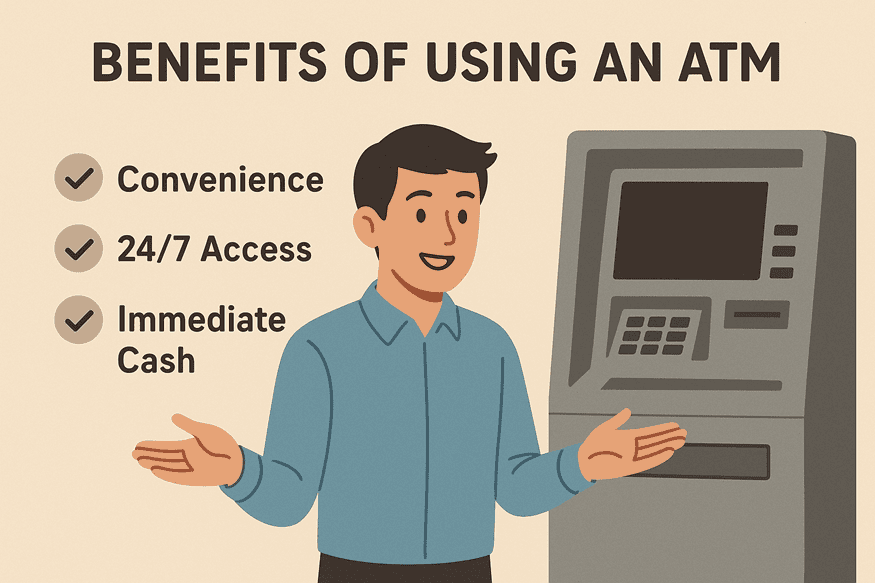
ATMs give you control over your money, save time, and reduce unnecessary trips to the bank. You can handle essential banking independently, anytime.
Key benefits
- 24/7 access to banking services
- Fast cash withdrawals without branch visits
- Easy balance checks and mini-statements
- Secure fund transfers
- Encourages financial independence and digital banking habits
How to Use an ATM: Step-by-Step Guide
Here are some tips to use an ATM and your ATM card securely -
- Put your card in the right way. Make sure the chip or stripe is facing towards the slot.
- Choose your language. Use the one that you can read and understand properly.
- Type your PIN. Always use your hand or body to hide the keypad from others.
- Choose among cash withdrawal, account balance check, fund transfer, and mini statement options, and click on it.
- Enter the amount. Most banks allow a withdrawal of ₹20,000 to ₹50,000 per transaction.
- Wait for the bank to authorise your request.
- Collect your card, cash, and receipts.
Tips for Safe Withdrawal
- Take out your card once you have completed the withdrawal and before leaving the ATM.
- Ensure that you keep cash, a card, and a receipt safely.
- Be cautious and vigilant of your environment when taking out money.
- In case it is your first time, ask for assistance from the security officer at the ATM, but never share your PIN.
- If your card gets stuck in the machine, contact the bank immediately by dialing the number present inside the premises of the ATM.
Pro Tip - Avoid using the ATM immediately after someone else has used it. Don’t accept help from strangers. Keep your bank’s helpline handy in case of any issues.
Banking Made Easy With ATMs and Hero FinCorp
ATMs make handling your money quick, easy, and stress-free. From withdrawing cash and transferring funds to paying bills, they bring everyday banking right to your fingertips, even if you’re not used to digital payments.
But when expenses grow beyond quick withdrawals, you can apply for a personal loan to meet your needs. Hero FinCorp’s personal loans offer fast approvals, simple documentation, and flexible repayment options. Apply today and move forward with confidence.
Frequently Asked Questions
Can I withdraw money without an ATM card?
Yes! A majority of banks are implementing cardless withdrawals via their mobile apps or OTPs.
What should I do if my ATM card is lost or stolen?
Immediately get in touch with your bank to inform them about it and have your card blocked (hot listed) by customer care, via the mobile app, or by going to the nearest branch.
Are ATM transactions free in India?
ATM transactions in India are not entirely free. You get a limited number of free transactions (usually 5 at your bank's ATMs and 3-5 at other banks' ATMs, varying by metro/non-metro) per month. After this, banks can charge up to ₹23/transaction + taxes for financial/non-financial services.
Can I use my ATM card internationally?
Yes, but only if your card is authorized for foreign transactions.
How safe is using an ATM card?
Using an ATM card is safe if you follow basic safety measures, such as covering your PIN when entering it and not leaving the machine until you've finished your transaction.
What is the difference between a debit card and an ATM card?
An ATM card is for cash withdrawals at ATMs only. But a debit card is multi-functional, working like an ATM card and supporting online/in-store purchases, online bill payments, and international use.
