Top 10 Manufacturing Business Ideas in India , Complete Guide

Seven and a half crore MSMEs are running in India right now.
Most of them did not start with a business plan or a consultant. Someone spotted something people around them needed, figured out how to make it, and started selling. The sector contributes 30% to India's GDP and 46% of total exports.
The manufacturing business ideas in this guide are not ranked by prestige. They are picked because people are actually making money from them at small scale, today, in Indian cities and towns you have heard of.
What Is a Manufacturing Business?
You buy something raw. You do something to it. You sell the result for more than it cost you to make.
That is genuinely the whole model. What makes manufacturing business ideas in India worth pursuing right now is not the theory.
Access to business loans, government subsidies, and digital marketplaces has made entering manufacturing more accessible than it has ever been.
A unit that would have needed a bank relationship and six months of paperwork in 2015 can get funded digitally in 2025.
Benefits of Starting a Manufacturing Business
Why manufacturing business ideas in India over trading or services? A few things that are genuinely true rather than just optimistic:
- Regular buyers and stable production create income patterns that project-based work rarely delivers
- Government tax incentives, subsidies, and loan schemes exist specifically for MSMEs, not for established industrial players who do not need the help
- Machinery and inventory sit on a balance sheet in ways that support future borrowing, which a pure service business cannot offer
- Small units that prove their model get access to government procurement channels that were previously closed to them
Also Read: What is an MSME Loan? Meaning, Types, Eligibility & How to Apply in 2026
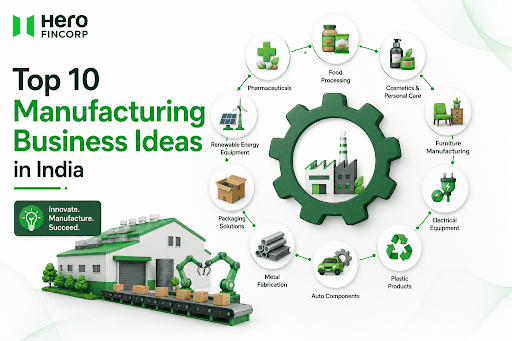
Top 10 Manufacturing Business Ideas.
1. Food Processing and Packaged Snacks
Packaged food demand does not slow down when the economy gets complicated. Schools, canteens, local retailers, and online grocery platforms all need consistent supply throughout the year.
Food products are among the most profitable small-scale manufacturing options in 2025. Setup runs between Rs. 5 lakh and Rs. 20 lakh. Margins sit between 20% and 30% for operators who control raw material sourcing well.
2. Textile and Garment Manufacturing
Most profitable textile units in Tirupur and Surat started by supplying local traders, not chasing export orders.
Textile is one of the most consistently prioritised manufacturing businesses from small to large investment scales. School uniforms, corporate workwear, and regional fashion labels are stable domestic buyers. Get production quality consistent first. Exports can follow.
3. Eco-Friendly Packaging
State plastic bans are not reversing. A paper bag manufacturing unit needs between Rs. 75,000 and Rs. 2 lakh to start and profitability grows directly because of plastic restrictions.
Hospitals, food chains, and e-commerce companies are all actively switching. The buyer is institutional and the order is recurring, which is exactly the kind of demand that keeps a small unit financially stable.
4. Herbal Soap and Personal Care
Investment for soap manufacturing runs between Rs. 30,000 and Rs. 70,000 with high demand in organic, aromatic, and festive markets. Commodity soap is a price war nobody wins at small scale.
Herbal and specialty variants are not competing on price. Several home-based units in this space have grown into national brands over five to seven years without ever starting with retail shelf space.
5. Agarbatti Manufacturing
Lakshmi Trading Services launched in 2018 with Rs. 8 lakh. By 2023 they were generating Rs. 45 lakh annually at a 28% profit margin, without leaving their region.
The global incense stick market was worth $1,234.5 million in 2024 and heads toward $1,950.59 million by 2032. Karnataka and Tamil Nadu dominate because of bamboo stick access and essential oil proximity. Location matters here more than most manufacturing business ideas.
6. Solar Energy Components
India is making strong financial commitments to solar development. Manufacturing opportunities exist for mounting structures, junction boxes, and cables, and demand grows with every new installation.
Government procurement is a stable anchor buyer alongside private installers. Budget 2025-26 explicitly prioritises clean tech manufacturing.
7. Dairy Processing
India produces more milk than any other country but processes very little into value-added products. Units making paneer, cheese, yogurt, and flavoured milk are entering a gap that urban consumers keep widening.
A unit fifty kilometres from a cooperative dairy runs completely different economics from one three hundred kilometres away. Location is not just a convenience decision here. It is a margin decision.
8. Spices Grinding and Packaging
India is the world's largest spice producer but most of it sells in raw form without branding. A grinding and packaging unit creates branded products that qualify for export and command better margins than unbranded raw spice.
Urban consumers are actively moving toward traceable, branded spices. Rural raw material sourcing is inexpensive and widely available.
9. Jute Bag Manufacturing
Starting capital runs between Rs. 75,000 and Rs. 2 lakh. No heavy machinery needed. Sometimes no machines at all. Retail chains, corporate gifting companies, and export buyers are all active. State plastic bans are structural.
10. Auto Components and Plastic Parts
India's EV revolution has opened component manufacturing opportunities for batteries, motors, and telematics backed by FAME-II government incentives. Precision parts suppliers at MSME scale regularly graduate into Tier 2 suppliers for larger OEMs over three to five years of consistent quality delivery.
Small and Medium Scale Manufacturing Ideas (MSME)
Several best manufacturing business in India options from this list need nothing more than a rented room and a small team:
- Agarbatti production from 200 to 500 square feet with three to four workers
- Jute bags stitched by hand without any machinery at entry level
- Herbal soap from basic moulds, a boiler, and sourced oils
- Spice grinding from one or two machines with locally sourced raw material
- Food processing on supply contracts with nearby schools, offices, and hospitals
Key Factors to Consider Before Starting a Manufacturing Business
Talk to real buyers before buying any machinery.
Not hypothetical buyers. Actual purchasing managers, shop owners, or institutional buyers who would pay for what you plan to make. Their answers will change your plan more than anything else on this list.
Raw material distance changes your margins more than your pricing does.
Two identical dairy units, one near a cooperative and one far from it, do not run the same business. Renting space in an industrial park rather than buying land keeps capital available for machinery that generates revenue instead of land that sits idle.
Budget for compliance before day one.
Licenses typically include Udyam registration, GST, factory license for medium units, and pollution control clearance. Food and personal care units also need FSSAI or AYUSH approval. Every one of these has a cost and a processing timeline that affects when production can actually start.
Working capital gaps kill businesses that demand would have saved.
Undersized working capital is the single most common reason new manufacturing companies fail. The lag between buying inputs and collecting payment is entirely predictable. Plan for it before the first production run.
Labour attrition is a quality problem disguised as an HR problem.
Constant retraining produces inconsistent output. Inconsistent output loses buyers. Losing buyers is very hard to recover from in the first two years.
How Hero FinCorp Supports Manufacturing Businesses
Capital pressure in a manufacturing business in India does not only appear at launch. Equipment breaks. A large buyer delays payment by sixty days. A production run needs more raw material than the account can cover mid-cycle.
Hero FinCorp has been active in business lending as an RBI-registered NBFC since 1991. For entrepreneurs pursuing manufacturing business ideas in India, it offers loan amounts built around actual cash flow, a fully digital application without branch visits, approvals that suit mid-cycle urgency, and repayment tenures that accommodate seasonal production.
Apply for a Hero FinCorp business loan here for fast disbursal into the business account. The Hero Digital Lending App is on Google Play and the App Store.
Conclusion
The best manufacturing business in India for any entrepreneur depends on available capital, location, raw material access, and what buyers nearby are already spending money on.
Manufacturing business ideas in India work when execution matches ground reality. Validate demand with real buyers, plan the working capital gap before production starts, and start smaller than feels right.
Frequently Asked Questions
Which manufacturing business is most profitable in India?
Food products, herbal items, and eco-friendly packaging are the most profitable manufacturing business ideas in 2025. Agarbatti at consistent production volume runs 25% to 28% margins.
What manufacturing business can be started with low investment?
Jute bags and herbal soap both start under Rs. 2 lakh. Candle making, spice packaging, and paper products are viable manufacturing business ideas in India for similar or lower outlay.
Can I start a manufacturing business as an MSME?
Yes. MSME registration opens government tax incentives, subsidies, and loan schemes for eligible units. Most manufacturing business ideas in this list qualify under current Udyam thresholds.
What licenses are required for manufacturing businesses?
Udyam registration, GST, factory license for medium units, pollution control clearance. Food and personal care manufacturing business ideas in India also need FSSAI or AYUSH approvals.
How much capital is needed to start a manufacturing unit?
Under Rs. 10 lakh covers most small-scale manufacturing business ideas including food processing, herbal soap, eco-packaging, and candle production. Define the product and output volume first.
Are manufacturing businesses eligible for government subsidies?
Yes. MUDRA, PMEGP, and Startup India offer loans, subsidies, and training support for manufacturing business ideas in India at MSME scale.
How can I get a loan for a manufacturing business?
Hero FinCorp provides business and personal loans for manufacturing business ideas in India through a fully digital process. Apply through the Hero Digital Lending App or the Hero FinCorp website for fast disbursal directly into the business account.
Disclaimer: The information provided in this blog post is intended for informational purposes only. The content is based on research and opinions available at the time of writing. While we strive to ensure accuracy, we do not claim to be exhaustive or definitive. Readers are advised to independently verify any details mentioned here, such as specifications, features, and availability, before making any decisions. Hero FinCorp does not take responsibility for any discrepancies, inaccuracies, or changes that may occur after the publication of this blog. The choice to rely on the information presented herein is at the reader's discretion, and we recommend consulting official sources and experts for the most up-to-date and accurate information about the featured products.
