Planning Your Dream Day: Average Wedding Cost in India
A big congratulations goes out to all the newly engaged people entering the wedding season! Amid the humorous remarks about the family and constant guest lists comes a burning question: “How much is the cost of a wedding in India?” If you’re planning the day in 2026, calculating the average cost of Indian weddings in 2026 can make the whole process easier on yourself!

What Is the Average Cost of Indian Weddings in 2026?
According to surveys on Indian weddings and market analyst data, the average cost of an Indian marriage is INR 20-40 lakh.
The average cost of an Indian wedding varies a lot from place to place. The minimum cost could be Rs 5-10 lakh for a ceremony in a small temple in a tier-3 city. In comparison, a wedding party hosted in a lavish palace in Udaipur costs more than INR 1 crore.
The Ultimate Wedding Budget Breakdown: Where Does the Money Go?
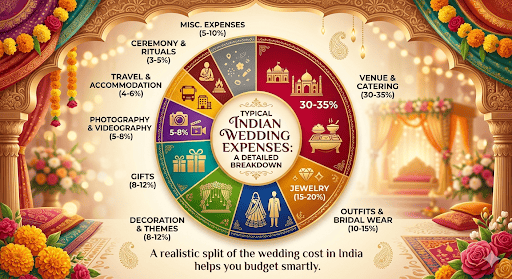
Ever wondered why the average cost of marriage in India feels like a moving target? Here’s a realistic split of a typical INR 30-lakh wedding budget. Use it as a starting point to match your own dream.
| Venue & Accommodation | INR 5–8 lakh | 20–25% |
| Catering & Food | INR 6–9 lakh | 20–25% |
| Photography & Videography | INR 2–4 lakh | 8–12% |
| Outfits & Jewellery | INR 5–8 lakh | 18–22% |
| Décor & Florals | INR 2.5–4.5 lakh | 8–12% |
| Priest & Ceremony | INR 0.5–1.5 lakh | 2–4% |
| Entertainment & DJ | INR 1–2.5 lakh | 4–8% |
| Travel & Stay | INR 1.5–3 lakh | 5–8% |
| Miscellaneous & Contingency | INR 1.5–2.5 lakh | 5–8% |
Regional & Tier‑City Variations in Indian Wedding Expenses
The location and your cultural style have an immense impact on the average cost of a wedding ceremony in India. Here is a quick look at how it varies.
Also Read: Wedding Under 5 Lakh: A Practical Planning Guide
Comparison between Metro Cities and Tier 2/3 towns
If you are getting married in one of the metro cities, including Delhi and Mumbai, you will need a venue, which may cost INR 4-7 lakh per event. In turn, your total budget could go up to INR 40-60 lakh. However, in a tier-2 town like Lucknow or Indore, an extravagant ceremony can be arranged at a much lower cost of INR 20-30 lakh. If you decide to hold your wedding ceremony in tier-3 towns, the venue will be even smaller, thereby reducing the budget to INR 10-15 lakh.
Comparison Between the Grand Ceremony in North India and the Traditional One in South India
North Indian weddings are 25-30% more expensive than those of South India because of several extra rituals, including cocktail night, mehendi party, and sangeet. South Indian weddings take place in temples and require minimal décor, resulting in less expenditure.
Comparison Between Destination Wedding Ceremony in Goa/Udaipur/Jaipur, and Wedding in Hometown
A destination wedding in royal Udaipur and beach Goa with 150 guests will cost you INR 80 lakh-INR 1.5 crore, which is twice as expensive as in your hometown. Travel costs, accommodation for the invited ones and additional vendor fees are what make destination weddings so expensive. Hometown weddings provide you with the opportunity to find familiar vendors and venues.
Middle‑Class Marriage Budget vs Luxury Weddings in India
You don't have to go broke for every celebration. If your heart is craving that aspirational experience and your wallet is pushing for middle-class pragmatism, here are a few things you can do:
- Pick three non-negotiables (e.g. venue, food and photography) and be prepared to compromise on everything else.
- Travel off-season (April-June or post Diwali lull), and you can haggle for discounts of 15-25%.
- Keep the number of functions low – an evening of sangeet and cocktails is a time- and money-saver.
- Consider a personal loan to bridge the gap without liquidating your savings. A flexible, no‑collateral loan can cover that dream lehenga or a last‑minute venue upgrade while you repay in comfortable EMIs. Use Hero FinCorp’s EMI calculator to plan your monthly outflow before you apply.
Plan the Ideal Day Without Any Stress
Although an ideal day may seem like a costly affair in India, with proper budgeting, the idea becomes quite achievable. Instead of making your wedding the most costly event, make sure it is an expression of you! While borrowing money for the extra expenses, ensure that you can afford to pay off your personal loan.
Explore Hero FinCorp’s instant personal loan and check your offer in minutes. Here’s to a wedding that’s rich in memories, not just receipts.
Also Read: How to Buy Gold on EMI for a Wedding?
Frequently Asked Questions
Can I take a personal loan for my wedding expenses?
A personal loan for a wedding is unsecured, requires minimal documentation, and disburses quickly.
Is a wedding loan tax‑deductible?
No, a personal loan taken for wedding expenses does not qualify for any tax deductions under the Income Tax Act.
How early should I apply for a wedding loan?
Start the process at least 2–3 weeks before your first major vendor payment.
Disclaimer: The information provided in this blog post is intended for informational purposes only. The content is based on research and opinions available at the time of writing. While we strive to ensure accuracy, we do not claim to be exhaustive or definitive. Readers are advised to independently verify any details mentioned here, such as specifications, features, and availability, before making any decisions. Hero FinCorp does not take responsibility for any discrepancies, inaccuracies, or changes that may occur after the publication of this blog. The choice to rely on the information presented herein is at the reader's discretion, and we recommend consulting official sources and experts for the most up-to-date and accurate information about the featured products.
