Wrong UPI Transaction Complaint Number: Report & Track Status

UPI has become India’s go-to payment method, handling over 21,634.67 million transactions each month by late 2026. This is no surprise, given how fast and convenient UPI payments are, but their speed can sometimes lead to mistakes.
Imagine this! In the midst of a busy day, you try to pay your landlord, but tap the wrong contact with a similar name. The transaction is successful, but later you realise the name wasn’t your landlord's, or worse, you send it to the right person, your money gets debited, but your app freezes, and the receiver says they never got it.
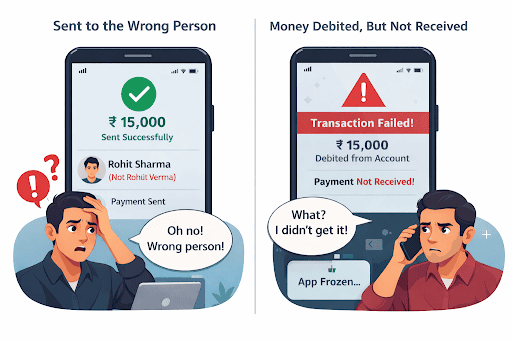
A wrong transaction happens when money is sent to the wrong person, while a failed transaction means the amount is debited but not credited.
The good news? There’s an official way to fix this.
This guide explains exactly how to report UPI issues, contact the right authorities via the NPCI contact number or the UPI complaint email ID, and recover your money.
Official UPI Complaint Contact Channels
UPI is managed by the National Payments Corporation of India (NPCI), which acts as the authority coordinating between all banks and payment apps. No matter which UPI app you use, NPCI’s official grievance system will handle your complaint.
If a UPI payment ever goes wrong, don’t worry, help is just a call away.
- You can reach the official NPCI contact number or the UPI ID customer care number at 1800-120-1740, a toll-free helpline that’s open 24/7. This is the quickest way to get an immediate answer and to find out what to do next.
- You can also use the UPI complaint email id upihelp@npci.org.in to report grievances.
How to File a Wrong UPI Transaction Complaint?
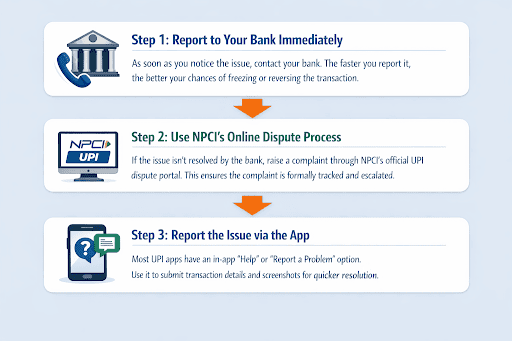
Made a payment to the wrong UPI ID? Here’s a simple step-by-step guide to complaining and getting your money back.
Step 1: Report to your Bank Immediately
- Time matters. Ideally, you should report the issue within the golden hour (24 -48 hours) to the Bank's UPI support team.
- Early reporting improves the chances of contacting the recipient’s bank before the money is withdrawn.
Step 2: NPCI’s Online Dispute Process
- Go to the NPCI official site--> Customer --> Click on UPI Complaint
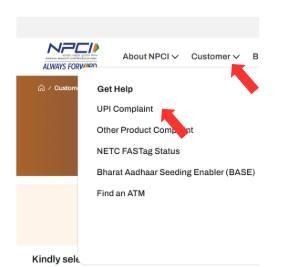
- The Dispute Redressal Mechanism page opens.
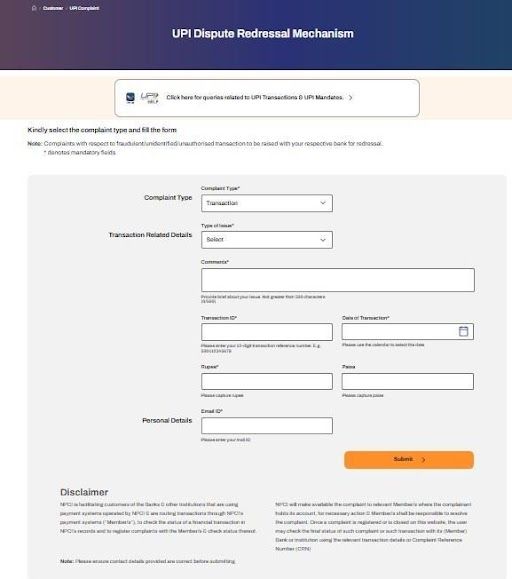
- Select -->Complaint -->Transaction.
- Choose the Transaction Type that best matches your complaint.
- Select the category as ‘Incorrectly transferred to another account and comment briefly about your issue.
- Fill in the transaction ID, amount, transaction date, email ID, and click Submit.
Step 3: Reporting via the App
- Open your UPI app. Click on Transaction History or Help & Support.
- Select the incorrect payment and choose the option to raise a complaint. This ensures the issue is logged both with the app and NPCI simultaneously.
Also Read: Fake Loan Apps: What Are They and How to Identify Them?
Handling Failed Transactions
Sometimes UPI payments fail due to technical glitches, server or network issues, or delays between banks, and the transaction status shows as Processing.
- UPI has an auto-reversal system, meaning that failed transactions are generally reversed within 3 business days.
- However, if you don't receive the money within the stipulated time, you can lodge a complaint with your bank, the UPI app, or the Dispute Redressal Mechanism.
How to Check a UPI Complaint Status?
After lodging your complaint, you will be issued a Complaint Reference Number (CRN). Enter the CRN in the NPCI Check Complaint Status portal to see how things are moving.
Here’s what the different statuses mean:
| Status | Meaning |
|---|---|
| Open / Pending | Your bank is still looking into the issue |
| Resolved | The money has been successfully credited |
| Closed | The bank has taken final action and closed the case |
Checking your complaint status regularly helps you know exactly when to follow up.
Understanding Different Types of UPI Issues
All UPI issues are not related to sending money to the wrong person. Here are some other common UPI errors you may face.
- PIN & Authentication Errors: They occur most often when an incorrect PIN is entered 3 times or when your account is temporarily blocked for security reasons.
- Failure to Process: The payment times out because the sender and receiver's banks fail to establish a connection.
- Account Linking Errors: Your mobile number is not registered with the bank, or the app could not retrieve your account information.
- Onboarding Troubles: Challenges with sign-up, mostly related to SMS verification or registration problems.
Once you've identified your problem, filing the right complaint is easier.
Also Read- UPI Not Working? Here’s How to Fix It Fast
The Banking Ombudsman
If the bank or NPCI fails to respond to your complaint within 30 days, you may escalate the matter.
The RBI has also enabled users to file complaints against banks and payment service providers through its Integrated Ombudsman Scheme.
You can submit complaints for free through the official CMS (Complaint Management System) portal.
Keep these details ready before filing a complaint.
- Date and time of transaction
- 12-digit Transaction reference ID
- Exact amount
- Virtual Payment Address
- Registered mobile number & email
Handling UPI Mistakes the Right Way
UPI is safe and reliable, but small human errors can happen. Knowing the right steps lets you get your money back much more easily. Make sure to cross-verify the recipient's name and UPI customer number before entering the PIN. Keep official grievance portals bookmarked along with the UPI customer care number.
Apart from online payments, UPI is also commonly used for EMI payments and bill settlements. NBFCs like Hero FinCorp actively support UPI-based loan repayments.
Apply for a hassle-free personal loan from Hero FinCorp to manage your expenses, and use UPI AutoPay to ensure you never miss an EMI.
यह भी पढ़ें: UPI Lite क्या है– हीरो फिनकॉर्प द्वारा संपूर्ण मार्गदर्शिका
Frequently Asked Questions
1. What is the official UPI complaint number?
The official UPI customer care number is 1800-120-1740.
2. Can a wrong UPI transaction be reversed?
Yes, but reversal depends on the recipient's consent and the bank's action.
3. How long will it take for a refund if my payment failed?
You will be refunded within 3 business days.
4. What if I sent money to someone who refuses to return it?
You can raise a formal complaint with your bank and NPCI.
Disclaimer: The information provided in this blog post is intended for informational purposes only. The content is based on research and opinions available at the time of writing. While we strive to ensure accuracy, we do not claim to be exhaustive or definitive. Readers are advised to independently verify any details mentioned here, such as specifications, features, and availability, before making any decisions. Hero FinCorp does not take responsibility for any discrepancies, inaccuracies, or changes that may occur after the publication of this blog. The choice to rely on the information presented herein is at the reader's discretion, and we recommend consulting official sources and experts for the most up-to-date and accurate information about the featured products.