Mobile Payment: Meaning, Types & Uses

Imagine you are at a roadside tea stall, looking for change to pay. The vendor points to a small QR code kept near the counter. You scan it, tap Pay, and the transaction is completed.
That hassle-free, quick payment you completed is a mobile payment.
Today, mobile payments are everywhere due to the sheer convenience and speed they offer. Let's understand the concept of mobile payments in more detail here.
What Is Mobile Payment?
Mobile payment is a financial transaction that one can perform using a mobile device, such as a smartphone or a tablet. It enables users to make everyday payments through either a mobile app or a mobile browser.
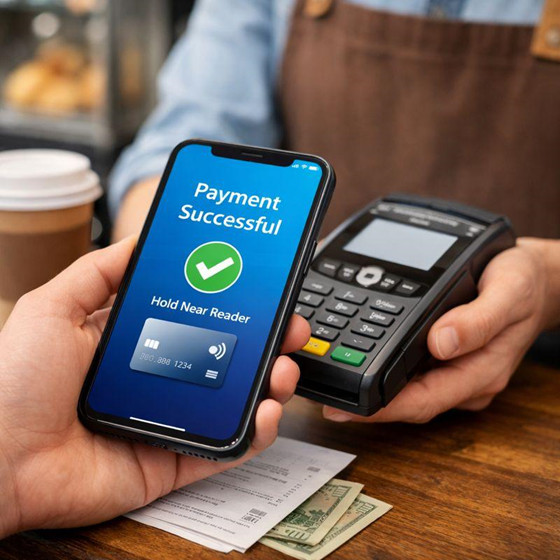
Mobile wallets and mobile commerce are two classic examples of mobile payment methods.
How Do Mobile Payments Work?
Mobile payments work somewhat similarly to traditional payments. Here’s how the process works-
1. Set Up Mobile Payment Methods
Install a mobile wallet, UPI (Unified Payment Interface) or a banking app.
2. Initiate the Mobile Payment
Once set up, you can make a mobile payment through the following ways:
- QR code scan (used by merchants)
- NFC tap (tap-to-pay using enabled smartphones)
- App-to-app transfer
Enter the amount and select the payment method.
Also Read: Set It and Forget It: Using UPI to Never Miss an EMI Again
3. Tokenisation, Encryption, and Authentication
Tokenisation replaces actual data with a secure digital token, whereas encryption protects the data during transmission. Likewise, authentication verifies the user through UPI PIN, app PIN, or biometrics.
4. Transaction Authorisation and Processing
The payment request is sent to the bank or payment network for verification and authorisation.
5. Transaction Confirmation
Once approved, there is an instant payment confirmation of the transaction completion.
Types of Mobile Payments
Mobile payments use various methods such as mobile wallets (Apple Pay, Google Pay) for tap-to-pay (NFC) and online purchases, P2P Apps (Venmo, Zelle) for sending money to friends, QR Code payments for quick scans, in-app purchases, and so on.
These methods can be segregated as -
Proximity Payments
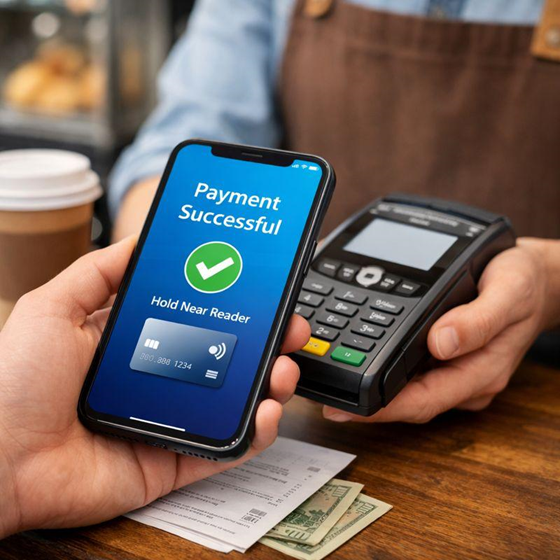 Also known as in-store payments, they are of two types-
1. NFC (Near-Field Communication)
NFC is a popular technology in mobile payment solutions that is used for quick tap-to-pay transactions.
2. QR Code Payments
You have to scan a QR code, enter the amount and PIN to make payments instantly.
Remote Payments (Online)
1. In-App Payments
Here, users pay for goods, services, or physical items directly within a mobile app. This offers more convenience and security by keeping transactions inside the app's branded checkout, often leveraging digital wallets (Apple Pay, Google Pay).
2. Mobile Web Payments
Mobile web payments are digital transactions using smartphones/devices for online or in-store purchases, leveraging apps (like Google Pay, Apple Pay, PayPal) with stored card info, or methods like NFC taps, QR code scans, and UPI.
Digital/Mobile Wallets
Digital wallets are typically categorised by transaction scope-
Closed wallets are for one company (e.g., Amazon Pay for Amazon)
Semi-Closed work with a network of partner merchants (like many UPI apps for specific stores)
Open wallets are often bank-issued and allow all transactions.
SMS and Direct Carrier Billing
SMS and Direct Carrier Billing (DCB) are mobile payment methods in which users charge digital purchases (games, subscriptions, etc.) to their phone bill or prepaid balance. You need phone number verification (OTP via SMS) for frictionless, one-click payments.
Advantages of Mobile Payments in India
Mobile payments offer significant advantages over traditional transactions, including enhanced convenience and faster checkout times. Let's discuss them in more detail here-
Convenience and Speed
Mobile payments are very convenient as they can be made from anywhere at any time (24*7) using a smart device.
Enhanced Security
Mobile payments are quite secure with features such as biometric authentication and data encryption/tokenisation.
Transparency and Tracking
Help enhance transparency and tracking by reducing leakage in government transfers.
Financial Inclusion
Various innovations like UPI 123PAY enable phone users and those in rural areas to participate in the digital economy without needing a smartphone or constant internet.
Cost-efficient
Mobile payment solutions are more cost-efficient for businesses as they reduce the operational costs associated with cash handling.
Versatility
Mobile payments allow users to perform a variety of financial transactions in almost any location, using a single mobile device and a unified platform like the UPI.
Security Features of Mobile Payments
To build trust in mobile payments, the Reserve Bank of India (RBI) mandates strict regulatory guidelines focused on security, data privacy, and fraud prevention. Key requirements effective as of late 2025/early 2026 include implementing risk-based authentication, device binding, and strict data localisation.
Other common security features of mobile payments are -
- Tokenisation - Replaces your actual card number with a unique, random "token" for each merchant/device, thus securing transactions
- Biometric Authentication - Uses unique biological traits such as fingerprints, facial scans or voice for user verification, thus adding a strong personal layer of security
- Two-Factor/Multi-Factor Authentication - Requires two or more forms of identification (e.g., fingerprint + PIN, or a one-time code) for transaction approval
Challenges and Future of Mobile Payments in India
India's mobile payments face typical challenges like internet connectivity in rural areas, fraud concerns, interoperability issues, cyber fraud, digital literacy gaps in rural areas, infrastructure issues, and merchant adoption hurdles.
However, the future of mobile payments is bright with UPI driving growth via biometrics, AI security, voice/tap payments, and integration with wearables.
Embracing Mobile Payments: What It Means for You
As mobile payment solutions through technologies like NFC and QR codes continue to grow, confidence and control are two of the most important aspects to consider.
With Hero FinCorp, you get access to both through a range of smart tools and secure choices. Hero FinCorp offers you multiple mobile payment options for loan EMIs, including the dedicated Customer App, UPI apps (Google Pay, PhonePe, etc.) via QR codes or direct payment.
Explore personal loan options and apply for one that fits your requirements!
2. What is the limit for mobile payments in India?
It is ₹1 lakh daily for regular person-to-person/merchant payments.
3. Can I use mobile payments without a bank account?
Yes, you can use mobile payments without a traditional bank account using digital wallets or prepaid cards linked to UPI.
 Apply For Used Car Loan
 Apply For Personal Loan
 Apply For Loan Against Property
 Apply For Two Wheeler Loan
 Apply For Business Loan
 Apply For New Car Loan
Did You Know
Disbursement
The act of paying out money for any kind of transaction is known as disbursement. From a lending perspective this usual implies the transfer of the loan amount to the borrower. It may cover paying to operate a business, dividend payments, cash outflow etc. So if disbursements are more than revenues, then cash flow of an entity is negative, and may indicate possible insolvency.