Digital Lending Platforms in India: How They Work, Benefits & How to Choose the Right One
- What is a Digital Lending Platform?
- How Do Digital Lending Platforms Work?
- Benefits of Digital Lending Platforms
- Types of Digital Lending Platforms in India
- Loan Products Available Through Digital Lending Platforms
- Eligibility Criteria for Digital Loans
- Documents Required for Digital Lending
- How to Choose the Right Digital Lending Platform
- RBI Guidelines for Digital Lending in India
- Common Risks of Digital Lending and How to Stay Safe
- Why Choose Hero FinCorp Digital Lending Solutions?
- Conclusion
- Frequently Asked Questions
Not long ago, borrowing meant a branch visit, a folder of photocopies and a wait of several days to hear anything back.
That experience has changed completely. Digital lending platforms in India now let you apply from your sofa, verify your identity on video, and receive money in your account the same day.
The convenience is real, and so is the need for care, because not every app you find is a regulated lender. This guide explains how these platforms work, what they offer, the RBI protections you are entitled to, and how to tell a trustworthy platform from a risky one.
What is a Digital Lending Platform?
A digital lending platform is an online service that connects you with a regulated lender and runs the entire loan process over the internet. There is no branch visit, no courier of documents, and no physical signature.
Everything happens through a website or an app. You register, share your details, complete your KYC digitally, and the platform assesses your application using verified electronic records rather than paper.
It helps to be clear about who is actually lending. The app you tap is often a digital lending application or a service provider working on behalf of a bank or a non-banking financial company. The money itself always comes from that regulated lender, and the loan agreement is with them.
So a digital loan platform is best understood as a delivery channel rather than a different product. The personal loan you take online carries the same regulatory protections as one arranged at a counter. Only the speed and the paperwork change.
How Do Digital Lending Platforms Work?
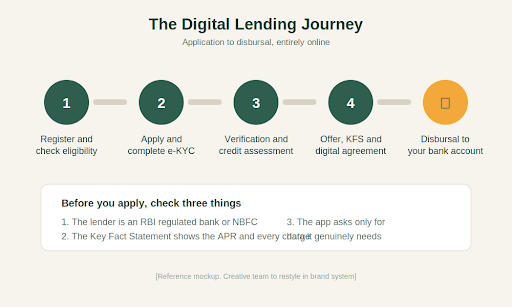
The journey looks long when written out, though most of it happens in the background while you wait a few seconds.
- Online registration. You sign up with your mobile number and verify it using a one time password.
- Eligibility check. You enter basic details such as age, income and employment, and the platform indicates what you may qualify for.
- Loan application. You select the amount and tenure you want and submit the application.
- Digital KYC. Your identity is confirmed through Aadhaar and PAN based e-KYC, sometimes with a short video call.
- Document verification. Income and bank details are validated electronically, with your consent, rather than through physical copies.
- Credit assessment. The lender checks your credit bureau record and repayment capacity before deciding.
- Loan approval. An offer arrives showing the amount, interest rate, tenure and every applicable charge.
- Digital agreement. You review the terms and sign electronically from your phone.
- Loan disbursal. Funds are credited directly to your bank account, which regulations require.
- EMI repayment. You repay monthly through auto-debit, net banking or the app, and can track the balance throughout.
Before you commit to any of it, run your numbers through a personal loan EMI calculator so you know exactly what the monthly outgo will be.
Benefits of Digital Lending Platforms
The advantages go well beyond simply avoiding a queue.
- A fully online application that you can complete in one sitting, without leaving home.
- Faster processing, with eligible applicants receiving decisions in minutes rather than days.
- Minimal paperwork, since verification runs on digital records instead of photocopies and attestations.
- Digital KYC that confirms your identity through Aadhaar and PAN in a few minutes.
- Access at any hour, including weekends and holidays when branches are shut.
- Quick eligibility checks that let you see indicative offers before committing to a full application.
- Transparent tracking, so you can follow your application from submission to disbursal in real time.
- Multiple repayment options, from auto-debit mandates to payments through the app.
- Secure digital transactions protected by encryption and regulated data handling standards.
There is a quieter benefit too. Because the process is standardised, the same criteria apply to everyone, which removes a good deal of the guesswork from borrowing.
Types of Digital Lending Platforms in India
The phrase covers several very different models. Knowing which one you are dealing with tells you who carries the responsibility for your loan.
Banks
Most banks now run their own digital lending journeys through net banking and their apps, often with pre-approved offers for existing customers. The lender and the platform are the same institution here.
NBFCs
Non-banking financial companies registered with the RBI lend through their own websites and apps. They frequently serve borrowers who fall outside a bank's narrower criteria, and Hero FinCorp sits in this category.
Fintech lending platforms
These are technology companies that build the application experience but do not usually lend their own money. They operate as digital lending applications for a partner bank or NBFC, which is why checking who the actual lender is matters so much.
Co-lending models
Here a bank and an NBFC share a single loan between them under an RBI approved framework. You deal with one journey while two regulated institutions share the funding and the risk.
Embedded finance platforms
Credit offered inside another service, such as the pay later option at an online checkout or financing arranged at a dealership. The loan still comes from a regulated lender behind the scenes.
Marketplace lending platforms
Comparison sites that show offers from several lenders so you can weigh them side by side. They pass your application to the lender you choose rather than lending themselves.
Whichever model you use, the rule stays constant. Money should only ever come from an RBI regulated bank or NBFC, and that name should appear clearly in your loan agreement.
Loan Products Available Through Digital Lending Platforms
Availability varies from one lender to the next, though most digital lending platforms offer some combination of these.
- Personal loans, which are unsecured loans used for weddings, medical bills, travel, renovation or consolidating other debts.
- Business loans for working capital, equipment and expansion, available through a digital business loan journey.
- Two wheeler loans that finance a bike or scooter, often with the two wheeler loan approved before you reach the showroom.
- Loan against property, a secured option where a loan against property unlocks a larger amount at a lower rate.
- Consumer durable loans that spread the cost of appliances and electronics, through a consumer durable loan at the point of purchase.
- Education funding, where personal loans for students cover fees, coaching and course costs.
- Gold loans, offered by some lenders against pledged jewellery, usually with a physical valuation step.
- Purpose specific journeys are increasingly common too, such as a dedicated loan for marriage or a loan for Travel, which simply package a personal loan around a particular need.
Eligibility Criteria for Digital Loans
Criteria differ across lenders and products, but most digital loans assess the same handful of factors.
- Age: typically between 21 and 58 years, though some lenders extend either end of that range.
- Citizenship: Indian citizens residing in India, with a few lenders serving NRIs on specific products.
- Employment type: salaried and self employed applicants both qualify, with different documents for each.
- Income: a minimum monthly income, commonly around ₹15,000, subject to the lender's assessment.
- Work experience: often six months in the current job for salaried applicants, or two years of business continuity.
- Credit history: a healthy credit score, with 725 and above preferred by many lenders for the better terms.
- Repayment capacity: your existing EMIs matter, since lenders look at how much of your income is already committed.
None of these are absolute. A slightly weaker score can be offset by stable income, and lenders weigh the whole picture rather than a single number.
Documents Required for Digital Lending
Requirements vary by lender and product, though the digital list is short by design.
- Aadhaar card for e-KYC and address verification.
- PAN card for identity, credit and tax records.
- Address proof, if your current address differs from the one on Aadhaar.
- Income proof, which may be verified digitally with your consent.
- Salary slips for recent months, where the lender asks for them.
- Bank statements, usually covering the last six months.
- Business proof and ITR for self employed applicants.
Many lenders now need very little beyond PAN and Aadhaar, since consent based verification handles the rest. You can see a full breakdown of the Documents Required For Personal Loan before you start.
How to Choose the Right Digital Lending Platform
This is the section worth reading twice, because the platform you choose matters more than the rate it advertises.
Confirm the lender is RBI regulated
Find the name of the bank or NBFC that will actually lend to you, and check it is registered with the Reserve Bank of India. Regulated lenders publish the digital platforms they work with, and the RBI maintains a public directory of authorised digital lending apps you can cross check.
Compare interest rates properly
Look at the annual percentage rate rather than the headline number, since the APR includes fees and gives you a true cost you can compare across lenders.
Read the processing fees and charges
Processing fees, foreclosure charges, late payment penalties and GST all affect what you actually receive and repay. Every one of them should be visible before you accept.
Check the loan tenure options
A longer tenure lowers the EMI and raises the total interest. Make sure the platform offers a range that lets you strike your own balance.
Look at customer reviews
Read recent reviews on the app stores, paying attention to complaints about hidden charges, recovery conduct or support that never responds.
Examine data privacy practices
A legitimate platform asks only for data it genuinely needs. Requests for access to your contacts, gallery or messages are a serious warning sign, and you should be able to withdraw consent later.
Assess digital security
Check for encryption, secure login and recognised security certifications. Your financial data deserves the same protection as your money.
Test customer support
Look for a published grievance redressal officer, a working helpline and a clear escalation path. You want to know this exists before you need it.
Insist on transparent terms
The agreement should be shared in full, in language you can follow, with nothing significant left to be explained later.
RBI Guidelines for Digital Lending in India
The Reserve Bank of India regulates digital lending closely, and the protections exist specifically for borrowers. Knowing them makes it much easier to spot a platform that is cutting corners.
Lending can only be done by a regulated entity, meaning a bank or an NBFC. Apps and websites that arrange the loan act on their behalf, and regulated lenders are required to publish the digital lending applications and service providers they work with.
Money must move directly between you and the lender. Loan funds are credited to your own bank account and repayments go to the lender's account, with no pass-through or pooled accounts in between.
You are entitled to a Key Fact Statement before signing, setting out the interest rate, the annual percentage rate, all fees, the tenure and the recovery mechanism. Any charge missing from that statement should not appear later.
Data collection must be need based and consent driven. A lender should not demand access to your contacts, media files or call logs, and you can withdraw consent or ask for your data to be deleted.
Every regulated lender must also run a grievance redressal process with a named officer, and complaints left unresolved can be escalated to the RBI Ombudsman. Hero FinCorp publishes both its list of digital lending partners and its grievance redressal process for exactly this reason.
Guidelines are updated periodically, so it is worth reviewing the latest position on the RBI website before you borrow.
Common Risks of Digital Lending and How to Stay Safe
Convenience attracts criminals as well as customers, so a little caution goes a long way.
Fake loan apps
Unregulated apps promise instant approval with no checks, then charge upfront fees, apply punishing interest or harass borrowers. Genuine lenders never ask for an advance payment to release a loan.
Phishing and fraudulent offers
Messages carrying links to lookalike websites are common. Type the lender's address yourself or use the official app rather than following a link from an SMS or a social media post.
Identity theft
Documents shared with an unverified platform can be used to borrow in your name. Check your credit report periodically so you would notice an account you never opened.
Hidden charges
Costs that surface only after disbursal are a red flag. The Key Fact Statement exists to prevent exactly this, so read it in full before agreeing.
Unauthorised data access
Apps that demand sweeping permissions may harvest your contacts for pressure tactics later. Review permissions before installing and refuse anything unnecessary.
A few habits keep you safe. Download apps only from the Google Play Store or Apple App Store, verify the lender's credentials, read the agreement before signing, and never share an OTP or password with anyone. Hero FinCorp's fraud awareness page is a useful reference if something looks suspicious.
Why Choose Hero FinCorp Digital Lending Solutions?
If you are weighing up the best digital lending platforms in India, here is where Hero FinCorp stands.
- A simple online application that takes minutes, with approval for eligible applicants in as little as 10 minutes.
- Minimal documentation, since PAN and Aadhaar are enough for most applicants to complete digital KYC.
- A secure digital process, supported by ISO 27001 certified processes and 256-bit encryption.
- Competitive interest rates shaped by your profile rather than a single flat slab.
- Transparent pricing, with the processing fee, foreclosure terms and every other charge disclosed before you accept.
- Flexible repayment across tenures of 12 to 36 months, with no prepayment charges on part payments.
- Dedicated customer support and a published grievance redressal route if you need to escalate.
- Multiple loan products, spanning personal, business, two wheeler, used car and property backed lending.
- A seamless journey from application through video KYC to same day disbursal for eligible borrowers.
Hero FinCorp is an RBI regulated NBFC backed by the Hero Group, with over 70 years of group lending heritage and more than 20 million customers. You can check your personal loan eligibility in minutes, or manage the whole journey on the Hero Digital Lending App for Android and iOS.
Conclusion
Digital lending has made borrowing faster and far less daunting, and the protections around it are stronger than many people realise.
The one habit worth keeping is verification. Confirm the lender is regulated, read the Key Fact Statement, and be wary of any platform that wants more data or more urgency than the situation warrants. Do that, and the convenience is yours to enjoy safely.
Frequently Asked Questions
What is a digital lending platform?
A digital lending platform is an online service that connects borrowers with regulated lenders and runs the whole loan process over the internet. Application, KYC, verification, approval and disbursal all happen digitally, with no branch visit or physical paperwork required.
How do digital lending platforms work?
You register online, check eligibility, apply and complete e-KYC using Aadhaar and PAN. The lender verifies your details and credit record electronically, sends an offer with all charges disclosed, and credits the money to your bank account after you sign digitally.
Are digital lending platforms safe in India?
They are safe when the lender behind the platform is an RBI regulated bank or NBFC. Risk comes from unregulated apps, so verify the lender's name, download only from official app stores, and avoid apps demanding access to your contacts or photos.
Are digital lending platforms regulated by RBI?
Lending itself is regulated, and only banks and NBFCs registered with the RBI may lend. Apps and websites usually operate as digital lending applications for those regulated entities, and lenders must publish the platforms and service providers they work with.
What types of loans are available on digital lending platforms?
Commonly personal loans, business loans, two wheeler loans, loan against property and consumer durable loans. Some lenders also offer gold loans and a Personal Loan for Students for education costs. Availability varies, so check what your chosen lender actually provides.
Who is eligible for digital loans?
Most lenders look for Indian citizens aged roughly 21 to 58, salaried or self employed, with a minimum monthly income around ₹15,000, some work or business continuity, and a healthy credit history. Exact criteria differ across lenders and products.
What documents are required for digital lending?
Usually Aadhaar and PAN for e-KYC, plus income proof such as salary slips or bank statements. Self employed applicants generally add business proof and ITR. Many lenders now verify income digitally with your consent, which reduces the list further.
How quickly can digital loans be approved?
Eligible applicants with complete details can be approved within minutes, and some lenders disburse the same day. Missing documents, income that needs manual checking or a weaker credit profile can extend this to a day or two.
What is digital KYC in online lending?
Digital KYC is electronic identity verification using Aadhaar and PAN, sometimes with a short video call or a live selfie for a face match. It replaces submitting physical copies and lets the lender confirm who you are within minutes.
How do I choose a trusted digital lending platform?
Confirm the lender is RBI regulated, compare the APR rather than the headline rate, read every charge in the Key Fact Statement, check recent app store reviews, review the data permissions requested, and make sure a grievance redressal route is published.
How can I identify fake loan apps?
Warning signs include no named regulated lender, approval promised without any checks, upfront fees demanded before disbursal, demands for access to contacts or photos, and no published address or grievance contact. Cross check the app against the RBI's directory of authorised apps.
Why should I choose Hero FinCorp for digital lending?
Hero FinCorp is an RBI regulated NBFC from the Hero Group, offering a fully digital journey with approval in as little as 10 minutes, minimal documentation, transparent charges disclosed upfront, flexible tenures and dedicated customer support across multiple loan products.
How can I apply for a Hero FinCorp loan online?
Visit the Hero FinCorp website or download the Hero Digital Lending App, enter your details, choose your amount and tenure, complete KYC with PAN and Aadhaar, and sign digitally. Eligible applicants receive funds directly in their bank account.
Disclaimer: The information provided in this blog post is intended for informational purposes only. The content is based on research and opinions available at the time of writing. While we strive to ensure accuracy, we do not claim to be exhaustive or definitive. Readers are advised to independently verify any details mentioned here, such as specifications, features, and availability, before making any decisions. Hero FinCorp does not take responsibility for any discrepancies, inaccuracies, or changes that may occur after the publication of this blog. The choice to rely on the information presented herein is at the reader's discretion, and we recommend consulting official sources and experts for the most up-to-date and accurate information about the featured products.