What is DSA in Finance? Full Form, Registration, Eligibility and Responsibilities

- DSA Full Form and Meaning in Finance
- Types of Direct Selling Agents (DSAs)
- Role and Responsibilities of a DSA in Banking
- How a DSA Works: Step-by-Step Process
- Eligibility Criteria to Become a DSA
- Documents Required for DSA Registration
- How to Register as a DSA Loan Agent
- DSA Code: Meaning and Importance
- DSA Opportunities Across Different Financial Products
- Earning Potential and Commission Structure for DSAs
- Benefits of the DSA Model
- Common Challenges and Mistakes to Avoid
- Conclusion
- Frequently Asked Questions
That phone call asking if you need a personal loan, the person at a property expo walking you through home loan options, the WhatsApp message about business loan schemes.
The person behind all of those is almost always a Direct Selling Agent.
DSA full form is Direct Selling Agent, sometimes called Direct Selling Associate. A DSA is affiliated with a bank or NBFC and finds potential borrowers for the institution, earning a commission on every successful loan disbursal.
No fixed salary. No mandatory office. Income scales entirely with how many loans get processed through the agent.

DSA Full Form and Meaning in Finance
DSA in banking is a bridge role. Instead of lenders hiring a massive sales team, they outsource customer acquisition to DSAs who earn commissions for every successful loan disbursal.
Who is a DSA?
A DSA identifies potential borrowers, acts as the first touchpoint, explains loan schemes that suit the borrower's requirements, and helps with application forms and document collection.
Students, retired bank officers, real estate agents, chartered accountants, and salaried professionals all work as DSAs alongside their primary occupation.
How DSAs Differ from Bank Employees and Loan Agents
A bank employee is on payroll and handles credit assessment and sanction. A loan DSA agent earns only when a loan disburses through them. T
he role of a DSA is strictly limited to sourcing proposals. Sanction happens at the sole discretion of the bank. Unlike an informal loan agent, a registered DSA holds a unique DSA code that tracks every application they submit.
Types of Direct Selling Agents (DSAs)
Independent DSAs
Independent DSAs may work for several banks and financial institutions, giving them access to a diversified portfolio of products and the ability to offer customised options.
Bank-Associated DSAs
Tied exclusively to one bank, selling only that institution's products. Narrower range but often closer working relationships and faster application turnarounds.
NBFC-Affiliated DSAs
NBFC-affiliated DSAs can promote Mudra loans to micro-enterprises and other products that banks do not always offer. NBFCs typically move faster on approvals and carry broader eligibility norms.
Role and Responsibilities of a DSA in Banking
Customer-Focused Responsibilities
- Leads come from wherever people with borrowing needs gather, personal contacts, referrals, housing societies, local business groups. There is no single source that works for everyone
- Matching the borrower to the right loan scheme matters more than pushing whichever product pays the highest commission, because a bad fit leads to rejection and that hurts the DSA's standing with the lender
- First-time loan applicants especially need help with the application form. What looks straightforward to a banker is genuinely confusing to someone who has never borrowed before
Lender-Focused Responsibilities
- Submitting complete, accurate applications with all supporting documents
- Uploading applications in the bank's CRM or partner portal and tagging them with the DSA code
- Conducting basic due diligence before submitting to avoid rejections
- Maintaining a healthy conversion ratio to retain good lender standing
How a DSA Works: Step-by-Step Process
- A DSA identifies a potential borrower through their network or a referral
- Explains available loan products and matches the borrower to a suitable option
- Checks basic eligibility informally before initiating a formal application
- Procures the completed loan application along with required documents from the borrower
- Submits documents and application to the bank with the DSA code attached
- The bank's credit team handles assessment, verification, and sanction
- Commission is triggered and paid on successful disbursal
Check your Hero FinCorp personal loan eligibility here to understand the personal loan products available for DSA sourcing.
Eligibility Criteria to Become a DSA
Educational Requirements
There are no minimum educational criteria required, meaning DSA registration is open to everyone regardless of finance background.
General eligibility across most lenders:
- Age 18 years and above, some lenders ask for 25 plus
- Indian citizen and resident
- Can be a student, salaried professional, non-salaried individual, or a registered company
- A good CIBIL score matters as lenders check it during registration
- A low credit score makes it difficult to become a DSA loan agent
Skills Required for Success
- Strong communication in local language and English
- Ability to explain financial products simply to borrowers from varied backgrounds
- Network-building to generate leads consistently
- Follow-up discipline since most conversions happen after multiple touchpoints
Documents Required for DSA Registration
Documents generally required for DSA registration across most banks and NBFCs:
- PAN card and Aadhaar card
- Address proof such as utility bill, passport, or voter ID
- Bank statements for the last three months
- Business proof if applying as a firm or company
- Educational certificates if specifically requested by the lender
How to Register as a DSA Loan Agent
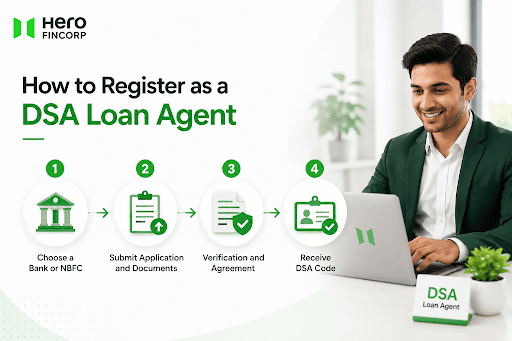
Step 1: Choose a Bank or NBFC
Research lenders whose products match your target borrower base. It is now possible to work with 20 plus banks and 40 plus NBFCs through digital partner programmes without visiting any branch.
Step 2: Submit Application and Documents
Visit the lender's official website and find the DSA registration section. Enter basic details like name, mobile number, and email ID, then upload required documents.
Step 3: Verification and Agreement
The bank or NBFC verifies documents, checks credit history, and conducts a background check. If satisfied, they send a DSA agreement for review and signature.
Step 4: Receive DSA Code
Once the agreement is signed, a unique DSA loan agent ID is issued. This code makes the agent officially authorised to source loans for that lender. Download the instant loan app on Google Play to start managing Hero FinCorp loan applications digitally.
DSA Code: Meaning and Importance
A DSA code is a unique identification number that a bank or NBFC issues once you officially register as their direct selling agent.
Why it matters:
- Proves the agent is authorised
- Tracks every application submitted and ties commission payouts to specific files
- Gives access to the lender's partner portal and CRM tools
- Without a valid DSA code, no commission can be processed
DSA Opportunities Across Different Financial Products
Personal Loans
Most commonly sourced product for a loan DSA agent. Personal loans carry the highest DSA commission rates at 1% to 3% of the disbursed amount. Fast processing and broad eligibility make them easiest to convert.
Home Loans
Home loans carry lower percentage payouts of 0.30% to 0.55% but generate higher absolute earnings due to larger ticket sizes. A 0.5% commission on a Rs. 50 lakh home loan is Rs. 25,000 per file.
Business Loans
Business loans from NBFCs offer up to 2.5% commission, making this one of the highest-earning product categories for experienced agents with MSME networks.
Loan Against Property
Larger ticket size, longer tenures, and less competition among DSAs compared to personal loans. The documentation complexity means borrowers need more hand-holding which strengthens the agent-borrower relationship.
Credit Cards
Credit cards pay a fixed amount per approved application, typically Rs. 500 to Rs. 4,000. Lower per-card earnings but high volume potential from a corporate or professional network.
Earning Potential and Commission Structure for DSAs
DSA commission is paid within 30 to 45 days of loan disbursement by most lenders. TDS at 2% under Section 194H applies when the cumulative commission from one lender exceeds Rs. 20,000 in a financial year.
A beginner DSA earning Rs. 10,000 to Rs. 50,000 a month is realistic. A more experienced agent running a team of sub-agents can earn Rs. 50,000 to Rs. 5,00,000 per month. The spread is wide because earnings depend entirely on loan volume, ticket size, and the product mix being sourced.
Disclaimer: These figures are only illustrative and not guaranteed. Actual earnings depend on your effort, network, lender policies and market conditions
Benefits of the DSA Model
Benefits for DSAs
- Flexible working hours with no fixed office requirement
- No minimum educational qualification is needed to begin
- Training is provided by the bank or NBFC at no cost to the agent
- Works alongside an existing job or business
- Income scales with effort and network size
Benefits for Banks and NBFCs
- DSAs extend reach into markets and demographics that branch networks cannot access
- Reduce operational costs by outsourcing early-stage customer acquisition
- Localised DSAs bring language fluency and community trust that branch staff often cannot replicate
Common Challenges and Mistakes to Avoid
New loan DSA agents consistently make these mistakes:
- Applying to too many lenders without understanding any product properly
- Submitting incomplete applications that return rejected and damage lender standing
- Not updating knowledge regularly since loan schemes, interest rates, and eligibility criteria change frequently
- Ignoring after-sales follow-up which loses referrals and repeat business
- Missing TDS compliance on commission income
Structural challenges also worth knowing upfront:
- Commission timelines vary by lender, sometimes running weeks after disbursal
- A low CIBIL score makes DSA registration difficult since lenders check it during verification
Conclusion
DSA in banking is one of the more accessible income models in India's financial sector right now. No degree requirement, no fixed capital, flexible hours, and DSA commission that scales with effort.
Getting registered with the right lender, building a consistent borrower network, and submitting clean applications is what separates agents who earn well from those who stall early.
Explore Hero FinCorp's products and apply through the personal loan app on the App Store to get started.
Frequently Asked Questions
What are the eligibility criteria to become a DSA?
Age 18 and above, Indian citizen, good CIBIL score. Students, salaried professionals, and companies can all register. No specific degree is required.
How long does the DSA registration process take?
Digital NBFC registrations can complete in a few days. Bank registrations involving physical verification take two to four weeks depending on application volume.
Can I represent multiple banks or NBFCs as a DSA agent?
Yes, you can work with multiple banks or NBFCs, but you must complete a separate DSA registration and get a unique code from each lender. Some agreements may include exclusivity clauses, so always read the terms carefully.
What does a Direct Selling Agent do?
A DSA identifies potential borrowers, explains loan schemes, helps fill application forms, collects documents, and submits them to the lender with their DSA code.
How do DSAs earn money?
DSA commission ranges from 1% to 3% on personal and business loans, and 0.30% to 0.55% on home loans. Most lenders process payouts within 15 to 40 days of loan disbursal.
What skills are required to become a successful DSA?
Strong communication, product knowledge, network-building ability, and consistent follow-up. Being convincing with a thorough understanding of the loan schemes you are selling is the core requirement.
Will I receive a license or DSA code after registration?
Yes. A unique DSA code is issued after registration and agreement signing, authorising the agent to source loans and track commission payouts.
Can a person with a low credit score become a DSA?
It is difficult. Lenders check CIBIL during DSA registration. Improving the credit score before applying is the most practical first step.
Why are DSAs important for banks and NBFCs?
DSAs extend the reach of financial institutions into markets and demographics that are otherwise hard to access, while reducing operational costs by outsourcing early-stage customer acquisition.
Disclaimer: The information provided in this blog post is intended for informational purposes only. The content is based on research and opinions available at the time of writing. While we strive to ensure accuracy, we do not claim to be exhaustive or definitive. Readers are advised to independently verify any details mentioned here, such as specifications, features, and availability, before making any decisions. Hero FinCorp does not take responsibility for any discrepancies, inaccuracies, or changes that may occur after the publication of this blog. The choice to rely on the information presented herein is at the reader's discretion, and we recommend consulting official sources and experts for the most up-to-date and accurate information about the featured products.