What is a UTR Number, Example & How to Check It?

Ever made an online transfer and wondered where your money went? That’s when the UTR number becomes important. It’s a unique identifier generated for every bank transaction, helping you track payments and resolve issues quickly.
From NEFT to UPI, every digital transfer has one.
This article breaks down what a UTR number is, shows examples, and explains how you can check it in just a few steps.
What Is a UTR Number?
A UTR number, or Unique Transaction Reference number, is a unique 12-digit alphanumeric code assigned to every financial transaction in India. This code is a crucial identifier for all major payment systems since it is generated each time a payment is made via RTGS, NEFT, IMPS, or UPI.
In Indian banking and NBFC operations, the UTR number means a precise way to track, verify, and resolve payment-related issues. Since each UTR is unique, it acts like a digital fingerprint for the payment, helping both the sender and receiver, and even the bank, monitor the status and details of any transfer.
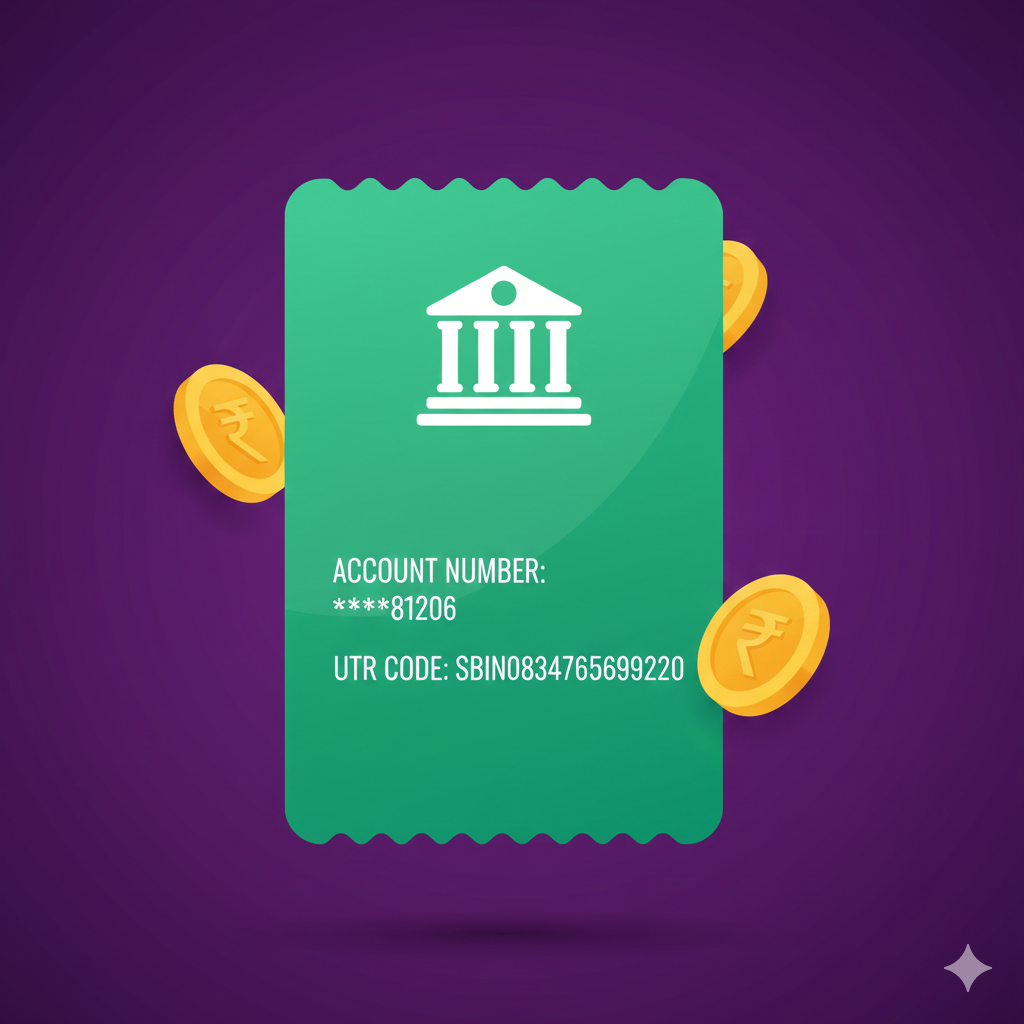
UTR Number Example
Let's understand how these codes are structured and why they are important with the following UTR number example from various transaction types and their formats. These UTR numbers are essentially unique, and some might be slightly variable depending on the payment method -
NEFT (16 characters) - HDFC N230710123456
- HDFC - Sender bank’s IFSC code
- N - Indicates NEFT
- 230710 - Date of transaction (YYMMDD)
- 123456 - Unique serial number
RTGS (22 characters) - ICIC R C2024030587654321
- ICIC -Sender bank’s IFSC
- R -RTGS transaction
- C -Channel (e.g., internet banking)
- 20240305 -Date (YYYYMMDD)
- 87654321 -Unique sequence
UPI (12 characters, alphanumeric) - AXIS12345678
- Bank/platform code plus unique ID
Each type differs in length and format. NEFT UTRs are shorter and straightforward, RTGS UTRs are longer and more detailed, while UPI UTRs are compact and platform-specific. Despite differences, all UTRs serve the same purpose: uniquely identifying transactions for transparency and traceability in the banking system.
How to Find Your UTR Number
Finding your UTR number is super easy and can be done using multiple methods. Here are five simple ways to find your UTR number online or offline.
1. Bank Statement or Passbook
Your UTR number appears on both physical and online bank statements. To access it online, here are the steps.
- Log in to your account.
- View the transaction history.
- Locate the relevant payment.
The UTR is listed alongside the transaction details.
2. Internet Banking
- Log in to your internet banking account.
- Access transaction history and filter by date or payment type.
- Click on the transaction to see full details, including the UTR number.
3. Mobile Banking App
- Open your bank’s mobile app.
- Go to your transaction history.
- Tap the specific transfer, and the UTR number will be displayed under “Details” or “More Info.”
4. Transaction Confirmation via SMS or Email
Most banks and UPI apps send transaction alerts to their customers.
Check your SMS or email confirmations; your UTR number is usually included in these alert messages.
5. Using Bank Customer Support
If you cannot locate the UTR number elsewhere, contact your bank’s customer support. Provide them with your transaction details, and the bank will give you the UTR number.
Using these methods, you can easily perform a UTR number check online or offline and track any transaction efficiently.
How to Track and Verify UTR Number Online
Tracking and verifying a UTR number online has become easier than ever. Thanks to most banks for offering simple tools to track NEFT, RTGS, and IMPS payments using the UTR code.
Tracking helps you confirm whether the amount has been credited, is still being processed, or has failed. While each bank has its own portal, the overall process remains similar, and many follow guidelines outlined by the RBI for payment status verification.

Steps to Track Your UTR Number Online
Step 1 - Visit Your Bank’s Net Banking Portal -
Log in to the official website or app and head to the ‘Track Transaction’ or ‘Payment Status’ section. Enter the UTR number and choose the transaction type.
Step 2 - Select NEFT, RTGS, or IMPS -
Banks allow users to pick the payment mode before displaying the status. This helps the system identify the correct settlement channel.
Step 3 - Check the Status - You will typically see one of the following -
- Pending/In Process
- Successful/Credited
- Failed/Returned
Step 4 - Allow Time for Settlement -
NEFT and RTGS follow batch or real-time settlement cycles, so slight delays are normal. IMPS and UPI are usually instant.
Step 5 - If an Issue Persists -
Share the UTR with your bank’s customer support team. They can trace the payment through NPCI or internal settlement systems and update you on the resolution.
This helps you complete a UTR number track online smoothly and ensures your payment is properly verified.
Importance and Uses of UTR Number
Understanding the importance of the UTR number is crucial for both individuals and businesses -
- Tracking Payments Reliably -Makes it easy to monitor all transactions clearly and efficiently
- Proof of Payment - Recognised for banking, legal, and audit purposes
- Dispute Resolution -Helps resolve delayed or missing payments quickly
- Accounting and Tax Audits -Simplifies reconciliation and recordkeeping for businesses and individuals
- Enhanced Security & Transparency - Boosts confidence and clarity in digital transactions
The UTR number is a dependable way to verify, trace, and validate any financial transfer, making it essential for modern banking.
Smart Banking Starts With Understanding Your UTR
A UTR number may look like a simple code, but it plays a vital role in keeping your transfers transparent, traceable, and secure. Whether you're resolving a failed payment, confirming a credit, or maintaining clean financial records, the UTR number ensures complete clarity in every transaction.
And when it comes to borrowing, this same clarity matters. If you ever need quick financial support for medical needs, travel plans, education, or urgent expenses, choosing the right lending partner makes all the difference.
Hero FinCorp offers a seamless, digital-first personal loan journey designed for speed, convenience, and reliability.
Apply for a Hero FinCorp personal loan today and experience a fast, transparent, and fully digital borrowing process built around your convenience.
Frequently Asked Questions
1. What's the difference between a UTR and a Transaction ID?
For every NEFT, RTGS, IMPS, and UPI transaction, banks issue a UTR. Transaction IDs may be app-specific and not standardised.
2. Can I use the UTR number as proof of payment?
Yes, it is recognised for both financial and legal purposes.
3. How many digits are there in a UTR number?
Depending on the type of transaction, 12–22 characters are typically used.
4. What should I do if I cannot find my UTR number?
Check your bank statement, get an email or SMS alert, or get in touch with your bank.
5. Is my UTR number safe to share?
Yes, it is safe to share it with authorised parties for verification purposes.
6. How is the UTR number generated by banks?
Automatically by the bank during NEFT, RTGS, IMPS, or UPI processing.
 Apply For Used Car Loan
 Apply For Personal Loan
 Apply For Loan Against Property
 Apply For Two Wheeler Loan
 Apply For Business Loan
 Apply For Loyalty Loan
 Apply For New Car Loan