How is Interest Calculated on Personal Loans? Formula, Methods & Examples

- What is Personal Loan Interest?
- How is Interest Calculated on a Personal Loan?
- Formula Used to Calculate Personal Loan Interest
- Reducing Balance vs Flat Interest Rate
- Example of Personal Loan Interest Calculation
- Factors That Affect Personal Loan Interest
- How to Reduce the Total Interest on a Personal Loan
- How a Personal Loan EMI Calculator Helps
- Hero FinCorp Personal Loan Interest & EMI Calculation
- Common Mistakes While Understanding Personal Loan Interest
- Frequently Asked Questions
You see the rate. You see the EMI. What sits between them is the bit most people never quite work out. So here is how is interest calculated on personal loans, with the formula and a worked example.
What is Personal Loan Interest?
Interest is what the lender charges you for the use of their money. Every EMI you pay on personal loans splits in two, one part clearing interest and the other reducing what you borrowed. Early on interest takes the larger share, and as the balance falls that share shrinks.
How is Interest Calculated on a Personal Loan?
Four things decide the number:
- Loan amount. Borrow more and you pay interest on more.
- Interest rate. The annual rate your lender offers, based on your profile.
- Repayment tenure. Stretch it out and the EMI drops, though the total interest climbs.
- Calculation method. Reducing balance or flat rate, and the gap between them is wider than most borrowers expect.
Change any one and your total cost moves with it.
Formula Used to Calculate Personal Loan Interest
Most lenders in India work on reducing balance, meaning interest applies only to what you still owe. The EMI comes from one standard formula:
EMI = P × r × (1 + r)ⁿ / [(1 + r)ⁿ − 1]
- P is the principal, or the amount you borrow
- r is the monthly interest rate, so an annual rate divided by 12 and then by 100
- n is the tenure in months
Reducing Balance vs Flat Interest Rate
Two loans can advertise the same rate and cost you very different amounts.
| Criteria | Bank | NBFC | Digital Lender / App |
|---|---|---|---|
| Approval speed | Slower | Faster | Fastest |
| Eligibility flexibility | Stricter | More flexible | Flexible, profile-based |
| Interest rate | Often lowest for existing customers | Competitive | Varies, compare the APR |
| Best for | Salaried with a strong score | Those wanting speed and flexibility | Small, quick, paperless loans |
Same headline rate, roughly ₹32,000 apart. Ask which method applies before you sign.
Example of Personal Loan Interest Calculation
Take ₹2,00,000 at 17.9% per annum over 24 months, on reducing balance.
| Loan amount | ₹2,00,000 |
|---|---|
| Interest rate | 17.9% per annum (1.5% per month) |
| Tenure | 24 months |
| EMI | About ₹9,985 |
| Total interest | About ₹39,636 |
| Total repayment | About ₹2,39,636 |
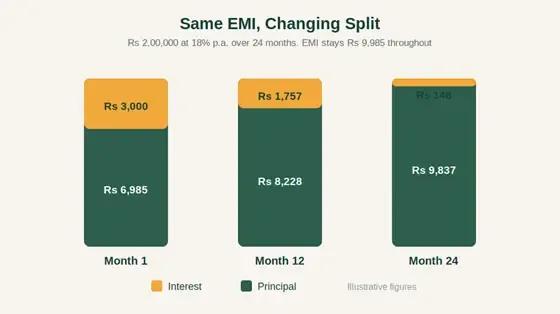
The EMI never changes, but its make-up does. Month one sends about ₹3,000 to interest and ₹6,985 to principal. By month 12 the interest share is roughly ₹1,757, and in the final month barely ₹148.
Factors That Affect Personal Loan Interest
Two people can approach the same lender and be quoted different rates. What moves it:
- Credit score, since a stronger record usually earns a better rate
- Monthly income and how steady it is
- Employment type, whether salaried or self employed
- Existing EMIs and other obligations
- The loan amount and the tenure you pick
- Your repayment history on past borrowing
- The lender's own credit assessment
These are personal, so the rate is too. Borrowing patterns vary across the country as well, as this look at rural borrowers driving personal loan growth shows.
How to Reduce the Total Interest on a Personal Loan
You have more control here than you might think.
- Pick the shortest tenure you can afford. This one choice saves the most.
- Protect your credit score, because a better rate compounds across the whole loan.
- Borrow only what you need, not what you are offered.
- Make part prepayments when you can, where your agreement permits them.
- Compare offers on total cost, including fees, not the rate alone.
- Pay every EMI on time, so penalties never inflate the total.
How a Personal Loan EMI Calculator Helps
Rather than wrestling with the formula, run the numbers through an EMI calculator. Enter the amount, rate and tenure, and it returns your EMI, total interest and total repayment. The value is in comparison. Test 12 months against 24 and 36, and the trade-off between a comfortable EMI and a lower overall cost becomes obvious.
Hero FinCorp Personal Loan Interest & EMI Calculation
Hero FinCorp offers an online Personal Loan EMI Calculator that helps eligible applicants estimate their EMI, interest payable and total repayment from the amount, rate and tenure. Do review the full terms and charges before applying. You can check your eligibility or use the instant Personal Loan App, and this guide to what the loan process involves covers what follows.
Common Mistakes While Understanding Personal Loan Interest
A few slips cost borrowers real money:
- Comparing headline rates instead of total borrowing cost
- Overlooking processing fees and other charges
- Mistaking a flat rate for a reducing balance one
- Choosing a long tenure purely for the smaller EMI
- Borrowing more than the situation actually needs
Most personal loans are unsecured loans, so the rate reflects the lender's risk as much as your numbers.
Frequently Asked Questions
How is interest calculated on a personal loan?
Most lenders use reducing balance, charging interest only on the amount still outstanding. Your EMI stays constant, while the interest share within it falls each month and the principal share rises correspondingly.
What formula is used to calculate personal loan interest?
The standard EMI formula is P × r × (1 + r)ⁿ divided by [(1 + r)ⁿ − 1], where P is the principal, r the monthly interest rate and n the tenure in months.
Is personal loan interest calculated monthly or annually?
Rates are quoted per annum but applied monthly. An 17.9% annual rate works out to 1.5% a month, charged on your outstanding balance at each EMI date.
What is the difference between reducing balance and flat interest rate?
Reducing balance charges interest on what you still owe, so the cost falls as you repay. A flat rate charges it on the original amount throughout, which makes an identical headline rate significantly more expensive.
Disclaimer: The information provided in this blog post is intended for informational purposes only. The content is based on research and opinions available at the time of writing. While we strive to ensure accuracy, we do not claim to be exhaustive or definitive. Readers are advised to independently verify any details mentioned here, such as specifications, features, and availability, before making any decisions. Hero FinCorp does not take responsibility for any discrepancies, inaccuracies, or changes that may occur after the publication of this blog. The choice to rely on the information presented herein is at the reader's discretion, and we recommend consulting official sources and experts for the most up-to-date and accurate information about the featured products.