Loan Repayment Plans: Types, Changes & Tips
- What is a Loan Repayment Plan?
- Types of Loan Repayment Plans Explained
- How a Loan Repayment Plan Works - Understanding Amortization
- Can You Change Your Loan Repayment Plan?
- How to Change Your Loan Repayment Plan – Step-by-Step Process
- Benefits of Managing and Understanding Your Loan Repayment Plan
- Hero FinCorp Loan Repayment Support Services
- Frequently Asked Questions
Most loan defaults don't happen because borrowers can't repay; they happen because no one helped them plan. A structured repayment strategy is the difference between a loan that builds a happy future and one that feels burdensome.
At the end of the day, a loan is just a tool, and like any tool, it’s only as good as the hands holding it. A structured repayment strategy is what bridge the gap between a debt that feels like a burden and a financial choice that actually builds the future you were aiming for. It’s about moving from "hoping the numbers work" to knowing exactly how they do.
What is a Loan Repayment Plan?
A loan repayment plan is a formal arrangement between a lender and borrower that governs the systematic, structured repayment of borrowed funds, including interest, over an agreed-upon period.
Think of it as the blueprint for the life of the loan. By breaking down a large sum into a series of structured installments, it turns what could be an overwhelming debt into a manageable cycle. This level of clarity is what keeps the process professional and transparent, giving both sides the confidence that the funds are being handled exactly as promised.
Also Read: Understanding Loan Repayment in Herofincorp
Types of Loan Repayment Plans Explained
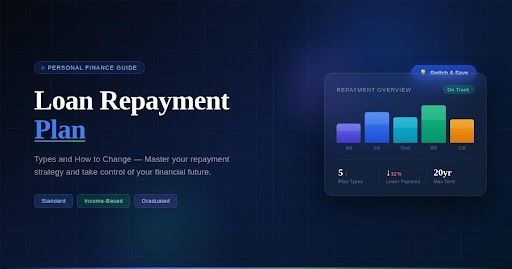
Managing debt effectively starts with choosing a repayment structure that aligns with your monthly cash flow. In the Indian lending landscape, banks and NBFCs offer several paths to becoming debt-free. Here are the most common types of loan repayment plans:
- Equated Monthly Installments (EMI): The most popular choice for home and car loans. You pay a fixed amount every month, consisting of both principal and interest, ensuring a predictable budget.
- Reducing Balance Method: Interest is calculated only on the remaining principal. As you pay off the loan, the interest component decreases, making it more cost-effective over time.
- Bullet Repayment: Common in gold loans or short-term credit, this allows you to pay only the interest periodically, while the entire principal is cleared in a single "bullet" payment at the end of the tenure.
- Graduated Repayment: Designed for young professionals, EMIs start low and increase gradually as your income grows.
- Flexible Repayment: These plans allow you to pay higher amounts when you have a surplus (like a Diwali bonus) and lower amounts during lean periods, providing a customized cushion for your finances.
Also Read: Debt Instruments: Meaning, Structure, and Types
How a Loan Repayment Plan Works - Understanding Amortization
Lenders split the total loan outstanding into smaller, fixed installments that borrowers repay over a set period. Each installment consists of a principal and an interest component. In the early and middle phases of a loan term, the interest portion is usually larger than the principal.
A borrower makes these payments every month, often called equated monthly installments (EMIs), until the principal, along with accrued interest, is fully paid. The process by which a lender determines the portion of interest and principal in each installment over the loan term is called amortization.
Lenders commonly use the following formula: EMI = [P × r × (1+r)^n] / [(1+r)^n - 1], where P is the principal, r is the monthly rate, and n is the number of months.
Example
Say Ramesh has taken a Two-Wheeler Loan
Ramesh borrows Rs. 50,000 to buy a new bike at 12% yearly interest (1% monthly) for 12 months.
Using the formula:
EMI = [50,000 × 0.01 × (1.01)¹²] / [(1.01)¹² − 1] ≈ ₹4,442/month
Here's what his first three payments look like:
| Month | EMI | Interest Paid | Balance |
|---|---|---|---|
| 1 | 4,442 | 500 | 46,058 |
| 2 | 4,442 | 461 | 42,077 |
| 3 | 4,442 | 421 | 38,056 |
Use the Interest Rate Calculator to find out the total repayment, including the principal amount and interest component.
Can You Change Your Loan Repayment Plan?
If you want to change your loan repayment plan because of financial hardship, then you have the following EMI restructuring options:
- Tenure extension
- Interest-rate reduction
- Principal deferment
Info: Good repayment history improves approval chances.
The company lays down the following eligibility criteria to qualify for the aforementioned reliefs.
- The loan has no prior long-term defaults.
- The request for restructuring should be corroborated with proof of hardship (example: salary slips, bank statements)
- The restructuring application should be submitted before missing an EMI.
Not all lenders allow prepayment, or if they do - they usually charge for it; however, most lenders allow foreclosure, subject to the completion of the initial lock-in period, if any.
Check your eligibility in minutes for a personal loan.
How to Change Your Loan Repayment Plan – Step-by-Step Process
In economic hardship, first identify your EMI relief need, like tenure extension, interest reduction, or principal deferment, then:
- Contact the lender's customer care at least 5 days before your due date. Do so before you miss an EMI.
- Submit a written request via email with supporting documents: bank statement, income-loss proof, ID/address proof, and hardship explanation.
- The lenders review your credit profile and repayment ability.
Expect 7–15 days for a hear-back. - Negotiate revised terms (e.g., lower EMI via longer tenure).
Once agreed, the lender formalizes a new repayment schedule. - Begin payments under the updated plan.
Also Read: Deferment Period in Annuity Plans: A Complete Guide
Benefits of Managing and Understanding Your Loan Repayment Plan
Understanding your loan repayment plan is an important aspect of managing your personal finances.
- Efficient budgeting: Knowing the exact EMI amount allows accurate monthly planning and budgeting.
- Interest savings: A good grasp on repayment policies and other available loan instruments creates financial awareness, which usually helps in making wiser decisions - leading to interest savings.
- Lower interest payment: Options like foreclosure of the entire loan usually lower the total interest payable.
Hero FinCorp Loan Repayment Support Services
Hero FinCorp offers multiple digital channels for loan repayment support. These digital channels intend to provide borrowers convenience for tracking, paying, and managing their EMIs.
For quick funds:
Apply for Hero FinCorp’s personal loan and get quick disbursals to meet your financial needs.
Alternatively, you can also download the Hero FinCorp Customer Service App from Google Play and App Store.
- Download on Google Play
- Download on the App Store
Use the app to track your EMIs, pay EMIs, view bounced EMI details with penalties, receive notifications and confirmations, register or switch mandates, request statements, request NOC post closure of loan, and raise service requests.
Also Read: Importance of Securing a NOC After Loan Closure
Frequently Asked Questions
Can I switch from equal EMI to flexible installments?
In many cases, yes, but it really depends on your lender’s specific policies. Some banks offer "step-up" or "step-down" plans where payments change as your income grows or stays seasonal. You’ll usually need to submit a formal request and show proof of income to prove you can handle the new structure.
Will changing my loan repayment plan impact my credit score?
Simply asking for a change doesn't hurt your score. However, if the new plan involves "restructuring" because you can’t afford the original payments, it might be flagged on your report. On the flip side, if the new plan helps you stay consistent and avoid missed payments, it’s actually the best move for your long-term credit health.
How long does it take for changes in a repayment plan to reflect?
It isn't instant. Once your application is approved, it usually takes one or two billing cycles for the new amount to show up in your account. You should keep making your original payments until you get a written confirmation that the new plan is officially live to avoid any accidental late fees.
Are there any charges involved in modifying a loan repayment plan?
Most lenders will charge a processing or administrative fee to update the legal contract and recalibrate their systems. This is often a flat fee or a small percentage of the remaining loan balance. It’s always smart to ask for an "all-in" cost estimate before you sign off on the change.
Can I extend my loan tenure through repayment plan changes?
Yes, this is a common way to lower your monthly stress. By stretching the loan over a longer period, your individual payments drop. Just keep in mind that while your monthly budget gets some breathing room, you’ll end up paying more in total interest over the life of the loan.
How do early repayments affect the loan repayment plan?
Putting extra money toward your principal usually gives you two choices: you can keep your monthly payment the same and finish the loan much faster, or you can "recast" the loan to keep the original end date but lower your monthly bill. Check your fine print for "prepayment penalties" before you make a large lump-sum payment.
Disclaimer: The information provided in this blog post is intended for informational purposes only. The content is based on research and opinions available at the time of writing. While we strive to ensure accuracy, we do not claim to be exhaustive or definitive. Readers are advised to independently verify any details mentioned here, such as specifications, features, and availability, before making any decisions. Hero FinCorp does not take responsibility for any discrepancies, inaccuracies, or changes that may occur after the publication of this blog. The choice to rely on the information presented herein is at the reader's discretion, and we recommend consulting official sources and experts for the most up-to-date and accurate information about the featured products.