Personal Loan EMI Bounce Charges: Meaning, Reasons, Charges & How to Avoid Them
- What are Personal Loan EMI Bounce Charges?
- Why Does a Personal Loan EMI Bounce?
- How are EMI Bounce Charges Applied?
- Impact of EMI Bounce on Your Loan
- How to Avoid Personal Loan EMI Bounce Charges
- What Should You Do If Your EMI Bounces?
- EMI Bounce Charges vs Late Payment Charges
- Hero FinCorp Personal Loan Repayment Support
- Best Practices for Timely Personal Loan Repayment
- Frequently Asked Questions
Salary day comes. The EMI auto-debit runs. The account does not have enough. What follows is not just a failed transaction. Personal loan EMI bounce charges kick in, sometimes penal interest too, and the credit score takes a note of what happened. This blog explains what these charges are, what triggers them, how much they typically cost, and what to do if an EMI does not go through.
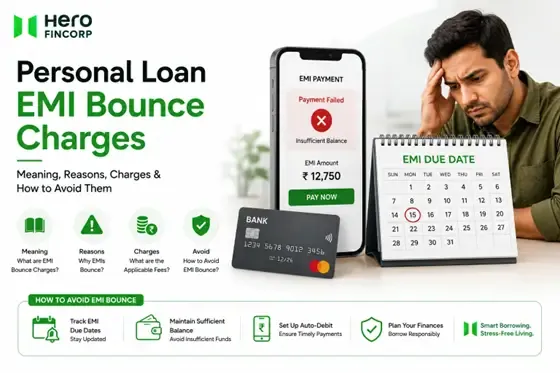
What are Personal Loan EMI Bounce Charges?
When an EMI auto-debit instruction runs and the bank cannot process it successfully, the lender treats it as a bounced payment and levies a penalty. That penalty is the personal loan EMI bounce charge.
Three terms often get confused here and they are not the same thing.
EMI bounce charge: A flat fee charged by the lender the moment a scheduled EMI fails to debit, regardless of how long it takes to repay. The charge is for the failed transaction itself.
Late payment charge: Applied when the missed EMI is not repaid within the grace period the lender defines in the loan agreement. This is time-sensitive and compounds the longer payment stays outstanding.
Penal interest: An additional interest rate applied on the overdue amount from the date of the bounce until the outstanding amount is cleared. Some lenders apply all three simultaneously. Others apply bounce charges and penal interest but not a separate late fee. The loan agreement is the only reliable source for which combination applies to a specific loan.
Why Does a Personal Loan EMI Bounce?
Most EMI check bounce situations trace back to one of these:
- Insufficient balance: Money simply is not there when the auto-debit runs. Most bounces start and end here.
- Wrong account details: One wrong digit in the account number or IFSC during NACH setup and the debit either lands nowhere or fails before processing.
- Lapsed NACH mandate: These expire quietly. Borrowers rarely notice until a bounce happens, usually after switching accounts or upgrading from a basic to a salary account.
- Closed account: Old salary account shut, new one opened, NACH still aimed at the old one. The debit fires and bounces right back.
- Debit restrictions: Some accounts have daily debit limits or restrictions on ECS transactions that block the EMI from processing
- Technical banking issues: Inter-bank system downtime, NPCI outages, or processing delays on the debit date that cause the transaction to fail at a technical level rather than a funds level
- Payment gateway failures: Digital mandate systems sometimes experience errors that result in bounced debits despite sufficient account balance
Knowing which of these caused the bounce determines how quickly it can be fixed. A balance issue has a different solution from an expired NACH mandate or a closed account.
How are EMI Bounce Charges Applied?
The bounce charge typically applies the moment the debit fails, not when the lender notifies the borrower. It is a fixed fee per bounce event rather than a percentage of the EMI amount.
Most lenders charge between Rs 200 and Rs 1,000 per bounced EMI. Some charge a flat amount regardless of loan size. Others link it to the outstanding principal or the EMI amount. The specific figure is in the schedule of charges attached to the loan agreement, not in the marketing material.
What makes a single bounce expensive is the combination of charges. The bounce fee lands immediately. If the missed EMI is not cleared within the lender-defined grace period, the late payment charge follows. Penal interest accrues from the date of the bounce on the overdue amount. On a Rs 10,000 monthly EMI, a single bounce followed by a 10-day delay can generate Rs 1,500 to Rs 2,500 in combined charges depending on the lender.
The loan agreement is the only document that shows exactly which charges apply in which sequence. Reading it before the first EMI is due avoids surprises.
Impact of EMI Bounce on Your Loan
A single bounce handled quickly is a fee. Multiple bounces handled slowly become a financial problem.
- Additional charges accumulate: Bounce fee, late payment charge, and penal interest can all run simultaneously. Each day of delay adds to the outstanding amount
- Repayment gets extended: The missed principal and interest does not disappear. It sits as an overdue amount that needs to be cleared before the loan resumes normal repayment
- Credit score impact: Every missed EMI that goes unreported for a full cycle shows up on the CIBIL report. The score drops and it does not care about the reason.
- Collection follow-ups: One missed payment brings a call. Two brings more. By the third, the process has escalated well beyond a polite reminder.
- Total borrowing cost increases: Every day of penal interest adds to the total amount that needs to be repaid. A Rs 3 lakh personal loan paid back exactly as scheduled has a certain total cost. The same loan with three bounced EMIs across the tenure costs considerably more
None of this is irreversible if acted on quickly. The damage is proportional to how long the missed payment stays unresolved.
How to Avoid Personal Loan EMI Bounce Charges
These practical steps cover the situations that cause most personal loan EMI bounce events:
- Maintain a buffer in the EMI account: Keep at least one to one-and-a-half times the monthly EMI in the account from two days before the due date. The debit typically runs on the specified date but some bank systems process it a day earlier
- Set payment reminders: Calendar alerts three days before the due date give time to transfer funds if needed
- Verify the NACH mandate is active: Check with the bank that the auto-debit instruction is live and valid, particularly after any account-level changes
- Do not close the salary account without updating the lender: Update the mandate immediately when switching accounts. The lender needs to set up a new NACH instruction, which takes time
- Keep emergency funds for EMI repayment: Three months of EMI equivalent sitting in a liquid account means a salary delay or unexpected expense does not trigger a bounce
- Monitor due dates when switching banks: Bank transitions are the single most common point at which NACH mandates Flag the EMI dates explicitly during any account migration
- Check account debit limits: Confirm the account's daily debit limit covers the EMI amount. Accounts with restrictions on ECS transactions need them removed before the mandate can process
What Should You Do If Your EMI Bounces?
- Identify the reason: Log into the bank app and check whether the failure was a balance issue, a mandate problem, or a technical error. This determines the right next step
- Arrange the funds: Transfer enough to cover the missed EMI plus the expected bounce charge before contacting anyone
- Contact the lender: Inform the lender of the bounce and the steps being taken. Early communication reduces the escalation that happens when borrowers go silent after a missed payment
- Make the missed payment promptly: Pay the overdue amount including any applicable charges as quickly as possible. Every day of delay adds to the penal interest
- Confirm successful payment: Get written confirmation from the lender that the outstanding amount has been received and the account is current
- Update the Auto-Debit instruction: If the bounce happened because of a mandate issue or an account change, get the new NACH mandate set up before the next EMI date
Timely action after a bounce significantly reduces the total cost of the event and prevents it from escalating into a collection situation or a credit score impact.
EMI Bounce Charges vs Late Payment Charges
| Factor | EMI Bounce Charge | Late Payment Charge |
|---|---|---|
| When it applies | At the moment the debit fails | After the grace period expires without payment |
| What triggers it | Failed bank transaction | Overdue EMI not paid within deadline |
| Amount | Fixed fee per bounce event | Percentage of outstanding or flat fee per day |
| Purpose | Compensates the lender for failed processing | Penalises delayed repayment |
| Can it apply together | Yes, both can apply to the same missed EMI | Yes, alongside bounce charge |
| Time-sensitive | Immediate, applies once per bounce | Increases the longer payment is delayed |
Both can apply to the same bounced EMI, which is why resolving a missed payment quickly matters as much as it does.
Hero FinCorp Personal Loan Repayment Support
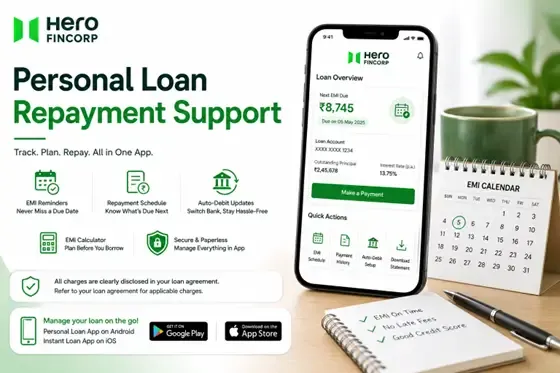
Keeping track of EMI dates, checking what is due next month, updating auto-debit instructions after switching banks. All of it runs through the Personal Loan App on Android and the Instant Loan App on iOS without calling anyone or visiting a branch.
For borrowers who want to see the monthly outflow before committing to a loan amount, the personal loan EMI calculator on Hero FinCorp's website runs the numbers across different amounts and tenures in seconds.
All applicable charges including bounce fees are disclosed in the loan agreement before signing. Borrowers managing repayment should refer to the schedule of charges in their specific loan agreement for the exact figures applicable to their loan.
Best Practices for Timely Personal Loan Repayment
Avoiding personal loan EMI bounce charges entirely is considerably easier than dealing with them after the fact. These practices keep repayments on track across the full loan tenure:
Budget the EMI as a fixed expense from day one. Treat the monthly EMI the same way rent or electricity is treated. It is not discretionary and it does not flex based on how the month goes.
Use Auto-Debit and do not turn it off. Auto-debit removes human error from the equation. The only risk is insufficient funds, which the buffer practice addresses.
Build an EMI emergency fund. Three months of EMI equivalent in a separate account means one bad salary month does not create a bounced payment.
Review repayment statements every quarter. Checking that payments are being recorded correctly catches errors before they become disputes.
Avoid taking on new credit that strains the EMI budget. A second loan or a new credit card raising total monthly obligations beyond 50% of net income is where repayments start to slip.
Notify the lender immediately when financial circumstances change. Most lenders have hardship processes that provide options before a borrower misses a payment, not after. Using these early makes outcomes considerably better.
Frequently Asked Questions
What are personal loan EMI bounce charges?
Personal loan EMI bounce charges are fees levied by the lender when a scheduled EMI auto-debit fails to process. The charge applies regardless of the reason for the bounce and is separate from any late payment fee or penal interest that may also apply.
Why are EMI bounce charges levied?
The lender incurs administrative and processing costs when a debit instruction fails. The bounce charge compensates for those costs and serves as a deterrent against repeated payment failures.
What causes a personal loan EMI to bounce?
Insufficient account balance, expired or cancelled NACH mandates, incorrect bank account details, closed accounts, daily debit limit restrictions, and technical banking or payment gateway failures are the most common causes of personal loan EMI bounce events.
How much are EMI bounce charges?
Most lenders charge between Rs 200 and Rs 1,000 per bounced EMI. The exact amount depends on the lender and the terms in the loan agreement. Some lenders link the charge to loan size, others apply a flat fee regardless of the EMI amount.
Are EMI bounce charges the same as late payment charges?
No. A bounce charge applies the moment the debit fails. A late payment charge applies when the missed EMI is not repaid within the lender-defined grace period. Both can apply to the same missed payment.
Does an EMI bounce affect my CIBIL score?
It can. Lenders report payment behaviour to credit bureaus on a regular cycle. A bounced EMI that stays unpaid beyond the reporting date can appear as a missed payment on the CIBIL report and reduce the score. Clearing the overdue amount quickly minimises the impact.
Can I avoid EMI bounce charges?
Keep enough balance in the account before the debit date, make sure the NACH mandate is active and pointed at the right account, and set a reminder a day or two before the due date. None of this is complicated. Most bounces happen because one of these three things slipped through the cracks.
What should I do if my EMI payment fails?
Figure out why it bounced first. Low balance, wrong account details, lapsed mandate. Fix that, arrange the funds including the bounce charge, and pay immediately. Then call or message the lender to let them know it has been settled. Waiting for them to follow up costs more time and sometimes more money.
Can I repay the missed EMI immediately?
Yes, and doing so quickly is the best course of action. Immediate repayment stops penal interest from accumulating and prevents the missed payment from being reported to the credit bureau as overdue.
Will I have to pay penal interest after an EMI bounce?
Most lenders apply penal interest on the overdue amount from the date of the bounce until the payment is cleared. The applicable rate is in the loan agreement's schedule of charges. This is in addition to the bounce fee and any late payment charge.
How can I check whether my EMI has bounced?
Check the bank account transaction history for the auto-debit date. An absent debit on the scheduled date confirms the bounce. Most lenders also send an SMS or email notification when a debit fails.
Can technical issues cause an EMI bounce?
Yes. System downtime at the bank, NPCI outages, or payment gateway failures can cause a debit to fail even with sufficient balance in the account. These bounce charges may sometimes be waivable on evidence that the failure was technical rather than due to insufficient funds. Contact the lender directly in these cases.
What happens if my EMI bounces multiple times?
Repeated bounces accumulate charges, damage the credit score, increase total borrowing cost, and can lead to escalated collection activity. Multiple missed payments may eventually affect loan account classification and make future credit access harder.
Can I change my Auto-Debit bank account?
Yes. Contact the lender to initiate the NACH mandate update process. The new mandate needs to be set up and activated before the existing mandate is cancelled to avoid a gap that could cause a missed payment.
How can I update my NACH mandate?
Submit a fresh NACH mandate form with the new bank details to the lender. The activation process typically takes a few working days. Time the switch to complete well before the next EMI date.
Do all lenders charge EMI bounce fees?
Most regulated lenders in India levy some form of bounce charge. The amount and structure vary. All charges must be disclosed in the loan agreement before signing under RBI guidelines.
Can EMI bounce charges be waived?
Some lenders consider waiver requests on a case-by-case basis, particularly for first-time bounces, documented technical failures, or long-standing customers with a clean repayment record before the event. There is no guarantee, and the decision rests entirely with the lender.
Disclaimer: The information provided in this blog post is intended for informational purposes only. The content is based on research and opinions available at the time of writing. While we strive to ensure accuracy, we do not claim to be exhaustive or definitive. Readers are advised to independently verify any details mentioned here, such as specifications, features, and availability, before making any decisions. Hero FinCorp does not take responsibility for any discrepancies, inaccuracies, or changes that may occur after the publication of this blog. The choice to rely on the information presented herein is at the reader's discretion, and we recommend consulting official sources and experts for the most up-to-date and accurate information about the featured products.