Refinance Loan: How It Works, Benefits, Types
- What Is a Refinance Loan?
- How Does Loan Refinancing Work?
- Types of Refinancing
- Example of Refinancing
- Benefits of Refinancing a Loan
- When Should You Consider Refinancing a Loan?
- Documents Required for Loan Refinancing
- Refinance Loan vs Personal Loan
- How to Calculate Savings from Loan Refinancing?
- Make Sure Refinancing Works for You
- Frequently Asked Questions
Your loan may have worked well when you took it, but your finances may have changed. A better rate, stronger credit profile, or a difficult EMI may make you look for a new option. Refinancing can replace your existing loan with terms that better fit your needs. This guide explains how it works, when it helps, and how to check savings.
What Is a Refinance Loan?
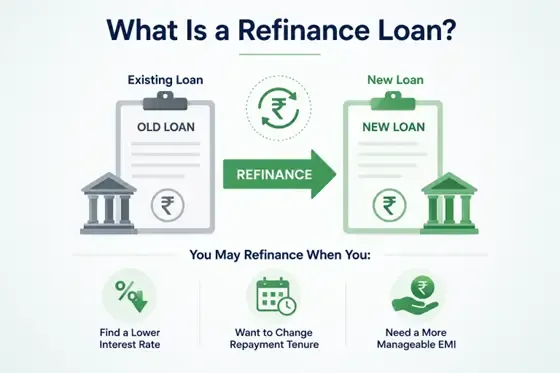
A refinance loan replaces your existing loan with a new loan. You may refinance when you find a lower interest rate, want to change your repayment tenure, or need a more manageable EMI.
However, a lower EMI does not always mean you will save money. Before switching, compare your outstanding loan balance, current and new interest rates, remaining tenure, and all applicable charges.
How Does Loan Refinancing Work?
Before you refinance, look at what you still owe on your current loan, then compare it with the new loan offer. This will help you check if switching can save you money.
- Check your current loan: Review details like the outstanding balance, interest rate, and remaining tenure.
- Compare new loan offers: See whether switching to a new loan can save you money. Review the interest rate, EMI, eligibility, and tenure of the new loan.
- Check the charges: Find out about processing fees, foreclosure charges, transfer fees, and any other applicable costs.
- Apply for the new loan: Submit the required documents and complete the lender's verification process.
- Settle your existing loan: Once the new loan gets approved, use the funds to repay your existing loan, depending on the refinancing arrangement.
Before making the switch, compare the total amount you will repay under both loans. A lower EMI may look attractive, but the new loan should also reduce your overall borrowing cost.
Also Read: What Is a Loan Modification and How Does It Work?
Types of Refinancing
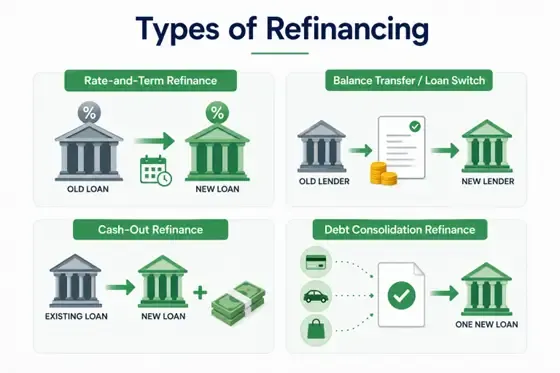
Refinancing can take different forms. Your loan type, financial goal, lender, and available security will determine which option applies to you.
Rate-and-Term Refinance
You replace the existing loan to get a lower rate or a different tenure. The new loan amount usually stays close to the outstanding balance. A longer tenure can lower your EMI, but it can also increase total interest.
Balance Transfer / Loan Switch
You move your outstanding loan to another lender that offers better terms. Check the new rate against transfer and processing charges. The expected saving should justify the cost of moving the loan.
Cash-Out Refinance
You refinance for more than the outstanding balance and use the extra amount for another financial need. Lenders may offer this option against eligible security. Availability and terms vary by lender and loan product.
Consolidation Refinance
You combine multiple loans or dues into one new loan. One EMI can make repayment easier to track. However, compare the new interest rate and total repayment before combining your debts.
Example of Refinancing
Suppose you have ₹3,00,000 outstanding for 24 months at 17.9% and receive an offer at 15% for the same tenure.
Existing loan:
EMI: ₹14,963
Interest: ₹59,106
New loan:
EMI: ₹14,546
Interest: ₹49,104
Interest saving: ₹10,002
Switching charges: ₹8,000
Net saving: ₹2,002
This example is illustrative. Your actual saving will depend on your loan terms and applicable charges. Use an EMI calculator before deciding.
Benefits of Refinancing a Loan
Refinancing can help when the new loan offers terms that better fit your finances. The actual benefit depends on the rate, tenure, outstanding balance, and switching costs.
Potentially Lower Interest Rate
A lower rate can reduce the interest you pay on the remaining balance. You benefit only when the interest saving exceeds the refinancing costs.
Lower EMI
A lower rate can reduce your monthly EMI. A longer tenure can also reduce the EMI, but you may pay more interest overall.
Flexible Repayment Tenure
A new tenure can better match your current repayment capacity. A shorter tenure can reduce interest, while a longer one can make monthly payments easier.
Better Loan Terms
A new lender may offer terms that suit your current financial position better. Compare the complete offer instead of focusing only on the interest rate.
When Should You Consider Refinancing a Loan?
You may consider refinancing when your current rate looks high, your credit profile has improved, or another lender offers better terms. It may also help if your EMI has become difficult to manage or you want to restructure repayment. Check the remaining interest and switching costs first.
Documents Required for Loan Refinancing
Depending on the lender and loan type, you may need the following documents:
- PAN and Aadhaar or other KYC documents
- Income proof
- Bank statements
- Existing loan statement
- Repayment details
Refinance Loan vs Personal Loan
These two options serve different purposes. Refinancing changes existing borrowing, while a personal loan provides fresh funds for a new requirement.
| Factor | Refinance Loan | Personal loan |
|---|---|---|
| Purpose | Replace existing borrowing | Fund a new need |
| Existing loan | Usually required | Not required |
| Collateral | Depends on loan type | Usually unsecured |
| Interest | Based on new terms | Based on lender and profile |
| Tenure | Revised under new loan | Based on loan offer |
| Charges | Switching costs may apply | Processing charges may apply |
| Use case | Restructure existing debt | Meet a fresh expense |
Neither option works better for every borrower. Your financial need should guide the choice.
How to Calculate Savings from Loan Refinancing?
Compare the figures that affect your total cost:
Existing cost = Remaining EMI × number of remaining EMIs
New cost = New EMI × new tenure
Potential saving = Existing cost − New cost − switching charges
An EMI calculator can help you compare different rates and tenures. Focus on the total cost, not just the lower EMI.
Make Sure Refinancing Works for You
Refinancing can lower your interest cost, reduce your EMI, or give you a repayment tenure that better suits your budget. However, the switch should make financial sense after you account for all applicable charges.
Compare both loans, use an EMI calculator, and review the terms before deciding. If you are considering a new Personal Loan, check your eligibility through the Hero FinCorp Instant Personal Loan App and explore your available options online.
Frequently Asked Questions
Why should I refinance my loan?
You may refinance to seek a lower rate, reduce your EMI, change the tenure, or get terms that better suit your current finances.
Can refinancing reduce my EMI?
Yes. A lower rate or longer tenure can reduce your EMI. However, a longer tenure can increase your total interest.
Can I refinance a Personal Loan?
You can refinance a personal loan if the lender offers the facility and you meet its eligibility requirements.
Is refinancing the same as a loan transfer?
A balance transfer moves your outstanding loan to another lender. Refinancing can also change the loan amount, rate, or tenure.
Is refinancing always beneficial?
No. Compare your expected interest savings with every applicable switching cost before deciding.
What charges apply when refinancing a loan?
Processing, foreclosure, transfer, documentation, and other applicable charges may apply. Check the lender's current fee schedule before switching. Hero FinCorp offers a minimum 2.5% plus GST processing fee and foreclosure charges of up to 5% plus GST on the outstanding principal for its personal loans.
Does credit score affect refinance loan eligibility?
Yes. Lenders may consider your credit score, repayment history, income, and existing obligations when assessing your application.
How can I calculate whether refinancing will save money?
Compare the remaining cost of your current loan with the total cost of the new loan, including applicable charges. The difference shows your potential savings.
Disclaimer: The information provided in this blog post is intended for informational purposes only. The content is based on research and opinions available at the time of writing. While we strive to ensure accuracy, we do not claim to be exhaustive or definitive. Readers are advised to independently verify any details mentioned here, such as specifications, features, and availability, before making any decisions. Hero FinCorp does not take responsibility for any discrepancies, inaccuracies, or changes that may occur after the publication of this blog. The choice to rely on the information presented herein is at the reader's discretion, and we recommend consulting official sources and experts for the most up-to-date and accurate information about the featured products.