Personal Loan Rejection Reasons: Why Your Loan Was Declined

Getting a rejection after waiting days for an answer is frustrating enough. Getting one with no real explanation makes it worse. Banks rarely tell borrowers the actual reason.
Most people receive a vague automated message and are left guessing what went wrong.
Personal loan rejection reasons are almost always predictable, though.
Lenders follow internal checklists, and most rejections trace back to a handful of the same issues. Knowing which one applies makes fixing it considerably more straightforward.
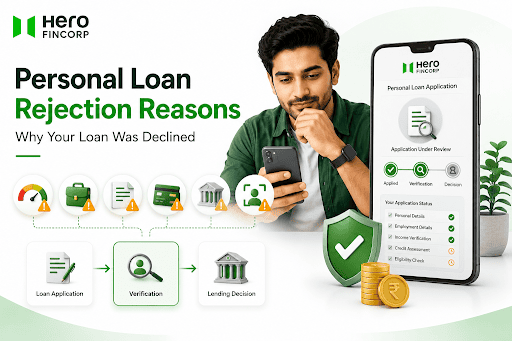
Common Reasons for Personal Loan Rejection
Lenders evaluate more than just the credit score. Income stability, existing debt load, and whether documents match across the application all feed into the final decision. These are the common reasons for personal loan rejection that show up most frequently:
Low Credit Score and Its Impact
Below 700 to 720 on the CIBIL scale, many applications never reach a human reviewer at all. An automated filter catches them first.
Several things push a score into that range:
- Missed or delayed EMI payments are sitting on the credit report
- Credit card dues left unpaid across multiple billing cycles
- Utilisation consistently above 30% of the total available card limit
- A loan that was settled rather than fully repaid
Any of these on the report answers why my personal loan was rejected for a large number of borrowers. The score is a symptom of past behaviour, and changing it takes consistent action over several months, not a quick fix.
Multiple Loan Applications and Hard Enquiries
Applying to several lenders at once feels logical when funds are urgently needed. What it does to the credit file is a different story.
Each application pulls a hard enquiry onto the report. Four or five of those in a single month sit there simultaneously and tell every lender reviewing the file the same thing: this person is applying everywhere. That signal alone is one of the reasons for personal loan rejection that borrowers rarely connect back to their own actions until it is flagged.
High Debt-to-Income Ratio (FOIR)
A high debt-to-income ratio causes rejections even for applicants whose credit score looks perfectly healthy.
FOIR calculates what percentage of monthly income is already committed to running EMIs. Add a new loan on top of a FOIR that already sits at 45%, and the total crosses the 50% ceiling that most lenders apply.
The application fails not because of credit history but because the numbers on repayment capacity simply do not work. This is one of the more overlooked common reasons for personal loan rejection across income groups.
Employment and Income Criteria
Why a personal loan was declined has nothing to do with credit score in many cases. The employer category, how long someone has held the current role, and whether the salary shows up consistently in bank statements all sit on the lender's checklist.
Lenders specifically scrutinise:
- Whether the company falls into their approved or unapproved employer list
- Salary continuity without gaps or sudden drops in recent months
- ITR filing for self-employed applicants showing declared income
- Length of time in the current role, with shorter tenures attracting more scrutiny
Someone who has changed employers three times in two years, regardless of income level, looks unstable across a 48-month repayment horizon.
Documentation Issues and Age Restrictions
Incorrect or missing documents are a straightforward cause of personal loan rejection that has nothing to do with the financial profile.
Watch for these specifically:
- Name spelt differently across PAN, Aadhaar, and bank account records
- Address proof showing a previous residence that does not match the application
- Bank statements are missing months or showing irregular formats
- Salary slips from the wrong period or are missing the employer stamp
Age matters too. Applications from borrowers close to 58 years requesting long tenures often get rejected at the eligibility filter before a single document is reviewed.
How to Avoid Rejection of Personal Loan Application

Knowing what caused a rejection is useful. Knowing what to do about it before the next application is more useful.
Here is how to avoid rejection of a personal loan application against each specific trigger:
Maintain a Good Credit Score
Start by pulling the actual credit report rather than just the score. RBI has encouraged lenders to share clearer reasons for rejection, and credit data is now updated more frequently. Use this to understand what went wrong in your case.
Then work through the basics:
- Every EMI and credit card bill is paid on or before the due date, without exception
- Credit card balances brought below 30% of the card limit and stayed there
- Old credit accounts left open since they contribute positively to the length of the history
- At least three to six months of clean behaviour on the report before applying again
None of that is complicated. It just requires consistency across enough billing cycles for the score to reflect the change. Check your Hero FinCorp personal loan eligibility here once the score has improved to see what is available.
Limit Loan Applications and Hard Inquiries
Ninety days between applications is the minimum worth sticking to. Before formally applying anywhere, use soft eligibility check tools that read the credit profile without registering a hard inquiry on the report.
One or two applications to lenders where eligibility clearly matches beats ten applications sent simultaneously, hoping something sticks. The Hero Digital Lending App on Google Play and the App Store lets borrowers check eligibility without triggering a hard pull on the credit report.
Ensure Stable Employment and Income
Six months in the current role is the floor. Twelve months is considerably better. Applicants with higher and more stable incomes face lower rejection rates.
If a salary increase happened recently, it needs to show in the last three months of salary slips and bank statement credits before it carries any weight in a lender's assessment. A verbal claim of higher income without matching documentation does not move the application forward.
Submit Complete and Accurate Documents
Work through the document checklist the lender publishes rather than assuming what is needed. Check every document for:
- Exact name matching across PAN, Aadhaar, bank account, and the application form
- Address proof reflecting the current residence stated in the application
- Three consecutive months of salary slips without gaps
- Six months of bank statements showing regular salary credits on consistent dates
A name spelt one way on Aadhaar and slightly differently on a bank statement has caused rejections on applications where the income, score, and employment profile were all strong. Cross-checking takes under ten minutes and removes that risk entirely.
Understanding the Importance of Your Credit Profile
The score is one number. The profile behind it tells a longer story, and experienced lenders read both.
What sits inside the credit profile:
- How long the credit history runs, with older accounts weighted more heavily
- The variety of credit types across secured and unsecured products
- Repayment consistency across every active account without exception
- How recently has any default, settlement, or serious delay occurred
A pattern of late payments, defaults, or high utilisation signals risk to the lender and results in either rejection or approval on terms considerably worse than the borrower expected.
Borrowers who get approved on the first attempt have almost always spent several months before applying, making sure the profile matches what their target lender wants to see.
That preparation is not obvious from the outside, but it is the difference between a clean first approval and a string of rejections.
Conclusion
Personal loan rejection reasons point to a specific action every time. A low score, a high FOIR, an employment gap, and a mismatched document each have a clear resolution path.
Fix the right thing, allow enough time for the credit profile to reflect that fix, and the next application starts from a fundamentally stronger position. Check your Hero FinCorp personal loan eligibility here when the profile is ready.
Frequently Asked Questions
Can a personal loan be rejected despite having a high credit score?
Yes. A 750+ score helps, but lenders assess income stability, existing debt, and documentation accuracy alongside it. A high FOIR or a name mismatch in documents can still result in rejection.
How long should I wait before reapplying after a loan rejection?
At least 90 days, long enough for the hard enquiry to age on the report and for whatever caused the rejection to be genuinely addressed before the next attempt.
Does settling a previous loan affect new personal loan applications?
A settled account tells the lender the borrower did not repay the full agreed amount. It sits on the credit report as a negative marker for years and factors into rejection decisions well after the original settlement date.
Can discrepancies in KYC documents cause loan rejection?
Name mismatches between PAN and Aadhaar or address proof showing an old residence get flagged at document verification before the credit file is even opened. These are direct personal loan rejection reasons entirely unrelated to financial profile.
Does applying for multiple loans increase the chance of rejection?
Each application registers a hard enquiry and multiple enquiries in a short period signal financial desperation to any lender reviewing the file. Spacing out applications and running soft eligibility checks first cuts that risk significantly.
Will being on probation affect my personal loan approval?
Most lenders require at least six completed months of employment before approving a loan. Probationary status signals income uncertainty across the full repayment tenure, which is one of the quieter reasons for personal loan rejection for people who have recently changed roles.
Disclaimer: The information provided in this blog post is intended for informational purposes only. The content is based on research and opinions available at the time of writing. While we strive to ensure accuracy, we do not claim to be exhaustive or definitive. Readers are advised to independently verify any details mentioned here, such as specifications, features, and availability, before making any decisions. Hero FinCorp does not take responsibility for any discrepancies, inaccuracies, or changes that may occur after the publication of this blog. The choice to rely on the information presented herein is at the reader's discretion, and we recommend consulting official sources and experts for the most up-to-date and accurate information about the featured products.