What is the Effect of Closing a Credit Card on Credit Score?
- Making an Informed Decision About Closing Your Credit Card
- The Direct Impact: How Closing a Credit Card Affects CIBIL Score
- When to Consider Closing a Credit Card (And When Not To)
- How to Safely Close Your Credit Card (If You Must)
- Monitoring Your CIBIL Score After Closing a Credit Card
- Pause and Review Before You Close
- Frequently Asked Questions
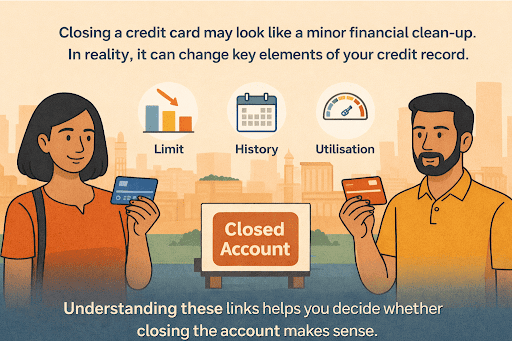
Closing a credit card may look like a minor financial clean-up. In reality, it can change key elements of your credit record.
Your available limit, account history, and utilisation ratio are all connected to active cards. Understanding these links helps you decide whether closing the account makes sense.
Making an Informed Decision About Closing Your Credit Card
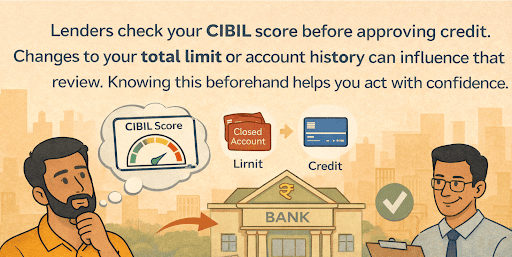
Lenders check your CIBIL score before approving credit. Changes to your total limit or account history can influence that review. Knowing this beforehand helps you act with confidence.
The Direct Impact: How Closing a Credit Card Affects CIBIL Score
Here is how closing a credit card affects CIBIL:
- Credit utilisation may increase: When you close a credit card, your total available credit limit reduces. If your outstanding balance remains the same, your credit utilisation ratio rises, and a higher ratio can lower your CIBIL score
- Average age of accounts may reduce: Closing an older card can shorten your overall credit history. A longer history is generally viewed positively in credit scoring
- Credit mix may change: If you have only a few accounts, closing a credit card can slightly reduce the mix in your credit profile
1. Credit Utilisation Ratio (CUR): The Immediate Effect
Your credit utilisation ratio shows how much of your total limit you use. Ideally, it should stay below 30%. When you close a credit card, your overall credit limit reduces. If your outstanding balance does not change, your utilisation percentage increases.
For instance, if your combined credit limit is ₹1,00,000 and you have used ₹20,000, your utilisation is 20%. If you close one card and the limit drops to ₹50,000, the same ₹20,000 balance raises your utilisation to 40%.
2. Length of Credit History: Old Accounts Matter
The length of credit history reflects how long your credit accounts have been active. If you close an older credit card, your average age of accounts can reduce. While the closed account may continue to appear on your report for some time, keeping a long-standing card active generally supports a stronger credit profile.
3. Credit Mix: Diversity in Your Credit Portfolio
Your credit mix refers to the different types of credit accounts in your report, such as credit cards and loans. When you close a credit card, the number of revolving accounts decreases. While this element matters less than utilisation or credit history, it can still have a minor effect on your score.
When to Consider Closing a Credit Card (And When Not To)
Look at the card’s fee, its age, and how much it adds to your available credit before moving ahead.
Reasons to Close Your Credit Card
You may decide to close a card in situations such as:
- The yearly charges outweigh the benefits you receive
- Easy access to credit is encouraging overspending
- Overlapping cards with similar features and no real advantage
- Ongoing difficulty controlling usage
When It’s Better to Keep Your Card Open
Keeping the card active may make more sense if:
- It is your oldest credit card and supports your credit history length
- You want to continue maintaining credit limit and keep utilisation lower
- The card carries no annual fee
- You use it occasionally and clear dues on time
Alternatives to Closing Your Credit Card
Before cancelling, consider practical alternatives to closing credit card accounts. You could:
- Downgrade to a lower-fee version
- Convert outstanding dues into EMIs
- Use a balance transfer option
- Keep the card active with limited use
Downgrading to a No-Annual-Fee Card
Ask your issuer about a product change credit card option. Many banks allow you to switch to a no annual fee credit card without closing the account.
Debt Management and Consolidating Balances
You can convert balances into EMIs or move dues to a balance transfer credit card offering lower interest. Managing the balance while keeping the account active often supports your credit score better than immediate closure.
How to Safely Close Your Credit Card (If You Must)
Mistakes during closure can create issues in your credit report. To close a credit card safely, clear the entire outstanding balance, including any unbilled transactions that may appear in the next cycle.
Redeem any reward points and remove auto-debits linked to the card. After placing the request, ask the issuer for written confirmation that the account has been closed at your request.
Step-by-Step Guide for Card Closure
Use this simple cancel credit card process:
- Redeem available rewards or cashback
- Pay the complete outstanding balance
- Submit a closure request through customer care or a written application
- Collect written confirmation of closure
- Review your credit report after 30–45 days to confirm the status shows “closed”
Monitoring Your CIBIL Score After Closing a Credit Card
After the account is closed, continue to monitor CIBIL score updates. The CIBIL score after closing a credit card may change if your utilisation ratio increases or your credit history reduces.
Check your credit report to confirm the account is marked as “closed” and not “settled”. Keep utilisation low on active cards and pay dues on time to support your score.
If you are planning to apply for credit soon, it helps to review your eligibility beforehand. You can explore financing options directly through the Hero FinCorp personal loan app on Android and iOS to check eligibility and apply digitally.
Pause and Review Before You Close
Closing a credit card can change your credit utilisation, shorten your credit history, and influence your overall CIBIL score. Reviewing your total limits, account age, and repayment track record helps you decide.
With Hero FinCorp's personal loan options, the process can take around 10 minutes. You can also check your eligibility in advance using the personal loan eligibility calculator.
Frequently Asked Questions
How long does a closed credit card account stay on my CIBIL report?
A closed credit card account generally remains on your CIBIL report for up to 7–10 years.
Can I reopen a credit card once it's closed?
In some cases, issuers may allow reopening within a limited time after closure. However, this is not guaranteed and depends on the bank’s policy.
Does closing multiple credit cards simultaneously have a worse impact?
Closing multiple cards at once reduces your total credit limit and may sharply increase your credit utilisation ratio.
Will my credit card rewards be forfeited if I close the card?
In most cases, unused reward points or cashback is forfeited once the card is closed.
What if my credit card has an outstanding balance when I close it?
Leaving dues unpaid can lead to negative reporting and damage your credit score.
How often should I check my CIBIL score if I close a credit card?
Check your CIBIL score within 30–45 days after closure.
Disclaimer: The information provided in this blog post is intended for informational purposes only. The content is based on research and opinions available at the time of writing. While we strive to ensure accuracy, we do not claim to be exhaustive or definitive. Readers are advised to independently verify any details mentioned here, such as specifications, features, and availability, before making any decisions. Hero FinCorp does not take responsibility for any discrepancies, inaccuracies, or changes that may occur after the publication of this blog. The choice to rely on the information presented herein is at the reader's discretion, and we recommend consulting official sources and experts for the most up-to-date and accurate information about the featured products.