Difference Between Microfinance and Microcredit
- What are Microfinance and Microcredit?
- Microfinance VS Microcredit: Key Difference
- Microcredit - A Focused Loan Product
- Microfinance - A Comprehensive Financial Ecosystem
- Services Included in Microfinance Beyond Loans
- Users of Microcredit and Microfinance
- Microcredit Loan Delivery Models
- Service Providers for Microfinance Schemes
- Significance and Effectiveness of Microfinance Programs
- Frequently Asked Questions
The economy of India is developing; yet, financial inclusion has taken on immense importance. Financial services can help people, small businesses, and corporations when they need urgent funds.
Here is an example:
Sunita, a tailor living in a small village in Jaipur, required ₹15,000 to buy a sewing machine for her business. She applied for a small loan from a microcredit service.
Ramesh, who already owned an established textile business in Lucknow, also obtained a business loan and insurance services from a bank.
Although both benefited from a financial service, their conditions reveal two distinct aspects: microcredit vs. microfinance.
Understanding these financial instruments can help small entrepreneurs and low-income people in India.
What are Microfinance and Microcredit?
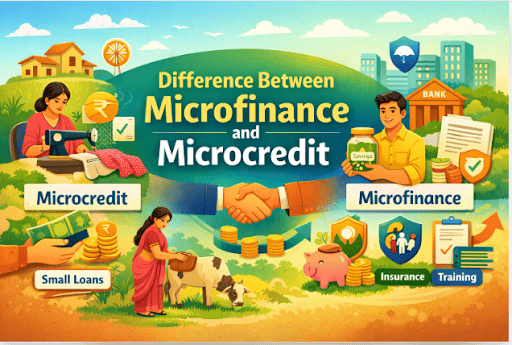
Microcredit is a small loan provided to low-income people or small-scale entrepreneurs who don't have access or may not want to refer to conventional financial institutions such as banks. This loan can help them generate profits and cover their personal expenses.
Microfinance, regulated by the RBI, is a broad concept that encompasses a range of financial products beyond loans.
Thus,
- Microcredit helps in offering small loans.
- Microfinance encompasses the entire financial system, including small loans, savings, insurance, and financial literacy training.
Both help in accessing financial facilities.
Also Read: 15 Small Business Ideas With Low Investment
Microfinance VS Microcredit: Key Difference
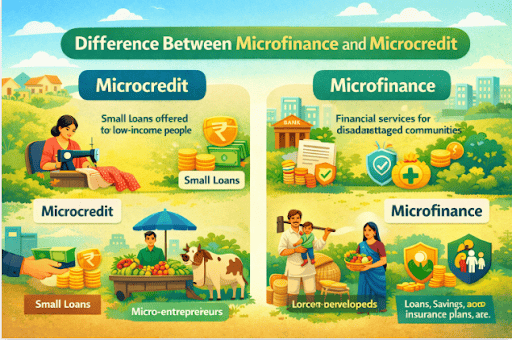
Here is the difference between microfinance and micro credit:
| Parameter | Microcredit | Microfinance |
|---|---|---|
| Definition | Small loans offered to low-income people | Broader scope of financial services offered to disadvantaged communities |
| Scope | Offer limited services of credit and loans | Offer credit, savings, insurance and other financial services |
| Goal | Provide loans for small businesses or livelihood | Ensure financial inclusion |
| Financial Services | Offer lending services | Offer loan, savings, insurance, and financial advise services |
| Target Beneficiaries | Micro-entrepreneurs and low-income groups | Low-income households, and those not receiving any financial services |
| Examples | Working capital loans | Loans, savings accounts, insurance plans, etc. |
Microcredit - A Focused Loan Product
Microcredit offers small loans to people who lack access to financial and banking systems or who may not wish to use them. These loans are:
- Small in value
- Short-term in duration
- Used for income-generating activities
For instance, microcredit can assist people to:
- Establish a retail business
- Buy machinery for a business at home
- Invest in agricultural supplies
- Grow their small businesses
Microfinance - A Comprehensive Financial Ecosystem
Microfinance offers several financial services that enhance long-term financial stability.
Microfinance institutions could provide:
- Microcredit facilities
- Savings facilities
- Insurance facilities
- Financial literacy training
- Business counseling
It helps people handle finances better and integrate them into the formal financial sector.
Services Included in Microfinance Beyond Loans
The distinction between microfinance and microcredit lies in the fact that microfinance encompasses more than just microcredit in the form of other financial services, such as:
- Saving schemes for poor people
- Microinsurance for protection from various risks
- Money management programs teach people how to manage their finances better
- Retirement savings schemes
- Small business advisory services
Users of Microcredit and Microfinance
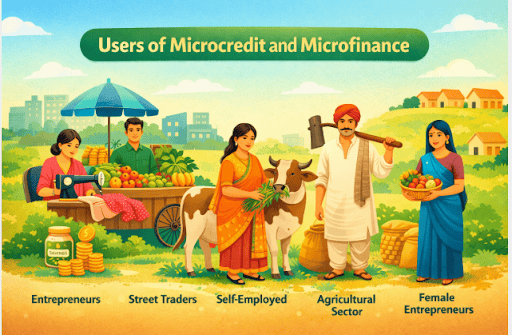
The users of microcredit vs microfinance include:
- Entrepreneurs operating at a small scale
- Traders working on the streets
- Self-employed individuals
- People from the agriculture sector
- Female entrepreneurs from rural areas
For instance, a small-time dairy farmer can utilize microcredit for buying livestock, and microfinancing may provide other facilities like insurance for safeguarding their income.
Microcredit Loan Delivery Models
Microcredit is about offering various loan schemes and enhancing repayment ratios.
Some microcredit loan schemes include:
Group Lending
A number of borrowers provide mutual guarantees for each other's loans.
Individual Lending
The borrowers receive loans individually, depending on their credibility and ability to repay.
Self-Help Group Lending
The borrowers form a community group and borrow funds jointly.
Service Providers for Microfinance Schemes
Microfinance services are provided by:
- MFIs
- Banks/NBFCs
- Self Help Groups or SHGs
- NGOs
Some factors that borrowers must consider before selecting a microfinance organisation are:
- Interest rates
- Repayments
- Transparency in fees and charges
- Eligibility requirements for loans
- Support systems for clients
- Compliance
Reputable financial firms abide by the rules laid out by regulators.
Also Read: What Is Personal Financial Management (PFM)?
Significance and Effectiveness of Microfinance Programs
Microfinance programs have been very effective in achieving financial inclusion in India.
They facilitate:
- Enhanced accessibility to financial instruments
- Entrepreneurship development among poor populations
- Better income-earning prospects
- Favourable savings culture
- Economic development in rural and small-scale enterprises
With the help of microfinance programs that make finance more accessible, people can engage better in economic development activities.
To find suitable financial solutions, try the personal loan journey on Hero FinCorp’s instant personal loan site.
One may also use the Hero FinCorp Digital Lending Application Android/iOS for managing their loan application process effectively.
Also Read: Financial Planning for Multiple Goals on Limited Income
Frequently Asked Questions
What is the difference between microfinance and micro credit?
Microcredit means loan financing to people who lack access to formal financial institutions. Microfinance offers other financial services like savings, financial advise, and insurance.
Do all microfinance institutions offer other services like savings and insurance?
Yes, many offer these services, but they may differ depending on the provider.
Is a microloan limited to use for business purposes only?
Microloans can be used for income-generating and also for fulfilling personal needs.
What is group lending, and what does it do?
It involves small loan groups that provide surety to one another's loans for minimising defaults and risks, and improving repayment.
Which type of charges do microloans incur?
They include interest rates, processing charges, and administrative costs.
How does microfinance help promote financial inclusion?
It provides access to financial services regardless of the lack of access to traditional banking services.
Disclaimer: The information provided in this blog post is intended for informational purposes only. The content is based on research and opinions available at the time of writing. While we strive to ensure accuracy, we do not claim to be exhaustive or definitive. Readers are advised to independently verify any details mentioned here, such as specifications, features, and availability, before making any decisions. Hero FinCorp does not take responsibility for any discrepancies, inaccuracies, or changes that may occur after the publication of this blog. The choice to rely on the information presented herein is at the reader's discretion, and we recommend consulting official sources and experts for the most up-to-date and accurate information about the featured products.