ACH Mandate: Full Form, Meaning & Benefits

- What Is an ACH Mandate?
- How Does an ACH Mandate Work in India?
- Types of ACH Transfers: ACH Debit vs ACH Credit
- Features and Benefits of ACH Mandate
- ACH Mandate vs ECS: Key Differences
- E-Mandate vs ACH Mandate: What Is the Difference?
- Common Uses of ACH Mandate in India
- How to Set Up, Modify, or Cancel an ACH Mandate?
- Make Recurring Payments Simpler
- Frequently Asked Questions
Your loan EMI reaches the lender on time every month. Your insurance premium gets paid without any reminders. Even your SIP continues without any extra effort from your side. Most people enjoy this convenience but rarely stop to think about what keeps these payments running smoothly.
The answer is an ACH mandate. Don't know about the process? This blog will educate you on the ACH mandate in depth and make you even more confident.
What Is an ACH Mandate?
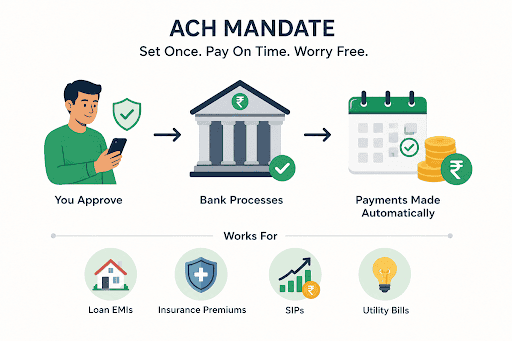
An ACH mandate authorizes your bank to process recurring payments on your behalf. After you approve it, the bank automatically pays your EMIs, insurance premiums, or investment installments on the due date. You stay worry-free while your payments stay on track.
How Does an ACH Mandate Work in India?
An ACH mandate follows a simple process from registration to payment. Although banks use secure systems in the background, the steps remain easy for every borrower to understand.
Step 1: You give your approval
You authorize your bank to debit a fixed or variable amount from your account. You can complete this either by paper form or via an online mandate.
Step 2: The mandate gets verified
Your bank verifies the account details and forwards the request through the NACH system.
Step 3: The mandate becomes active
After successful verification, the mandate becomes active. The lender receives confirmation that future collections can begin.
Step 4: The payment gets deducted
On every due date, the bank deducts the approved amount from your account and transfers it to the authorized organization.
Step 5: Records stay updated
The bank records every successful transaction. You can also view these payments in your bank statement or loan account whenever required.
Types of ACH Transfers: ACH Debit vs ACH Credit
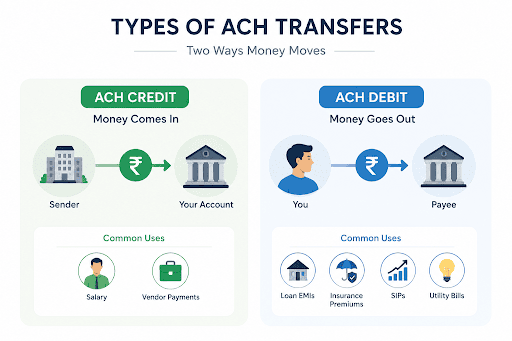
ACH transfers work in two different ways. The difference depends on whether money leaves or enters your account.
ACH Credit: What It Means and When It Is Used
An ACH credit moves money into another account after the sender starts the transaction. Employers often use it to pay salaries, while businesses use it to transfer vendor payments. The account holder controls when the payment begins.
ACH Debit: What It Means and When It Is Used
An ACH debit comes into action when you allow your bank to make recurring payments from your account. The bank then deducts the approved amount on every due date. This method works well for loan EMIs, insurance premiums, SIPs, and other regular bills.
Features and Benefits of ACH Mandate
An ACH mandate does more than automate payments. It also helps you manage recurring payments with fewer mistakes and less effort.
| Features | Benefits |
|---|---|
| Automatic payment | Reduces the chance of missing due dates |
| One-time authorisation | Removes the need to pay manually every month |
| Secure banking process | Protects payment instructions through authorised banking channels |
| Digital tracking | Makes it easy to check payment history and records |
ACH Mandate vs ECS: Key Differences
Both ACH and ECS support recurring payments, but banks now prefer the NACH-based ACH system because it offers faster processing and wider coverage.
| ACH Mandate | ECS |
|---|---|
| Uses the NACH platform | Uses the older ECS network |
| Covers banks across India | Works in selected locations |
| Processes payments faster | Takes comparatively longer |
| Supports better digital management | Offers limited digital features |
E-Mandate vs ACH Mandate: What Is the Difference?
Two things happen when you choose auto debit. First, you give your bank permission to collect money from your account. This is called an e-mandate. After that, the bank uses an ACH mandate to collect the approved amount on every due date.
The difference is simple. An e-mandate records your approval, while an ACH mandate helps the bank carry out that instruction. Both work together to keep recurring payments smooth and on time.
Common Uses of ACH Mandate in India
You may already be using an ACH mandate without realizing it. Banks and financial institutions rely on it for several recurring payments.
Loan EMI Auto-Debit
Your lender collects the monthly EMI directly from your bank account on the due date.
SIP and Mutual Fund Investments
Investment companies deduct the selected amount automatically every month.
Insurance Premium Payments
Insurance providers collect premiums on schedule, helping you keep your policy active.
Utility and Subscription Billing
Electricity bills, broadband charges, OTT subscriptions, and similar services use automatic deductions for timely payments.
How to Set Up, Modify, or Cancel an ACH Mandate?
Banks keep the process simple. You can create a mandate while applying for a loan, opening an investment account, or signing up for another recurring payment. Most lenders also allow online registration through internet banking or net banking.
If you want to change your bank account, payment amount, or due date, submit a request to modify. To stop future deductions, raise a cancellation request with your bank or service provider. Always wait for confirmation before assuming the mandate has ended.
Make Recurring Payments Simpler
An ACH mandate removes the hassle of making the same payment every month. Once you understand how it works, you can manage your EMIs and other recurring payments with greater confidence.
If you're planning to borrow, Hero FinCorp makes the journey just as easy. Check your eligibility online, apply through the personal loan app, and manage your repayments with confidence from one place.
Frequently Asked Questions
What is the full form of ACH in banking?
ACH stands for Automated Clearing House.
What is the difference between an ACH mandate and an NACH mandate?
In India, banks process ACH mandates through the NACH platform managed by NPCI.
Are there any charges for an ACH mandate in India?
Most banks do not charge customers for basic ACH mandate registration.
What happens if an ACH mandate debit fails due to insufficient funds?
The payment fails, and your bank or lender may apply applicable penalty charges.
Can I have multiple ACH mandates active on one bank account?
Yes. You can register multiple mandates if your account supports them.
Is an ACH mandate safe? How is it regulated in India?
Yes. Banks process ACH mandates through the secure NACH system. National Payment Corporation of India regulates it.
How long does it take for an ACH mandate to get activated?
Activation usually takes a few working days after successful verification.
Disclaimer: The information provided in this blog post is intended for informational purposes only. The content is based on research and opinions available at the time of writing. While we strive to ensure accuracy, we do not claim to be exhaustive or definitive. Readers are advised to independently verify any details mentioned here, such as specifications, features, and availability, before making any decisions. Hero FinCorp does not take responsibility for any discrepancies, inaccuracies, or changes that may occur after the publication of this blog. The choice to rely on the information presented herein is at the reader's discretion, and we recommend consulting official sources and experts for the most up-to-date and accurate information about the featured products.