What Is No Dues Certificate

- What Is a No Dues Certificate (NDC)?
- Purpose and Significance of an NDC
- Types of No Dues Certificates and Their Uses
- How to Obtain a No Dues Certificate: General Process and Specific Scenarios
- The Importance of Keeping Your No Dues Certificate Safe
- Hero FinCorp's Assurance: Clear Your Dues, Get Your Certificate
- Frequently Asked Questions
A No Dues Certificate (NDC) is official proof that all your financial obligations have been fully settled. Whether you’re closing a loan, switching jobs, or dealing with a property transaction, an NDC helps you move forward with confidence and clarity.
In this blog, we break down what a No Dues Certificate means, why it matters, and the simple steps to obtain one without hassle.
What Is a No Dues Certificate (NDC)?
NDC is an officially issued document that verifies the complete repayment of a loan by the borrower. It is typically issued by the lender and signifies the closure of your loan period.
Although most institutions automatically issue NDC upon complete repayment of the loan/borrowings, you must begin the process as soon as the loan tenure is over.
Purpose and Significance of an NDC
NDC acts as legal proof that there are no outstanding financial obligations, which is crucial for closing loans, releasing pledged assets (like property documents or vehicle RCs), and improving credit scores.
Types of No Dues Certificates and Their Uses
There are various types of no-due certificates, each serving a specific purpose across financial, legal, and professional scenarios. The uses of a no dues certificate range from enabling smooth and streamlined loan closures and property transfers to ensuring hassle-free job exits and utility disconnections.
Here are some of the common types of NDC:
Loan No Dues Certificate
A loan no dues certificate is typically issued by lenders once a borrower has fully repaid a loan. This applies to personal loans, home loans, and vehicle loans and confirms that there are no pending EMIs, interest, or penalties.
Property Tax No Dues Certificate
A property tax no dues certificate is issued by municipal corporations after all property tax dues are cleared. This document is essential during property sales, ownership transfers, or while applying for building approvals.
Employment No Dues Certificate
An employment no dues certificate is provided when an employee leaves an organisation. It confirms that the employee has returned company assets, completed handovers, and settled any financial or administrative obligations.
Other Common NDCs (e.g., Rental, Utility Bill)
Other widely used no-dues certificates include
- Rental no dues certificate: Confirms no pending rent or damages at the end of a tenancy.
- Utility bill clearance: Issued for electricity, water, or gas bills when closing or transferring connections.
- Educational no dues certificate: Provided by institutions after library, hostel, or fee dues are cleared.
- Society no dues certificate: Required during resale of flats to confirm maintenance dues are settled.
How to Obtain a No Dues Certificate: General Process and Specific Scenarios
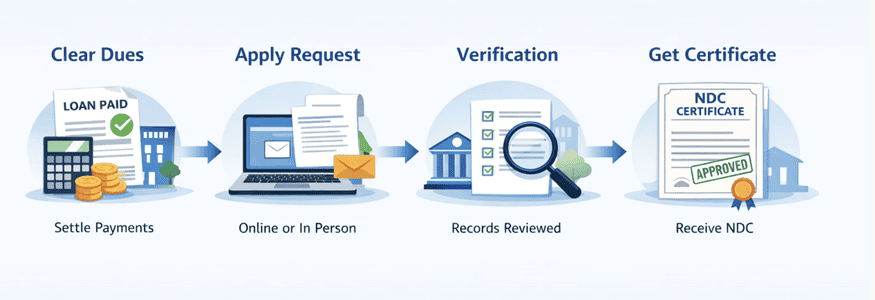
Knowing how to get an NDC is quite important once you’ve cleared all your dues with an institution. In general, the process of obtaining an NDC involves settling pending dues, submitting a formal request, and verifying records.
Whether you wish to obtain an NDC for a property, loan, or service account, the issuing authority reviews payments, followed by issuing the certificate as proof of zero liability.
1. For Loans and Financial Products
Obtaining a Hero FinCorp no-dues certificate, also known as a loan closure certificate, is quite a structured and borrower-friendly process.
Here’s how it typically works:
- Start by repaying your loan completely, including the final EMI, interest rates, and any foreclosure or processing charges.
- You can make an online NDC request, which can be made through the lender’s customer portal, mobile app, or by emailing customer support with loan details.
- Alternatively, you may visit a branch, especially if physical verification or document submission is required.
2. For Property Tax Clearance
If you’re wondering how to get a property tax no dues certificate, most local authorities now offer both online and offline options.
Here is the process:
- Online Municipal Portals: Go to your city’s property tax website, enter the property ID, clear pending dues, and apply for an online property NDC.
- Local Municipal Offices: Submit an application form, pay outstanding tax, if any, and request the certificate in person.
- Citizen Service Centres: Many cities provide single-window centres for faster processing.
Essential Documents Required for NDC Application
Common documents required for a no dues certificate include:
- Completed NDC application form
- Valid government-issued ID
- Account or reference number
- Proof of full payment
The Importance of Keeping Your No Dues Certificate Safe
The importance of keeping a No Dues Certificate goes far beyond simple paperwork. This is an important document and official proof that all your financial obligations have been fully settled.
Keeping your NDC properly protects you from system errors, incorrect recovery claims, or legal complications long after a loan is closed.
Whether you wish to sell an asset, apply for new credit, or simply want peace of mind, it is recommended to store your NDC securely as evidence of your clean financial record.
Also Read: How to Get No Objection Certificate (NOC) for Bike Online?
Hero FinCorp's Assurance: Clear Your Dues, Get Your Certificate
At Hero FinCorp, we prioritise transparency and customer confidence in the loan closure process. Once you clear your dues, Hero FinCorp issues your NDC on time, confirming that your loan account is officially closed.
The NDC certificate serves as an official record of repayment and safeguards you from future discrepancies.
The streamlined closure process at Hero FinCorp helps borrowers proceed with their personal loan journey without worrying about finances, thereby reinforcing trust and clarity at every step. Get in touch with us for more details!
Frequently Asked Questions
Is a No Dues Certificate legally mandatory for all types of closures?
No, an NDC is not legally mandatory in every case. However, it is highly recommended for loans, credit cards, and employment exits.
How long does it take to receive a No Dues Certificate after clearing all payments?
NDC typically takes 7–15 working days after full repayment.
What if my NDC shows an outstanding amount that I have already paid?
Immediately contact the issuing authority, share payment receipts or transaction references, and get it rectified.
Can I apply for a new loan without a No Dues Certificate for a previous one?
Yes, but it may complicate the approval process, as many lenders require an NDC or a loan closure certificate to verify repayment history.
Is an electronic No Dues Certificate valid?
Yes. An e-NDC issued is legally valid, provided it is issued by the authorised institution.