What Is Equity Capital? All You Need to Know
- What Does Equity Capital Mean? An Introduction
- Types of Equity Capital in India
- Equity Share Capital vs. Preference Share Capital
- How to Calculate Equity Capital?
- Pros and Cons of Equity Capital
- Importance of Equity Capital for Small Businesses and Startups
- Sources of Equity Capital
- Indian Legal and Regulatory Framework for Equity
- Make the Right Funding Choice for Your Business
- Frequently Asked Questions
Rohan decided to launch a startup with his savings. When his business grew, he realised he needed more money to sustain operations and stay competitive. However, he was hesitant to take out a loan and was anxious about monthly repayments.
This is where equity capital can help him. Equity capital is when investors who believe in your idea invest in your business in exchange for a share of profits and ownership.
In this guide, we will learn what equity capital is, how equity capital works and why it is important in establishing and expanding a business.
What Does Equity Capital Mean? An Introduction
Equity capital is one of the critical sources of funds for a business. Many businesses obtain equity by issuing and selling their stock to investors.
Unlike debt, you don't have to repay the equity, and it is a permanent source of finance. This is especially valuable for businesses that want to grow without the burden of fixed repayments.
Read More: What is Debt Financing? A Complete Guide
Types of Equity Capital in India
In India, equity capital is classified into different categories depending on how shares are issued and paid for.
- The Authorised Capital is the maximum shares that the company is permitted to issue under its Memorandum of Association.
- Issued Share Capital is a portion of the Authorised Share Capital that the company actually allocates to investors.
- Subscribed share capital refers to that portion of the Issued share capital that an investor has purchased.
- Paid-up Capital is the money that investors have actually paid for the shares they purchased and represents the real capital at the company's disposal.
Equity Share Capital vs. Preference Share Capital
Knowing the difference between equity and preference share capital enables investors and companies to find the optimum balance between control, risk, and returns.
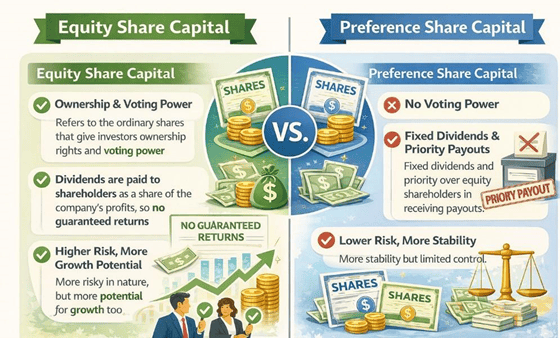
Equity Share Capital | Preference Share Capital |
|
|
How to Calculate Equity Capital?
Equity capital can be calculated using a simple formula.
Formula:
Equity Capital = Total Assets – Total Liabilities
This is a company's net worth, showing what remains for shareholders after all debts have been settled.
For example, start-up XYZ has total assets of ₹50 lakh and liabilities of ₹20 lakh.
Using the formula: Equity Capital = ₹50 lakh – ₹20 lakh = ₹30 lakh.
This amount represents the shareholders’ stake in the business. It is an indicator of the company's financial strength and is used by investors to assess its value and stability.
Also Read: Capital Adequacy Ratio: Meaning & Formula Explained
Pros and Cons of Equity Capital
There are several benefits of equity capital, particularly for developing companies.
Advantages
- No obligation to repay the funds. This alleviates financial strain and lets companies concentrate on expansion.
- It gives businesses a chance to take calculated risks without worrying about fixed interest payments.
- Equity finance lends a company credibility and attracts more investors.
Disadvantages
- Equity has its share of disadvantages, too.
- Raising equity means sharing ownership and, hence, diluting the founders' control of the company.
- Decision making becomes more complicated.
- Investors anticipate greater returns than the lenders.
Importance of Equity Capital for Small Businesses and Startups
For startups and other small enterprises, equity capital is usually the best source of finance. As of March 2026, $4.23B had been raised in 455 rounds of equity funding for these ventures across India. Small businesses and startups usually operate in high-risk environments where stable cash flow is uncertain and, hence, debt financing is difficult to manage.

Indian entrepreneurs have access to multiple sources of equity capital.
- Angel investors, who offer capital in return for company ownership at the startup stage.
- Venture capital companies invest in high-growth potential startups.
- Private equity is also available for more mature businesses seeking to expand their operations.
- Businesses can also raise equity via an Initial Public Offering (IPO) in which shares are sold to the public on stock markets.
Indian Legal and Regulatory Framework for Equity
In India, equity share capital is governed by the Companies Act and regulated by the Securities and Exchange Board of India. The rules are designed to make things more transparent, protect investors, and regulate how companies issue stock. SEBI regulations improve investor confidence and long-term growth for publicly traded companies.
Make the Right Funding Choice for Your Business
Equity capital plays an important role in helping businesses grow. Understanding what equity capital is and how it works can help you make smarter funding decisions and plan for long-term success.
However, not every situation calls for sharing your ownership. If you’re looking for quick yet flexible funds without diluting your control, personal loans can be a practical alternative. Platforms like Hero FinCorp make it easier to access funds when you need them while keeping full ownership of your business.
Apply for a personal loan today. You can also download their Personal Loan App to conveniently access funds for your business.
Frequently Asked Questions
1. Is equity capital a liability?
No, it represents the owners’ funds in the business, and unlike loans, it doesn’t need to be repaid.
2. What is the difference between authorised and paid-up capital?
Authorised capital is the maximum amount a company can raise. Paid-up capital is the actual money received from shareholders.
3. How is a company’s balance sheet impacted by equity?
Equity capital is listed under the shareholders’ equity section and increases the company’s overall value and stability.
4. Is equity capital cheaper than debt capital?
Equity capital may look cheaper, but it can cost a lot over time as you split your profits and ownership of the business. Debt capital incurs interest, but once the debt is paid off, the lender has no claim on your profits.
Disclaimer: The information provided in this blog post is intended for informational purposes only. The content is based on research and opinions available at the time of writing. While we strive to ensure accuracy, we do not claim to be exhaustive or definitive. Readers are advised to independently verify any details mentioned here, such as specifications, features, and availability, before making any decisions. Hero FinCorp does not take responsibility for any discrepancies, inaccuracies, or changes that may occur after the publication of this blog. The choice to rely on the information presented herein is at the reader's discretion, and we recommend consulting official sources and experts for the most up-to-date and accurate information about the featured products.
 Apply For Used Car Loan
 Apply For Personal Loan
 Apply For Loan Against Property
 Apply For Two Wheeler Loan
 Apply For Business Loan
 Apply For New Car Loan
Did You Know
Disbursement
The act of paying out money for any kind of transaction is known as disbursement. From a lending perspective this usual implies the transfer of the loan amount to the borrower. It may cover paying to operate a business, dividend payments, cash outflow etc. So if disbursements are more than revenues, then cash flow of an entity is negative, and may indicate possible insolvency.