Credit Monitoring: Understand and Protect Your Financial Health
Most of us rarely think about our credit profile, but in a world of instant financial transactions and personal information constantly being uploaded to the Internet, it really pays to be informed. Checking your credit periodically can help you avoid surprises and stay in control of your finances.
This is where credit monitoring is helpful.
In this blog, we explore all about credit monitoring, its different types, and why it’s a smart way to keep tabs on your financial health.

What is Credit Monitoring?
So, what is credit monitoring? It is a service that regularly monitors your credit file with the credit bureaus and alerts you to any changes to your credit report or score, including new enquiries, opened accounts, fraud alerts, or identity theft.
This allows you to catch problems early and safeguard your financial well-being.
Take Priya, a 32-year-old IT professional. She’s got an alert from her credit monitoring service that a new credit card has been issued in her name. However, she had never requested one. Since she was informed immediately, Priya was able to contact the bank and prevent the fraud from damaging her credit score.
Who Needs Credit Monitoring Services?
Credit monitoring benefits anyone who has borrowed money or is looking to do so. It’s particularly useful if you tend to apply for lots of loans or credit cards, have had your identity stolen, or are making a major purchase soon.
Features of Credit Monitoring Services
- Real-time alerts for report changes
- Regular credit score updates
- Multi-bureau monitoring
- Fraud detection alerts
- Identity theft support
- Access to your credit report
- Tips to improve credit health
Types of Credit Monitoring Services
There are several types of credit monitoring services, and here are the primary ones.
1. Credit Report Monitoring
This monitors your credit report and alerts you to any newly opened accounts, credit inquiries, changes in your payment history, or changes to your personal information. This helps with early detection of identity theft or reporting mistakes.
2. Credit Score Monitoring
This is only about changes to your credit score, and you will be notified of any increases or decreases.
3. Multi-Bureau Monitoring
Since lenders report to different bureaus, a few credit monitoring services use reports from multiple bureaus rather than just one for broader, better protection.
4. Identity Theft Monitoring
This type of service monitors for suspicious activity involving your personal data, like potential misuse of your identity, and tells you what to do next if you find evidence of fraud.
Choose the type of service based on your financial situation and the level of protection you want.
How Credit Report Monitoring Works?
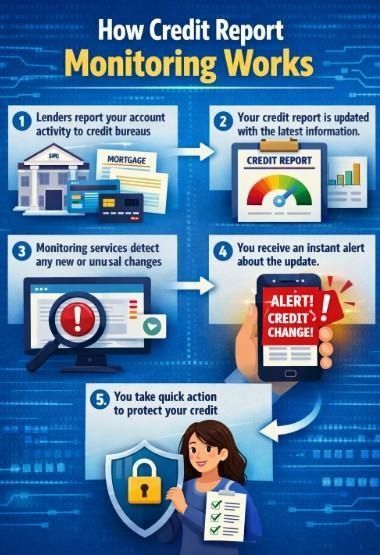
Here’s how credit report monitoring works in simple steps.
- Banks and lenders routinely report information, including payments, balances and new inquiries, to the credit bureaus, which then update your credit report accordingly.
- If you're signed up for a service, they monitor your credit file and identify any changes or new activity.
- When a new item shows up, you get an alert with information about what changed.
- You can then check it to confirm it’s real or take action if it seems suspicious, helping you catch mistakes early and reduce the risk of identity theft.
Understanding Credit Score Monitoring
Our credit score suddenly becomes very important when we apply for a loan or credit card. It is estimated that around 45% of Indians never check their credit score.
With credit score monitoring, alerts are sent to you whenever your credit score changes. Your score is affected by factors such as
- Payment history
- Credit utilisation
- New credit inquiries
- Length of your credit history
Some services also explain why your score changed, helping you make smarter financial decisions.
To improve your credit score:
- Pay your bills on time
- Have a low credit card balance
- Don't apply for several credit together
- Regularly review your credit report for mistakes
Also Read: Credit Utilisation Ratio: Meaning, Calculation & How To Improve
What is Credit Protection?
Credit protection is about guarding your financial identity and enabling you to act quickly if it is compromised. While credit monitoring is about alerts, credit protection shows you what to do if there’s a problem.
This is why many credit protection services provide fraud resolution support, identity theft insurance, and experts who help you through the recovery process.
Take Charge of Your Credit
Credit monitoring keeps you informed, helps you catch issues early, and enables you to make better financial decisions. Maintaining a healthy credit profile will also help you get loans from NBFC's like Hero FinCorp on better terms.
Though credit monitoring helps you manage your financial health, life can be unpredictable. With Hero FinCorp personal loans, you can get flexible funds quickly, letting you handle emergencies without hurting your credit.
Don't wait! Download the Instant Loan app or apply online for a personal loan today!
Frequently Asked Questions
1. How frequently is my credit report updated?
Most lenders update credit reports every month, though the frequency may vary.
2. Does credit monitoring improve my credit score?
No, it doesn’t directly affect your credit score, but it helps to monitor your credit health.
3. Is credit monitoring the same as checking my credit report?
Credit monitoring alerts you to changes, but you should still check your credit report often.
4. Can credit monitoring alert me to identity theft in its early stages?
It can alert you to suspicious activity so you can take immediate action and reduce potential damage.
Disclaimer: The information provided in this blog post is intended for informational purposes only. The content is based on research and opinions available at the time of writing. While we strive to ensure accuracy, we do not claim to be exhaustive or definitive. Readers are advised to independently verify any details mentioned here, such as specifications, features, and availability, before making any decisions. Hero FinCorp does not take responsibility for any discrepancies, inaccuracies, or changes that may occur after the publication of this blog. The choice to rely on the information presented herein is at the reader's discretion, and we recommend consulting official sources and experts for the most up-to-date and accurate information about the featured products.