Steps to Becoming Financially Independent by 30
Will you achieve financial security by 30?
Your saving and planning habits will decide the answer. You must make choices that contribute to your long-term goals. You should find out where your money goes and make smart choices accordingly. This helps save enough to be financially secure by the time you reach 30.
Let's find out the steps and habits for a sustainable plan to be financially independent by 30.
What Is Financial Security?
Financial security means having enough funds to cover your monthly expenses and unexpected costs. It involves setting short-term and long-term plans to balance daily expenses, emergencies, and future necessities.
You get the stability to always stay on track, be it retirement by a certain age, traveling, or unexpected costs.
Steps to Secure Your Financial Future in India
How do you ensure financial security by 30? Here are the steps you should take to be financially independent by 30 -
Budgeting
- List income sources, including salary, investments, business, and other earnings
- Create categories for monthly expenses under variable and fixed costs
- Decide on an amount to save each month
- Review the budget regularly and adjust as needed
Pro Tip - Use UPI, investment apps, and online banking to track, save, and invest efficiently.
Emergency Fund and Insurance
Save living expenses for at least three to six months. Here's how you can do it -
- Start with small amounts but save regularly
- Set up automated savings to ensure consistency
- Get strong and tailored life, health, and vehicle insurance coverage to protect your finances from sudden shocks
- Maintain easy access to the emergency fund. Keep it distinct from your checking account
Managing Debt
Debt, especially with high interest rates, compounds over time. Plan to pay it off as early to reduce the burden on your savings and income.
Here are the methods you can use -
- Debt Consolidation - Merge multiple loans with high interest rates into a single loan. This helps simplify payments and reduce interest
- Avalanche Method - Paying debts with higher interest rates first to reduce interest payments
- Snowball Method - Pay small debts first, regardless of the interest rate
Also Read - What is Debt Trap? Meaning and How to Get Out of It
Invest Early and Get Passive Income
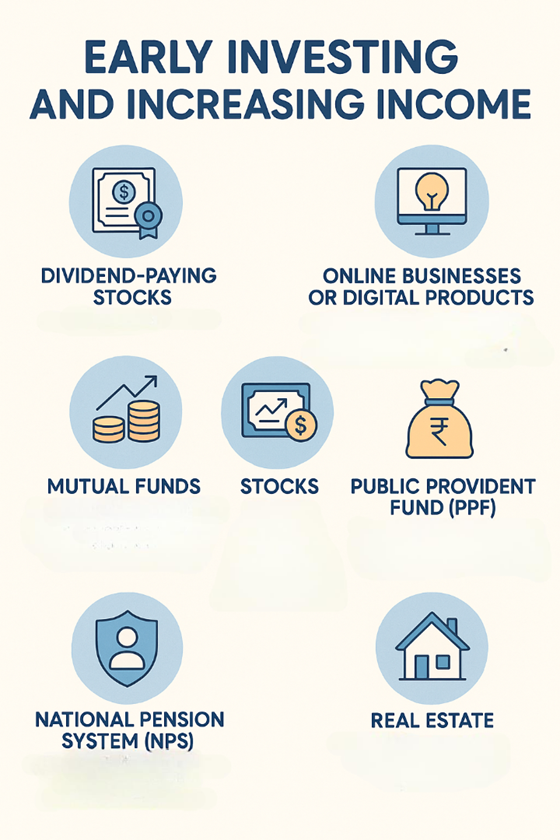
Start investing early to benefit from compounding.
- Diversify your portfolio and review it regularly
- Create a plan to manage your expenses and generate income after retirement
- Pick a tax-deferred account to avoid impulse purchases, as you will face tax consequences
- Apart from your employer-sponsored retirement plan, contribute to an individual retirement account (IRA)
How to Become Financially Independent by 30
Set short-term, medium-term, and long-term goals to manage your finances. Here's how to plan your finances for these goals -
Short Term Goals(0-3 years)
These goals require you to maintain liquidity and safety.
- Create an emergency fund
- Repay credit card debt
- Save money for down payments, vacations, and other such expenses
Medium-Term Goals (3–7 Years)
Medium-term goals include buying your own house, funding education, or starting your family.
- Diversify your savings and investments at this stage
- Balance debt and equity to grow your money without a lot of risk
Long-Term Goals (Beyond 7 Years)
Your goal is to plan for retirement or pay for your children's education. Start early, as even a one-year delay can cost you compounding growth.
Common Habits That Build Financial Security
Small habits help you ensure consistency in your financial security efforts. Here are the habits to follow to build financial security -
Monthly Reviews
- Review your finances monthly to track progress
- Analyze your spending and your budget to catch issues
- Make adjustments accordingly
Avoiding Lifestyle Inflation
Lifestyle inflation is what happens when your spending goes up as your earnings increase. Follow the 50-30-20 rule -
- Spend 50% on needs
- 30% on your personal needs
- 20% on savings and investments
Disciplined Saving
Set SMART (Specific, Measurable, Achievable, Relevant, and Time-bound) goals
Cut unnecessary expenses and focus on your financial goals
Pro Tip - For non-essential purchases, use the 24-hour rule. Wait for 24 hours. Then decide if you need it. This helps you avoid wasteful spending.
Continuous Financial Learning
Connect with a financial planner or go for a financial planning course to know how to analyse and plan your roadmap to financial security
Stay informed about your financial health and the market changes Prepare for an Emergency
Keep funds aside for emergencies. Keep it in your Savings Accounts, Money Market Account, or Liquid Mutual Funds. Once used up, start rebuilding it quickly.
Be Financially Secure With Hero Fincorp
Being financially independent by the time you're in your 30s requires early effort and planning. Keep an emergency account to cover unexpected expenses without financial stress. A personal loan helps fill the gap if your emergency savings are insufficient.
Hero FinCorp offers quick-approval, paperless personal loans that make accessing funds during urgent situations easier and faster.
Keep your finances in place even in emergencies with Hero FinCorp!
FAQs
1. To be financially secure in India, how much emergency fund is required?
As an emergency fund, keep at least three to six months' worth of costs.
2. Can you be financially secure without investing in the stock market?
Yes. You can look for alternative options, such as public provident fund, debt mutual funds, and more.
3. How does financial security differ for salaried vs self-employed?
Salaried individuals have a fixed source of income and employer-provided benefits. But the fixed income limits their option. Self-employed don't have a fixed income. There are ups and downs. They need to plan personal and business finances carefully.
4. What is the first step towards becoming financially independent by 30?
The first step to becoming financially independent by 30 is monitoring your income, expenses, assets, debts, and goals.
5. How can I balance spending now and saving for long-term security?
Do an analysis of your spending habits and make a plan that aligns with your goals.
6. Is financial security the same as simply having a savings account?
No. You also need emergency funds, insurance, investments, and more.
 Apply For Used Car Loan
 Apply For Personal Loan
 Apply For Loan Against Property
 Apply For Two Wheeler Loan
 Apply For Business Loan
 Apply For New Car Loan
Did You Know
Disbursement
The act of paying out money for any kind of transaction is known as disbursement. From a lending perspective this usual implies the transfer of the loan amount to the borrower. It may cover paying to operate a business, dividend payments, cash outflow etc. So if disbursements are more than revenues, then cash flow of an entity is negative, and may indicate possible insolvency.