Difference between Capital Expenditure and Revenue Expenditure
- Difference Between Capital and Revenue Expenditure
- Distinguish Between Capital Expenditure and Revenue Expenditure
- How to Optimise Capital and Revenue Expenditures
- Which common challenges arise in managing expenditures?
- Why is it necessary to distinguish between CapEx and RevEx?
- Optimise Your Expenses
- Frequently Asked Questions
Businesses spend money in different ways. Every expense is treated differently in the business. Some business expenses help build long-term assets, while others are part of daily business operations.
The distinction between capital expenditure vs. revenue expenditure helps to make better financial planning. In business, it is necessary to control unnecessary expenses and increase income.
Difference Between Capital and Revenue Expenditure
Knowing the difference between capital expenditure and revenue expenditure is important to understand the type of expense. These differences show how the benefit of the expense is recorded in financial statements.
Capital Expenditure
Capital expenditure is the cost of acquiring an asset, such as a building or machinery, that provides long-term value. Revenue expenditure includes all the daily operational costs, such as rent, salaries, and maintenance.
For example, the investment of 8 lakh on purchasing a delivery vehicle is a capital expense. It is because the delivery vehicle will be used for many years in the business. On the other hand, the fuel expense of ₹20,000 is a short-term expense. This expense is recurring and incurred for a short term.
Capital expenditure is capitalised rather than recognised as an expense in the year of purchase. The cost is spread over the asset's useful life and includes depreciation.
CapEx is important because it drives business growth. However, you will need careful planning as it includes a large upfront investment.
Revenue Expenditure (RevEx)
Revenue expenditure includes costs of daily business operations. These are short-term expenses and are included in the same financial year.
For Example, revenue expenditure includes rent, salaries, and electricity bills. A monthly office rent of INR 50,000 and maintenance of INR 10,000 are revenue expenditures.
Revenue expenses are fully charged to the profit and loss statement in the same accounting year. It means that these expenses reduce profit in that year.
Revenue expenditure is necessary for the smooth running of the business. These costs may not provide long-term value, but are important for conducting operations and generating revenue.
Also Read: Difference Between Short Term and Long Term Loans
Distinguish Between Capital Expenditure and Revenue Expenditure
| Basis | Capital Expenditure | Revenue expenditure |
| Definition | Money spent on long-term assets | Money spent on daily operations |
| Duration | Long-term benefit | Short-term benefit |
| Accounting treatment | Capitalised and depreciated | Expended immediately |
| Frequency | Occasional | Recurring |
| Impact on profit | Spread over time | Reduces profit immediately |
| Example | Buying machinery | Paying salaries and rent |
How to Optimise Capital and Revenue Expenditures
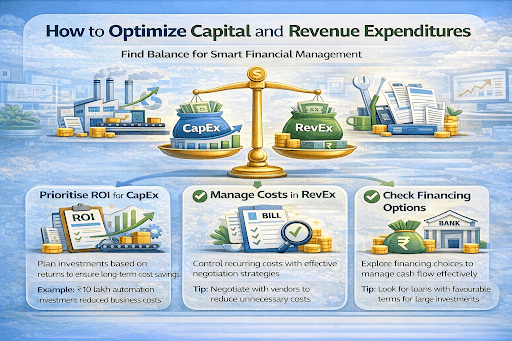
Management of CapEx and RevEX needs a balance.
For capital expenditure, planning investments based on returns is important. For example, an investment of 10 lakh in automation can help reduce business costs.
Controlling recurring costs without affecting operations is key to managing revenue expenditure. Negotiation with vendors and reducing unnecessary costs improve business profitability.
Checking financing options when funding large capital investments helps manage cash flow more effectively. You can go through the options on the official site of Hero FinCorp here.
Which common challenges arise in managing expenditures?
The major challenge in managing expenditure is to estimate returns. Not all expenses give a long-term value.
Managing recurring costs is another problem. Small repeated expenses can also add up over time.
Cash flow management is critical when large capital investments recur along with high operational expenses. Careful financial planning is necessary to balance these two types of spending in the business.
Why is it necessary to distinguish between CapEx and RevEx?
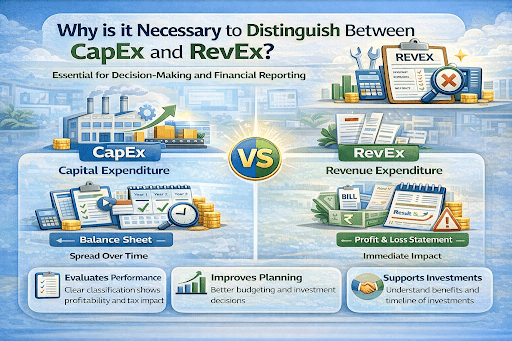
Distinguishing between CapEx and RevEx is necessary for decision-making and financial reporting.
CapEx is spread over time and affects the balance sheet. On the other hand, RevEx affects the profit and loss statement. This difference shows how profitability is measured and how tax is calculated.
For example, higher revenue expenditure reduces taxable profit immediately. On the other hand, the capital expenditure offers many benefits over several years through depreciation.
Clear classification helps businesses to evaluate performance and plan budgets. It also helps to make investment decisions in the business.
Optimise Your Expenses
Capital and revenue expenditures serve different purposes in the business. However, they are both necessary for the business. While capital expenditure helps achieve long-term growth, the other helps with daily operations.
Knowing the differences between these two concepts helps to manage cash flow. It also helps to make profitable financial decisions and plan expenses properly. Maintaining the right balance between CapEx and RevEx supports business stability and growth.
Frequently Asked Questions
Can an expense be included in both capital and revenue expenditure?
Yes, in a few cases, the expense is treated as both capital and revenue expenditure. For example, the major upgrades can be capital, while the regular maintenance is revenue.
What is the reason for capitalising capital expenditure?
Capital expenditure yields benefits for many years. So the cost is spread over time.
Is advertising cost included in capital or revenue expenditure?
Normally, advertising costs are treated as revenue expenditure. However, it is included in capital expenditure if it provides long-term brand value.
How is depreciation related to capital expenditure?
Depreciation spreads the cost of capital assets over the useful life.
Is revenue expenditure included in the balance sheet?
No, the revenue expenditure is included in the profit and loss statement.
What do companies spend on large capital expenditures?
Usually, companies finance large capital expenditures through loans, internal funds, and external financing options.
Disclaimer: The information provided in this blog post is intended for informational purposes only. The content is based on research and opinions available at the time of writing. While we strive to ensure accuracy, we do not claim to be exhaustive or definitive. Readers are advised to independently verify any details mentioned here, such as specifications, features, and availability, before making any decisions. Hero FinCorp does not take responsibility for any discrepancies, inaccuracies, or changes that may occur after the publication of this blog. The choice to rely on the information presented herein is at the reader's discretion, and we recommend consulting official sources and experts for the most up-to-date and accurate information about the featured products.
 Apply For Used Car Loan
 Apply For Personal Loan
 Apply For Loan Against Property
 Apply For Two Wheeler Loan
 Apply For Business Loan
 Apply For New Car Loan
Did You Know
Disbursement
The act of paying out money for any kind of transaction is known as disbursement. From a lending perspective this usual implies the transfer of the loan amount to the borrower. It may cover paying to operate a business, dividend payments, cash outflow etc. So if disbursements are more than revenues, then cash flow of an entity is negative, and may indicate possible insolvency.