Fixed Interest Rate - Meaning, Pros & Cons, and How Does It Work?
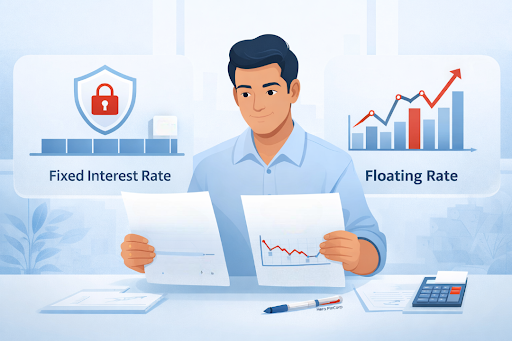
Taking out a loan isn't just about the amount you borrow. It is also about how affordable your monthly repayments are. A small decision, like choosing between a fixed interest rate or a floating interest rate, can make a significant difference in your finances over the years.
In India, most borrowers opt for a fixed interest rate as EMIs remain constant throughout the loan tenure.
This blog covers what a fixed interest rate is, how it works for Indian loans, its merits and drawbacks, and when opting for a fixed-rate loan is right for you.
What Is a Fixed Interest Rate?
A fixed interest rate does not change during the loan tenure or for a specific period determined by the lender. A fixed rate of interest means your EMI stays the same, regardless of market fluctuations.
Rahul applied for a personal loan of ₹5 lakh for his home renovation.
He had two options -
- Floating rate loan at 18.08% for 3 years
- Fixed rate loan at 17.9% for 3 years
The total interest he will pay in both situations is as follows
| Loan Type | Interest Rate | EMI (Approx.) | Total Interest |
|---|---|---|---|
| Floating | 18.08% | ₹18,096 | ₹1,51,466 |
| Fixed | 17.9% | ₹18,076 | ₹1,50,743 |
This is the scenario when the floating rates remain stable. However, if over the tenure the floating rates increase, EMIs will rise.
Let's explain this with an example.
Loan Details (Both Borrowers)
- Loan amount -₹3,00,000
- Tenure -3 years (36 months)
Upasana – Fixed Interest Rate Loan
- Interest rate -17.9% per annum (fixed)
- Monthly interest rate -17.9% ÷ 12 = 1.49%
Repayment Summary
- EMI: ₹10,846
- Total amount paid -₹3,90,446
- Total interest paid - ₹90,446
Since the interest rate stays constant throughout the tenure, Upasana’s EMIs and total interest cost remain predictable.
Sunil – Floating Interest Rate Loan
- Year 1 interest rate - 17.9%
- After 1 year - Rate increases by 3.8% → 21.8%
Monthly Rates
- First 12 months - 17.9% ÷ 12 = 1.5%
- Remaining 24 months - 21.8% ÷ 12 = 1.82%
What Happens in Sunil’s Case?
- Sunil pays EMIs calculated at 17.9% for the first year.
- After 12 months, the outstanding balance is recalculated at 21.8% for the remaining tenure.
- This leads to higher EMIs and a higher total interest outgo in the later years.
Final Outcome
- Total amount paid - ₹4,02,300
- Total interest paid - ₹1,02,300
Final Comparison
| Borrower | Interest Type | Total Interest Paid |
|---|---|---|
| Upasana | 17.9% Fixed | ~₹90,446 |
| Sunil | Floating (17.9% → 21.8%) | ~₹1,02,300 |
Key Takeaway
Sunil ends up paying about ₹6,000 more in interest due to the sharper rate increase. This clearly shows the trade-off -
- Fixed interest rates offer certainty and easier budgeting
- Floating rates may start lower, but can become costlier when rates rise sharply
How Are Fixed Interest Rates Calculated?
In a loan with a fixed interest rate, the interest is fixed at the time of sanction based on your credit score, income, loan amount, and term, and remains the same for the entire tenure.
For example, if your loan is ₹ 5 lakhs at 20% fixed rate for 3 years.
Loan Amount - ₹5,00,000
Interest Rate - 20% per year (Fixed)
Tenure - 36 Months (3 Years)
EMI = ₹18,582/month
EMI Breakdown Table
| Month | Opening Balance | Interest (1.667%) | Principal Paid | EMI (Same Every Month) |
|---|---|---|---|---|
| 1 | ₹5,00,000 | ₹8,335 | ₹10,247 | ₹18,582 |
| 2 | ₹4,89,753 | ₹8,164 | ₹10,418 | ₹18,582 |
| 3 | ₹4,79,335 | ₹7,989 | ₹10,593 | ₹18,582 |
| ... | ... | ... | ... | ... |
| 36 | ₹18,272 | ₹305 | ₹18,277 | ₹18,582 |
Key Points to Understand
- EMI stays the same every month: ₹18,582
- Interest reduces as the loan balance goes down
- Principal repayment increases every month
What Is the Benefit of Fixed Interest Rates?
Predictable monthly payments make it easier to plan your finances. Here are a few more reasons to choose fixed-rate loans.
Stable EMIs
A fixed interest rate means your monthly EMI will not change, which aids in budgeting and managing household expenses.
Protection From Increasing Interest Rates
Fixed interest rate loans protect against market volatility. Your EMI will not change, even if the RBI hikes policy rates or banks raise lending rates.
Better Financial Planning
The certainty of EMIs makes it easier to plan your savings, investments, insurance, and long-term financial goals
Ideal for Short-Term Loans
A fixed-rate loan is more appropriate for short-term financing. It provides stability and helps you with repayment planning over the loan tenure.
Cons of Fixed Interest Rate Loans
While fixed interest rate loans offer stability and predictable EMIs, they’re not without drawbacks. Understanding the disadvantages of fixed interest rate loans can help you decide whether these loans will actually work for you.
A Bit More Interest Rate
Fixed-rate loans are slightly higher than floating-rate loans as lenders charge extra for rate stability and protection against interest rate increases.
No Benefit From Rate Cuts
In a loan with a fixed interest rate, you don't gain from a decrease in market interest rates. Your EMI will not change even if the RBI or banks reduce interest rates on loans. If you want to benefit from the reduced rates, you may need to switch your loan, which will incur additional fees and require more paperwork.
Foreclosure Charges
Some lenders charge foreclosure fees on fixed-interest-rate loans. These penalties can reduce savings from an early repayment.
Limited Availability for Long-Term Loans
For long-term credit, fixed interest rates may not be available. Lenders often offer fixed rates for a limited period, after which the loan reverts to a floating interest rate.
Fixed Interest Rate Loan in India- Tips to Choose the Best
Finding the right fixed-interest rate loan in India is not just about the interest rates. Here are a few things to consider for an informed decision.
- Fixed interest rates may vary by lender. Always compare interest rates to get the best deal, depending on your creditworthiness.
- Don't just look at the interest rate. Check processing fees, documentation charges and other costs that add to the overall cost.
- A longer tenure results in a lower EMI but higher total interest paid. Select a tenure that gives the best balance between affordability and overall cost.
- Fixed interest rate loans prohibit early repayment. Read between the lines to understand the prepayment terms to avoid surprises later.
Also Read - How is Interest Calculated on Personal Loans?
Fixed Rate Interest: A Smarter Way to Borrow Without Surprises
Fixed-rate loans are a good choice for borrowers who prefer predictable EMIs. Go for personal loans with fixed rates, shorter terms and fast approvals to handle sudden financial requirements.
Start your personal loan application with Hero FinCorp and enjoy the comfort of fixed monthly repayments.
Frequently Asked Questions
What are the differences between fixed and floating rates?
A fixed interest rate remains unchanged throughout the loan term, while a floating interest rate varies according to market interest rates.
Could the fixed interest rate be changed once the loan is disbursed?
No. A fixed interest rate remains constant for the agreed period.
How does inflation impact fixed interest rate loans?
Inflation does not change your fixed interest rate or EMI.
Would it be better to choose a fixed interest rate during rising market rates?
Yes. A fixed interest rate, when rates are rising, keeps your EMIs stable.
Disclaimer: The information provided in this is for informational purposes only. While we strive to present accurate and updated content, travel conditions, weather, places to visit, itineraries, budgets, and transportation options can change. Readers are encouraged to verify details from reliable sources before making travel decisions. We do not take responsibility for any inconvenience, loss, injury, or damage that may arise from using the information shared in this blog. Travel involves inherent risks, and readers should exercise their judgment and caution when implementing recommendations.