Is It a Good Idea to Take Out a Personal Loan to Invest in a Mutual Fund?

- What is a Mutual Fund?
- Types of Mutual Funds
- What is a Personal Loan?
- Can You Use a Personal Loan to Invest in Mutual Funds?
- Why Do Some Investors Use Personal Loans for Investments?
- When Does Using a Personal Loan for Mutual Fund Investments Make Sense?
- Pros and Cons of Taking a Personal Loan to Invest in Mutual Funds
- Risks of Investing in Mutual Funds Using a Personal Loan
- Factors to Consider Before Taking a Personal Loan for Mutual Funds
- Alternatives to Taking a Personal Loan for Mutual Fund Investments
- How to Apply for a Personal Loan with Hero FinCorp
- Conclusion
- Frequently Asked Questions
On the surface the logic holds. Borrow Rs. 7 lakh at 14%, put it into a fund that has averaged 18% over the last three years, and the 4% difference becomes profit on someone else's money.
A few investors have genuinely pulled this off. A larger number discovered mid-tenure that the fund was down 20%, the expected recovery was not coming fast enough, and the EMI showed up in the bank statement regardless.
Taking a personal loan to invest is not a wise decision unless the expected returns clearly outweigh the loan cost and the risks have been genuinely assessed rather than assumed away. This guide works through both sides.

What is a Mutual Fund?
A mutual fund collects money from a group of investors and puts it to work across a range of securities, all managed by a SEBI-registered fund manager. They buy units in the fund and the manager handles the decisions.
How Mutual Funds Work
The fund manager selects securities based on market research and ensures the portfolio stays aligned with the fund's objectives and SEBI regulations. Returns flow from two sources: appreciation in the value of the underlying assets and dividends earned along the way, both distributed proportionally to unit holders based on how many units they hold.
Types of Mutual Funds
Not all mutual funds carry the same risk profile, and that matters a lot when borrowed money is involved:
- Equity funds: Primarily stocks. Higher return potential but they can drop sharply in a bad year
- Debt funds: Bonds and fixed income instruments. Returns are steadier but lower
- Hybrid funds: A mix of both. The equity portion drives growth while debt softens the downside
- Index funds: Passively track an index like Nifty 50 without active stock selection
- ELSS funds: Equity funds with a mandatory 3-year lock-in that qualify for Section 80C tax deductions
What is a Personal Loan?
A personal loan is an unsecured product offered by banks and NBFCs. No asset needs to be pledged. The lender looks at income, credit score, and employment before deciding how much to lend and at what rate.
Key Features of Personal Loans
- No collateral required
- No end-use restriction, funds can legally go toward investments including mutual funds
- Fixed monthly EMI regardless of what happens with any investment made using the funds
- Approval within 24 hours through digital lenders for eligible applicants
Interest Rates and Repayment
Personal loan interest rates in India range between 10% and 24% annually depending on the lender and the borrower's credit profile. That cost is fixed whether the mutual fund is up 20% or down 15% in any given month.
Can You Use a Personal Loan to Invest in Mutual Funds?
Is It Legally Allowed?
Yes. Personal loans carry no predetermined end use. Borrowers can direct funds toward any legal purpose, including mutual fund investments. The lender does not track what happens to the disbursed amount after it reaches the bank account.
How the Process Works
The borrower takes the personal loan for investment, transfers the funds into a mutual fund account, and the EMI obligation starts from the next billing cycle. The two are completely separate. A month where the fund drops 8% still requires the full EMI to be paid on time without exception.
Why Do Some Investors Use Personal Loans for Investments?
Expectation of Higher Returns
If expected investment returns are higher than the loan interest rate, borrowing to invest could theoretically amplify returns. A fund historically delivering 16% CAGR against a 12% loan rate looks like a 4% net gain on borrowed capital. The problem is that historical returns do not guarantee future performance.
Market Opportunities
A sharp market correction sometimes creates entry points that feel too good to miss. Investors without liquid savings at that moment consider borrowing to capture the opportunity before prices recover.
Lack of Immediate Capital
For investors who have identified a strong window but lack the savings, a personal loan for mutual fund investment provides immediate access to capital rather than waiting months to accumulate the required amount through income.
Also Read- What is Personal Financial Management?
When Does Using a Personal Loan for Mutual Fund Investments Make Sense?
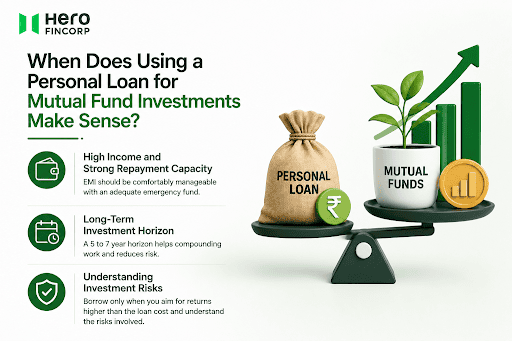
High Income and Strong Repayment Capacity
The EMI must be fully manageable from the monthly income regardless of how the investment performs. If salary covers the EMI comfortably with room to spare and an emergency fund sits separately, the loan side of the equation is controlled even if the fund underdelivers.
Long-Term Investment Horizon
A 12-month investment window with a 14% loan cost needs the fund to return above 14% in exactly that year. A 5 to 7 year horizon gives compounding time to work and reduces the chance of being underwater when the loan matures.
Understanding Investment Risks
Only when confident that investment choices will yield returns higher than the loan cost, and risks have been genuinely assessed rather than hoped away, should borrowing to invest be considered. Investors who have lived through a market correction understand this viscerally in a way spreadsheet projections cannot capture.
Pros and Cons of Taking a Personal Loan to Invest in Mutual Funds
Potential Benefits
- Immediate lump sum available at a chosen market entry point
- Potential to earn returns above the loan interest rate if the fund outperforms
- No collateral risk since the loan is unsecured
- Structured EMI creates financial discipline around the repayment commitment
Key Risks
- If the investment performs poorly, the invested amount can be lost while the loan obligation continues with full interest
- EMI runs as a fixed cost whether the portfolio is up or down
- High-interest debt paired with volatile investments creates real financial stress when markets move against the position
- Missed EMIs damage credit score independently of investment performance
Risks of Investing in Mutual Funds Using a Personal Loan
Market Volatility
Equity funds can drop 20 to 30% in a bear market. The EMI does not pause during that period. An investor who borrowed Rs. 7 lakh and sees the portfolio fall to Rs. 3.75 lakh still owes the full loan amount plus interest on borrowed money.
Interest Cost vs Investment Returns
Loan interest is a guaranteed cost. Mutual fund returns are not. The investment must return at least as much as the interest incurred. If it does not, losses increase while the debt continues to accumulate.
Debt Burden
Even a well-performing portfolio feels stressful when a fixed EMI runs alongside it. A job change, medical emergency, or delayed salary in any month during the tenure makes the EMI feel punishing, regardless of what the fund is doing.
Impact on Credit Score
If the investment underperforms and repayment becomes difficult, missed EMIs on a personal loan for investment affect creditworthiness and future loan eligibility for years.
Factors to Consider Before Taking a Personal Loan for Mutual Funds
Loan Interest Rate
If the loan rate is 16% and the expected fund return is 14%, the strategy is loss-making before the first EMI clears.
Expected Returns
Factor in exit loads, capital gains tax, and the fund's expense ratio before calculating net returns. The gross return number the fund advertises is not what actually lands in the account after costs.
Financial Goals
Borrowing to invest should connect to a specific goal and timeline. Vague wealth creation goals with borrowed money tend to unravel when markets get uncomfortable.
Emergency Fund Availability
Three to six months of expenses should sit in a liquid account before taking on any EMI obligation. Without this, one unexpected expense can disrupt both the loan repayment and the investment at the same time.
Risk Appetite
If hesitant about any of the core risk factors involved, avoid borrowing to invest altogether. The stress of watching a borrowed investment drop is significantly different from watching a loss on money that was already saved.
Alternatives to Taking a Personal Loan for Mutual Fund Investments
SIP Investments
A Systematic Investment Plan spreads investment across monthly instalments from existing income. No interest cost, no EMI pressure, and rupee cost averaging reduces the impact of market volatility over time. This is the most recommended route for retail investors in India for good reason.
Lump Sum Investments from Savings
Waiting to accumulate a lump sum before investing eliminates interest cost entirely. The opportunity cost of waiting is real but considerably lower than paying 12 to 24% interest annually on borrowed capital.
Step-Up SIP Strategy
A step-up SIP increases the monthly investment amount by a fixed percentage each year, typically aligned with salary increments. It builds a growing investment corpus without debt and without requiring a large upfront capital base.
How to Apply for a Personal Loan with Hero FinCorp
For investors who have run the numbers honestly and determined that borrowing makes sense for their specific situation, Hero FinCorp offers a fully digital personal loan process with fast approval and direct bank account disbursal.
Check Eligibility
Check your Hero FinCorp personal loan eligibility here before starting the application.
Submit Documents
Upload PAN, Aadhaar, and income proof digitally. No branch visit required at any stage.
Complete KYC
e-KYC runs through Aadhaar OTP verification and completes within minutes on a phone.
Receive Funds
Once approved, funds transfer directly into the bank account. Download the instant loan app on Google Play or the personal loan app on the App Store and manage everything from a phone.
Conclusion
Using a personal loan for mutual fund investment can work in the right conditions: strong and stable income, a long investment horizon, a genuine understanding of downside risk, and a loan rate meaningfully below expected returns. For most retail investors, those conditions are hard to meet simultaneously. A disciplined SIP from monthly income tends to build wealth more reliably, with far less stress, than a borrowed lump sum riding on market returns that may or may not arrive on schedule.
Frequently Asked Questions
Can I Take a Personal Loan and Invest in Mutual Funds?
Yes. Personal loans carry no end-use restriction and funds can go toward mutual fund investments. Whether it makes financial sense is a separate question that depends entirely on the return-to-cost comparison and repayment capacity.
Can I Take a Personal Loan and Invest in Stocks?
Yes, and the same risk logic applies. Direct stock investing is more volatile than diversified mutual funds, making a loan-funded equity position riskier still.
Is Borrowing Money to Invest a Good Strategy?
Only in specific circumstances. Borrowing to invest can amplify returns but magnifies losses equally when the investment underperforms, while the loan obligation continues regardless.
What Happens If My Investment Returns Are Lower Than the Loan Interest Rate?
The shortfall comes out of pocket while the full loan amount still needs repaying. An 8% return against a 16% loan rate produces an 8% annual loss on the borrowed capital, on top of any market movement.
Can a Personal Loan Affect My Investment Performance?
Indirectly yes. EMI pressure can force premature redemption at a loss if cash flow tightens. Selling at the wrong time because of loan pressure is one of the most common ways leveraged investors underperform what the fund itself delivers.
Are SIPs Better Than Investing Borrowed Money?
For most investors, yes. SIPs carry no interest cost, need no EMI management, and benefit from rupee cost averaging. Starting with SIPs using existing capital is the smarter and lower-stress route for most retail investors.
How Much Risk Is Involved in Investing Through a Personal Loan?
Significant. Market returns are never guaranteed while the loan interest rate is a fixed cost that accrues regardless of portfolio performance. The combination of a guaranteed liability and an uncertain asset is the core of the risk.
Can I Get Tax Benefits on a Personal Loan Used for Investments?
In some cases, interest paid on a personal loan used for investments may be allowed as a deduction against certain types of investment income under Section 57 of the Income Tax Act. This depends on the nature of income, documentation, and tax rules at that time. Always check with a chartered accountant before planning any tax benefit.
Disclaimer: The information provided in this blog post is intended for informational purposes only. The content is based on research and opinions available at the time of writing. While we strive to ensure accuracy, we do not claim to be exhaustive or definitive. Readers are advised to independently verify any details mentioned here, such as specifications, features, and availability, before making any decisions. Hero FinCorp does not take responsibility for any discrepancies, inaccuracies, or changes that may occur after the publication of this blog. The choice to rely on the information presented herein is at the reader's discretion, and we recommend consulting official sources and experts for the most up-to-date and accurate information about the featured products.