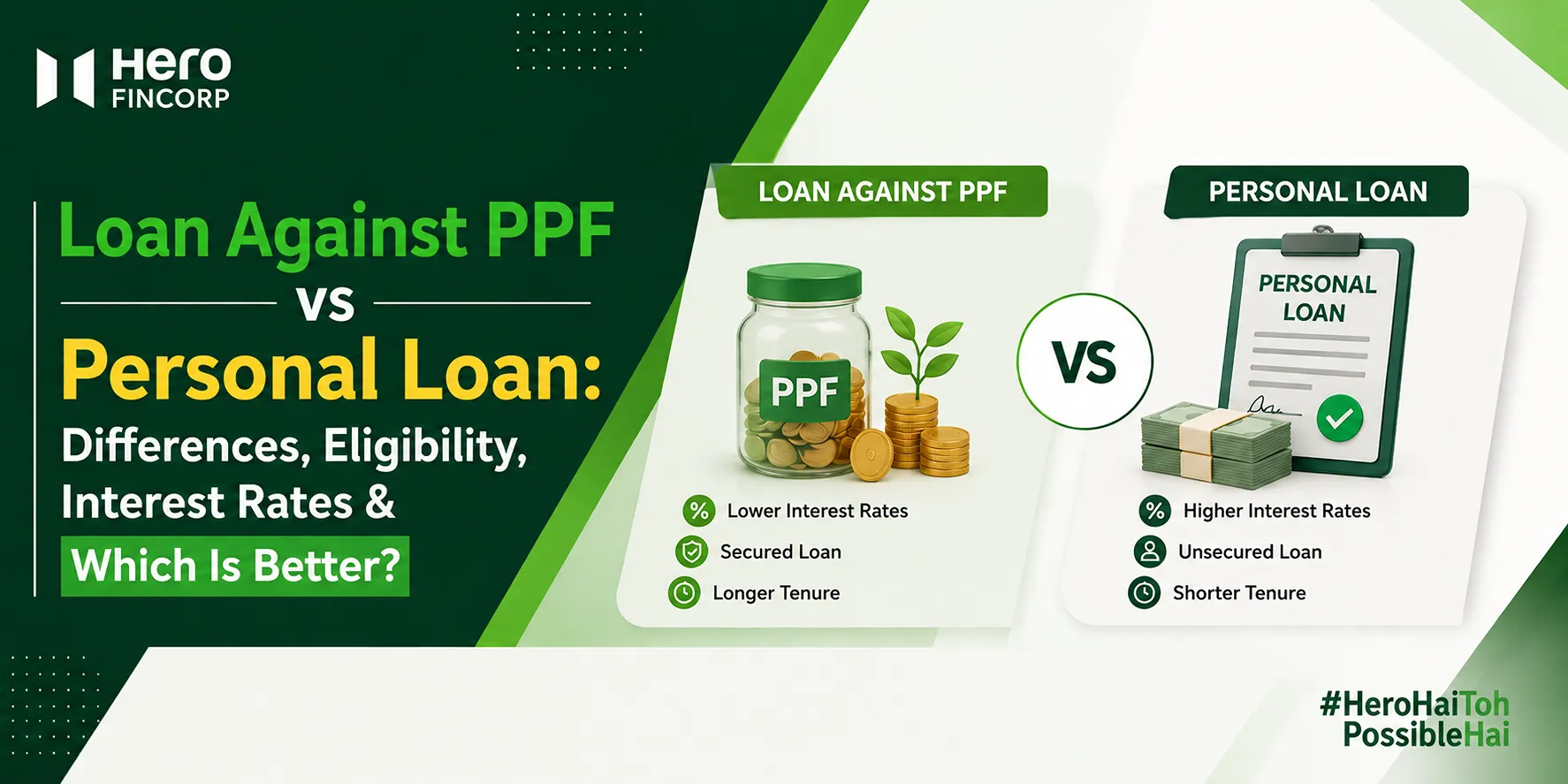
Loan Against PPF vs Personal Loan: Differences, Eligibility, Interest Rates & Which Is Better?
- What Is a Loan Against PPF?
- What Is a Personal Loan?
- Loan Against PPF vs Personal Loan: Key Differences
- Eligibility Criteria Compared
- Interest Rates and Repayment
- Benefits of a Loan Against PPF
- Benefits of a Personal Loan
- When Should You Choose a Loan Against PPF?
- When Should You Choose a Personal Loan?
- Hero FinCorp Personal Loan
- Final Thoughts
- Frequently Asked Questions
In times when you need funds, having a Public Provident Fund (PPF) account already poses a dilemma, as you may wonder whether you should borrow money against your PPF account or apply for an unsecured personal loan. Both borrowing choices, although effective and useful, differ greatly in terms of eligibility requirements, money availability, rate of interest, repayment schedule, and flexibility.
While the loan against PPF may be granted only under specific and stringent PPF regulations, a personal loan gives more freedom for people who qualify. The Loan Against PPF vs Personal Loan reviews the two options for you to enable you to make the right choice.
What Is a Loan Against PPF?
A loan against PPF lets eligible PPF account holders take out a loan based on the amount in their account, but this can be done only within a specific time frame allowed under the PPF rules. The maximum loan amount, PPF loan interest rate, repayment duration, and all other requirements depend on government regulations.
The loan is linked to the user’s PPF account and cannot exceed the limits specified in these rules. The borrowers keep their income-generating PPF account while repaying the loan and thereby keep on saving money for the future.
What Is a Personal Loan?
A personal loan is an unsecured loan offered by banks and NBFCs to eligible borrowers, meaning you typically don't need to pledge any asset as collateral. It's a flexible borrowing option often used for medical emergencies, wedding expenses, education costs, travel, home renovation, or consolidating existing debt.
Because approval is largely based on your income and credit profile rather than any specific asset, it tends to be accessible to a wider range of applicants compared to asset-linked borrowing options.
Loan Against PPF vs Personal Loan: Key Differences
Although both borrowing options provide financial assistance, they differ in several important aspects. Here's a side-by-side look at how the two options compare:
| Feature | Loan Against PPF | Personal Loan |
|---|---|---|
| Security | Against PPF balance | Usually unsecured |
| Eligibility | PPF account holder meeting applicable rules | Based on lender eligibility criteria |
| Loan Amount | Limited by PPF balance and rules | Based on income, credit profile, and lender policy |
| Interest Rate | As per applicable PPF loan rules | Varies by lender and applicant profile |
| Repayment | As per PPF regulations | Fixed EMI over chosen tenure |
| Processing Time | Depends on PPF institution | Often quicker through digital application |
| End Use | General financial needs | Multiple personal financial needs |
The right choice largely depends on how much you need to borrow, how quickly you need the funds, and whether you'd rather keep your long-term PPF savings untouched.
Eligibility Criteria Compared
For a loan against PPF, the applicant must have an eligible Public Provident Fund account and satisfy the conditions prescribed under the applicable PPF rules. The loan amount depends on the eligible balance available in the account. Eligibility works quite differently for the two options:
- PPF account requirements – You need an active PPF account that falls within the applicable loan eligibility period under current rules
- Income requirements – Personal loans typically require proof of stable income, while PPF loans are assessed based on your account balance and tenure
- Age – Most personal loan lenders have a minimum and maximum age criterion; PPF loan eligibility is tied to account age rather than applicant age
- Employment – Personal loan eligibility often considers whether you're salaried or self-employed
- Credit assessment – Personal loans usually involve a credit score and repayment history check, which isn't a factor for PPF loans
- Documentation – Personal loans generally require KYC documents and income proof; PPF loans mainly require your PPF passbook and account details
For example, Rehan needed funds for home renovation. Although he had a PPF account, it was not within the eligible borrowing period. After checking his income, employment details, and credit profile, he explored a personal loan that better matched his financial requirements.
Interest Rates and Repayment
One of the key differences between a Loan Against PPF vs Personal Loan is the way interest rates and repayment terms are determined. Interest rates and repayment structures differ significantly between the two:
- Interest rate structure - PPF loan interest rates follow rules set by the government and are typically linked to the prevailing PPF interest rate, while personal loan interest rates vary by lender and depend on your credit profile and income
- Repayment tenure - PPF loans usually need to be repaid within a defined period under applicable rules, while personal loans offer a chosen tenure, often ranging from a few months to several years
- EMI concept - Personal loans are usually repaid through fixed monthly instalments (EMIs), making budgeting more predictable
- Prepayment options - Many personal loan lenders allow prepayment or foreclosure, subject to applicable terms and charges
- Overall borrowing cost- This depends on the applicable interest rate, tenure, and any processing or prepayment charges involved
Since personal loan interest rates vary by lender, it's worth comparing a few options and checking the Personal Loan Interest Rate offered before committing.
Benefits of a Loan Against PPF
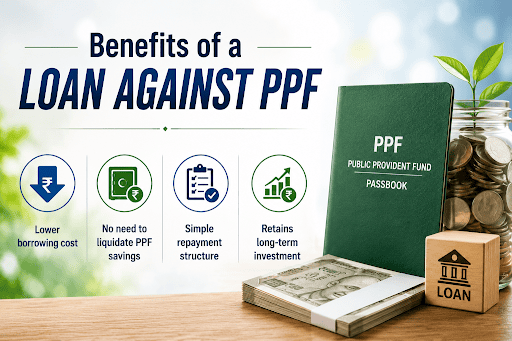
A loan against PPF can be a suitable borrowing option for eligible account holders who need funds while continuing to build long-term savings. Some of its key benefits include:
- Potentially lower borrowing cost, subject to applicable rules at the time of borrowing
- No need to liquidate your PPF savings, letting your long-term investment continue growing
- A relatively simple repayment structure governed by set rules
- Helps you retain your long-term investment while still accessing funds when needed
However, there are certain limitations. A loan against PPF is available only during the prescribed eligibility period, and the maximum loan amount is restricted by the eligible PPF balance and applicable regulations. Therefore, it may not be suitable for borrowers requiring larger loan amounts.
Benefits of a Personal Loan
A Personal Loan or Loan Against PPF decision often depends on flexibility and funding requirements. Personal loans offer several advantages for eligible borrowers. Some of the key benefits include:
- No collateral required, making it accessible without pledging any asset
- Flexible end use, whether it's for medical expenses, travel, or a wedding
- Higher loan amounts, subject to your income, credit profile, and lender eligibility
- Online application, which can significantly speed up the process
- Flexible repayment tenure, letting you choose an EMI that fits your monthly budget
- Quick processing, subject to lender approval and document verification
These features make personal loans a practical option for individuals seeking flexible financing without pledging any investment or asset.
When Should You Choose a Loan Against PPF?
A loan against PPF may be appropriate if you satisfy the applicable eligibility conditions and require a relatively smaller amount for a short-term financial need.
It can be suitable when you:
- Have an eligible PPF account under the prescribed rules.
- Need a modest loan amount within the permitted borrowing limit.
- Prefer not to liquidate your long-term PPF investment.
- Want to borrow under the repayment framework specified for PPF loans.
However, if your funding requirement exceeds the permitted loan limit or you are not eligible under the applicable PPF rules, you may need to consider other borrowing options.
When Should You Choose a Personal Loan?
A personal loan may be a more suitable option when you require greater borrowing flexibility or do not qualify for a PPF loan. A personal loan may be more suitable if:
- You don't have a PPF account, or it doesn't fall within the eligible borrowing period
- You need a higher loan amount than your PPF balance would allow
- You're dealing with an emergency expense that needs quick funding
- Your requirement doesn't fit neatly into a single, small-ticket need
- You'd value flexible repayment options tailored to your monthly budget
Choosing between a Loan Against PPF vs Personal Loan should ultimately depend on your financial requirements, repayment capacity, and eligibility.
Hero FinCorp Personal Loan
Take Rehan, who needed funds for a medical expense but didn't have an eligible PPF loan window to fall back on. In situations like this, an instant personal loan can offer a quicker, more flexible route to funding, without requiring any collateral.
Eligible applicants can explore a Hero FinCorp Personal Loan, which is built around a few key principles:
- Fully online application process
- Competitive interest rates based on your profile
- Flexible repayment tenure to suit your budget
- Minimal documentation requirements
- Transparent charges with no hidden surprises
- Quick processing, subject to eligibility
Before applying, it's worth using the Personal Loan Eligibility Calculator to get a sense of how much you may qualify for.
With competitive Personal Loan Interest Rate flexible repayment periods, fewer documents required, and clear charges, individuals are able to select a repayment schedule that is suitable for them. Borrowers can apply via the Personal Loan App, making the borrowing process more convenient. Loan approval and processing remain subject to eligibility, document verification, and the lender's applicable terms and conditions. You can also check your eligibility instantly with Hero FinCorp.
Final Thoughts
Both a Loan Against PPF and a Personal Loan have their special features, and the choice of a better one will depend on the exact financial situation. If you are already eligible and the loan amount is not large, it might be a good decision to take out a PPF loan to save money. However, Personal Loans are more flexible and allow customers to get larger amounts.
Frequently Asked Questions
What is the difference between a Loan Against PPF and a Personal Loan?
A loan against PPF can only be availed by valid PPF account owners under the respective scheme rules and is backed by the PPF fund as collateral. Personal loans are usually unsecured loans given on certain criteria provided by the lender, including the borrower's eligibility, income, and credit status.
Which loan has a lower interest rate: PPF loan or Personal Loan?
PPF loan interest rates are in accordance with the government rules, which are mostly lower than the other loan rates, while personal loans can have different rates according to the lender and the applicant. Hence, it is advisable to compare the rates before selecting one.
Can I get a Personal Loan without a PPF account?
Yes. A personal loan can be taken without a PPF account. The borrower has to be eligible on the criteria laid down by the lender, which generally includes salary, employment status, and credit rating.
How is the loan amount decided under a PPF loan?
The loan amount in case of a PPF loan is determined on the basis of the prevailing PPF rules and the eligibility balance in the PPF account at the time of borrowing.
Disclaimer: The information provided in this blog post is intended for informational purposes only. The content is based on research and opinions available at the time of writing. While we strive to ensure accuracy, we do not claim to be exhaustive or definitive. Readers are advised to independently verify any details mentioned here, such as specifications, features, and availability, before making any decisions. Hero FinCorp does not take responsibility for any discrepancies, inaccuracies, or changes that may occur after the publication of this blog. The choice to rely on the information presented herein is at the reader's discretion, and we recommend consulting official sources and experts for the most up-to-date and accurate information about the featured products.