Loan Amortization: Meaning, Formula, Schedule & How It Works
- What Is Loan Amortization?
- How Does Loan Amortization Work?
- Loan Amortization Formula Explained
- Example of Loan Amortization
- Types of Loans That Use Amortization
- Benefits of Loan Amortization
- Factors That Affect Loan Amortization
- Loan Amortization vs Loan Term
- How Prepayments Impact Loan Amortization?
- Understanding Your EMI Better
- Frequently Asked Questions
Ritika paid her home loan EMI on time every month. After one year, she opened her loan statement expecting the balance to reduce sharply. Instead, she noticed that the amount had dropped very slowly, which confused her.
Many borrowers notice the same thing during repayment. In the beginning, a larger share of the EMI goes toward interest instead of the loan amount. Loan amortization explains why this happens and how EMIs change over time. This guide explains it with simple examples and calculations.
What Is Loan Amortization?
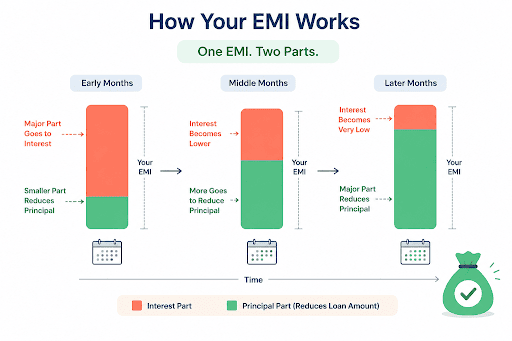
Loan amortization explains how your loan gets repaid little by little through monthly EMIs. Every EMI includes two parts. One part pays the interest, while the other reduces the loan amount.
During the first few months, a bigger share of the EMI goes toward interest because the pending loan amount stays higher. Later, the interest amount starts reducing, and a larger part of the EMI begins cutting down the actual loan balance. This process continues until you repay the full loan.
How Does Loan Amortization Work?
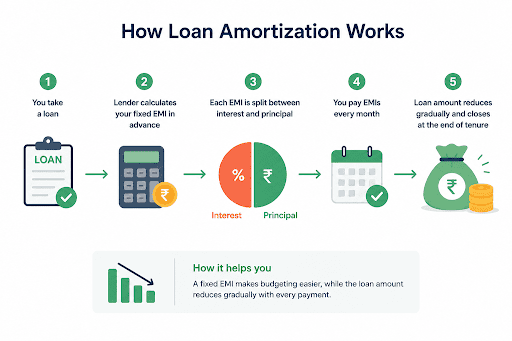
Loan amortization follows a structured repayment system. Lenders calculate the EMI in advance and divide each payment between interest and principal throughout the loan tenure.
Principal and Interest Components
Every EMI contains two parts. One part pays the interest charged by the lender, while the second part reduces the actual loan amount.
Fixed EMI Structure
Most lenders keep EMIs fixed throughout the loan tenure. This helps borrowers manage monthly payments more easily and track repayments.
Changing Interest-to-Principal Ratio Over Time
Interest takes a larger share during the initial months because lenders calculate it on the outstanding balance. Later, the principal share increases as the balance starts falling steadily.
Loan Amortization Formula Explained
Lenders use a standard formula to calculate EMIs and repayment schedules. This formula helps them maintain a structured repayment timeline.
Standard Loan Amortization Formula
EMI = [P × R × (1 + R)^N] ÷ [(1 + R)^N − 1]
Where P stands for the loan amount, R stands for the monthly interest rate, and N stands for the total number of monthly EMIs
Why Lenders Use This Formula
The formula helps lenders calculate fixed EMIs accurately. Borrowers also get a clear repayment structure before taking the loan.
Example of Loan Amortization
A practical example makes loan amortization easier to understand because borrowers can see how EMI distribution changes over time.
Sample Loan Scenario
Loan Amount = ₹5,00,000
Interest Rate = 10% annually
Loan Tenure = 5 years
EMI Breakdown During Initial Months
EMI = Around ₹10,624
Month 1
Interest = ₹4,167
Principal = ₹6,457
Month 2
Interest = ₹4,113
Principal = ₹6,511
EMI Breakdown Near Loan Maturity
During the final months, the interest portion becomes much smaller because the outstanding balance drops significantly. Most of the EMI starts reducing the principal amount directly.
Types of Loans That Use Amortization
Many common loans in India use amortization because lenders collect repayments through structured EMIs.
Personal Loans
Personal loans usually follow shorter repayment schedules with fixed monthly payments.
Home Loans
Home loans use long amortization schedules because borrowers repay them over several years.
Auto Loans
Vehicle loans spread repayments across fixed EMIs to make ownership more manageable.
Education Loans
Education loans also follow amortization once borrowers begin repayment after the moratorium period.
Also Read: What Is the Moratorium Period in a Loan? Meaning and Benefits
Benefits of Loan Amortization
Loan amortization gives borrowers a clear picture of how their loan gets repaid month after month. It also makes EMIs easier to understand and track during the repayment period.
Predictable Monthly Payments
Fixed EMIs help borrowers understand how much money they need every month for repayments.
Structured Debt Repayment
Each EMI reduces the loan balance step by step throughout the repayment period.
Better Financial Planning
Borrowers can plan savings and future expenses with greater confidence.
Clear Loan Closure Timeline
Amortization schedules clearly show when the loan will end.
Factors That Affect Loan Amortization
Several factors directly influence EMI structure and repayment speed.
Loan Amount
Higher loan amounts increase both EMIs and overall interest costs.
Interest Rate
A higher interest rate increases the interest portion within every EMI.
Loan Tenure
Longer tenures reduce monthly EMIs but increase total interest payments.
Prepayments and Part-Payments
Prepayments reduce the outstanding balance faster and improve repayment efficiency.
Loan Amortization vs Loan Term
Loan amortization explains how lenders divide EMIs across the repayment period, while the loan term simply refers to the total duration of the loan. One explains repayment structure, and the other explains repayment length.
How Prepayments Impact Loan Amortization?
Prepayments directly reduce the outstanding loan amount before schedule. This changes the repayment structure in the borrower’s favour.
Reduction in Interest Cost
Lower balances reduce future interest charges significantly.
Shorter Repayment Tenure
Prepayments may help borrowers close loans earlier than planned.
Faster Principal Reduction
A larger share of future EMIs starts reducing the principal amount directly.
Understanding Your EMI Better
Loan amortization helps you understand where your EMI money goes every month and why the loan balance reduces slowly in the beginning. Once you understand this repayment pattern, managing EMIs and planning part payments feels much easier.
If you are looking for a personal loan, choose a lender that keeps the process simple from start to finish. Hero FinCorp offers quick digital access, easy repayment tracking, and flexible loan options designed around your needs. Check your eligibility online and apply now for a smooth borrowing experience.
Frequently Asked Questions
What is the meaning of loan amortization?
Loan amortization means repaying a loan gradually through fixed EMIs over a specific period.
What is the loan amortization formula?
EMI = [Loan amount × monthly interest rate × (1 + monthly interest rate)^total number of EMIs] ÷ [(1 + Monthly interest rate)^total number of EMIs − 1].
What is an amortization schedule?
An amortization schedule shows how every EMI gets divided between interest and principal.
Why do early EMIs contain more interest than principal?
Lenders calculate interest on the outstanding balance, which remains highest during the initial months
Which loans are typically amortized?
Loans such as home loans, personal loans, auto loans, and education loans are amortized.
Can prepayment reduce the amortization period?
Yes. Prepayments can reduce the amortization period.
How does loan tenure affect amortization?
Longer tenures reduce EMIs but increase the total interest paid across the loan period.
Disclaimer: The information provided in this blog post is intended for informational purposes only. The content is based on research and opinions available at the time of writing. While we strive to ensure accuracy, we do not claim to be exhaustive or definitive. Readers are advised to independently verify any details mentioned here, such as specifications, features, and availability, before making any decisions. Hero FinCorp does not take responsibility for any discrepancies, inaccuracies, or changes that may occur after the publication of this blog. The choice to rely on the information presented herein is at the reader's discretion, and we recommend consulting official sources and experts for the most up-to-date and accurate information about the featured products.